
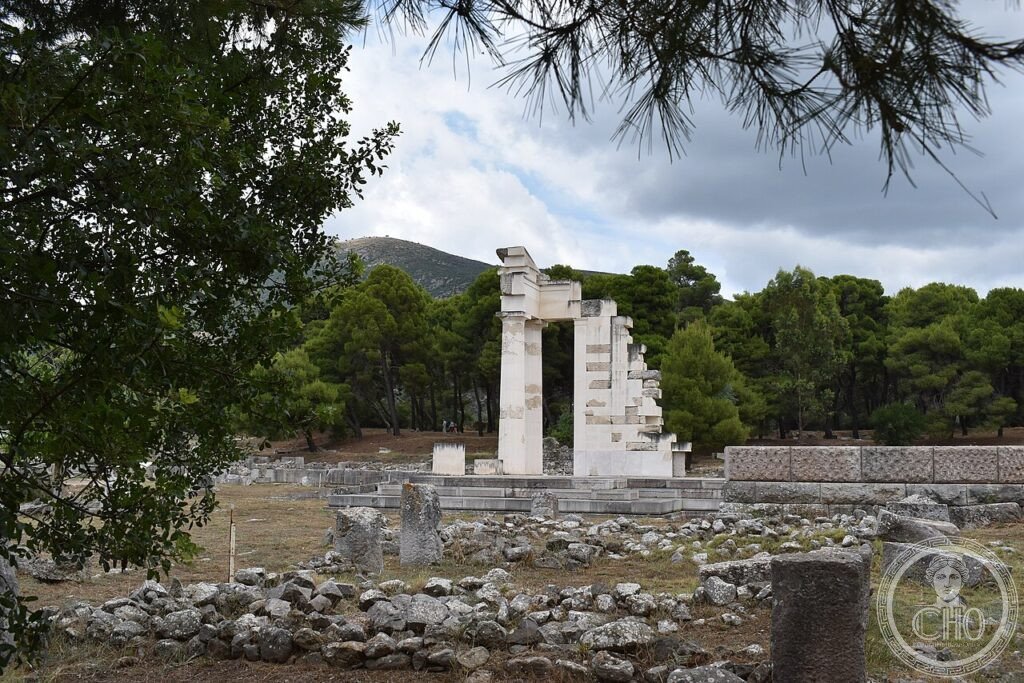
Sanctuary of Asklepios at Epidaurus
The most acoustically perfect theatre in the history of architecture and the premier sanctuary of healing in the ancient Greek world — Epidaurus (Argolid, Peloponnese; UNESCO WHS 1988) combines the greatest surviving example of ancient Greek theatre design (the 14,000-seat Theatre of Polykleitos the Younger, 4th century BCE) with the ruins of the Asklepion where the sick and injured of the ancient world came to be healed by the god Asklepios.
At a glance
Epidaurus (the most precisely EpidaurusTheatre single Polykleitos Younger 4th century BCE 14000 seats 55 rows limestone cavea orchestra 23m circular thymele perfect acoustics whisper last row coin drop incubation Asklepion abaton kline sanctuary healing snakes Asclepius staff UNESCO heritage: the theatre (the Theatre of Epidaurus (4th century BCE; architect: Polykleitos the Younger; 14,000 seats (55 rows) in a hillside cavea; the most perfectly preserved ancient Greek theatre (it was not converted to Roman use, not sacked, and was buried under centuries of earth that preserved it until excavation in the 1880s CE)); the acoustics (the extraordinary acoustic properties of Epidaurus have been the subject of scientific study: a whisper from the center of the orchestra is audible in the highest row 59m away; in a study by Georgia Tech researchers (2007 CE), the secret of the acoustics was identified as the limestone of the seats (which acts as a high-frequency filter, absorbing the low-frequency background noise of the wind and the audience while allowing the higher frequencies of the human voice to travel unimpeded); the test: a coin or a match dropped at the center of the orchestra is audible as a clear click throughout the theatre); the Asklepion (the sanctuary of Asklepios was the most famous healing center of the ancient world (alongside Cos and Pergamon); the Asklepion at Epidaurus drew pilgrims from across the Mediterranean world; the treatment (the sick came to the sanctuary, underwent purification, and then spent the night in the abaton (the sleeping hall) where Asklepios was believed to appear in a dream and prescribe a cure; the cure was often bathing, herbs, fasting, or exercise; the sanctuary had thermal baths, a gymnasium, a stadium, and a library)) — the most precisely EpidaurusTheatre single Polykleitos Younger 4th century BCE 14000 seats 55 rows limestone cavea orchestra 23m circular thymele perfect acoustics whisper last row coin drop incubation Asklepion abaton kline sanctuary healing snakes Asclepius staff UNESCO heritage in any UNESCO world heritage site)).
Key facts
- The Acoustic Secret: the most precisely EpidaurusTheatre single limestone seat filter low frequency noise voice high frequency travel unimpeded Georgia Tech 2007 whisper coin match 59m audible last row UNESCO heritage — the most extraordinary acoustic engineering of the ancient world: the acoustic research (Georgia Tech researchers (Nico Declercq and Cindy Dekeyser) published a study in 2007 CE demonstrating that the corrugated limestone surface of the seating acts as a complex acoustic filter; the limestone rows absorb low-frequency sounds (crowd noise, wind) while reflecting high-frequency sounds (the human voice) upward toward the back rows; the effect was almost certainly not planned by the architect (Polykleitos did not know acoustic physics in the modern sense) but was the result of intuitive optimization of the hillside seating material; the result is that in total silence, a coin dropped at the center of the orchestra is audible in the highest row; in modern use (the Epidaurus Festival, held every summer since 1955 CE), concerts and theatre performances are staged in the theatre without amplification (approximately 15,000 audience members per performance; the back rows are 59m from the stage))
- GPS: 37.5955° N, 23.0775° E
History
From pre-Hellenic Apollo to Asklepios to Roman spa (the most precisely EpidaurusTheatre single Bronze Age 1400 BCE Pelops hero cult 6th century BCE Asklepios sanctuary Panhellenic Games Epidauria Roman renovation Caracalla 3rd century CE plague healing snake Hygieia staff Snakes Asklepios symbol medicine Cavea Pausanias 2nd century CE excavation Panagiotis Kavvadias 1881 Epidaurus Festival 1955 UNESCO heritage: the history: the pre-Hellenic period (the hill at Epidaurus was a sacred site from the Bronze Age (approximately 1400 BCE); the earliest cult was to the hero Apollo Maleatas (a pre-Hellenic healing deity associated with the sun); the 6th century BCE (the cult of Asklepios (the healing god, son of Apollo and the mortal Coronis; killed by Zeus as a punishment for raising the dead, then elevated to divine status) absorbed the earlier cult; Asklepios became the most important healing god of the ancient world; his symbol (a serpent wound around a staff) is still the symbol of medicine (the caduceus / rod of Asclepius))); the great sanctuary period (the 5th-4th centuries BCE; the sanctuary accumulated extraordinary wealth from the gifts of healed pilgrims; the Tholos (the circular colonnaded building at the center of the sanctuary; late 4th century BCE; designed by Polykleitos the Younger (the same architect who designed the theatre); the most expensive building at Epidaurus; the purpose (probably the sacred well or the place where the healing snakes were kept))); the Roman period (the sanctuary was sacked by Sulla in 87 BCE but subsequently rebuilt; Roman emperors made donations; Caracalla visited in 215 CE to be healed (he was suffering from the mental guilt of his brother Geta’s murder); the sanctuary functioned until approximately 426 CE when the Byzantine emperor Theodosius II ordered all pagan sanctuaries closed) — the most precisely EpidaurusTheatre single Bronze Age 1400 BCE Pelops hero cult 6th century BCE Asklepios sanctuary Panhellenic Games Epidauria Roman renovation Caracalla 3rd century CE plague healing snake Hygieia staff Snakes Asklepios symbol medicine Cavea Pausanias 2nd century CE excavation Panagiotis Kavvadias 1881 Epidaurus Festival 1955 UNESCO heritage in any UNESCO world heritage site)).
What you see
The theatre, the Tholos, and the Asklepion (the most precisely EpidaurusTheatre single cavea 55 rows limestone lower theatron 34 rows 4th century BCE upper epitheater 21 rows 3rd century BCE orchestra 23m thymele altar skene stage ruins Tholos circular 4th century BCE Polykleitos the Younger temple Asklepios abaton kline steles iamata healing inscriptions museum UNESCO heritage: the visitor zones: the Theatre (the principal monument and the first stop; approach from the museum side; the acoustic test (stand in the center of the orchestra; speak in a normal voice; the sound carries clearly to the upper rows); the best view (from the top row of the upper theatron — the 55th row — looking down at the orchestra and the pine-covered hills of the sanctuary)); the Asklepion (the actual sanctuary ruins; 100m from the theatre; the ruined foundations of the principal buildings: the Temple of Asklepios (380 BCE; the chryselephantine (gold and ivory) cult statue of Asklepios; designed by Thrasymedes of Paros; the statue is now lost but described by Pausanias (2nd century CE); the Tholos (the circular colonnaded building; one of the most discussed buildings of ancient Greece; the inner concentric walls and the labyrinthine underground passages are still not fully understood (possibly for snake-keeping or ritual); the abaton (the dormitory; the inscriptions (the Iamata — the records of miraculous healings inscribed on stone steles and set up by grateful patients; currently in the museum; the most important ancient medical documents in the world (they record specific diagnoses and treatments, including reattaching detached heads and restoring sight))); the museum (the Archaeological Museum of Epidaurus; the architectural models and original stone blocks from the Tholos and the Temple of Asklepios; the Iamata steles)) — the most precisely EpidaurusTheatre single cavea 55 rows limestone lower theatron 34 rows 4th century BCE upper epitheater 21 rows 3rd century BCE orchestra 23m thymele altar skene stage ruins Tholos circular 4th century BCE Polykleitos the Younger temple Asklepios abaton kline steles iamata healing inscriptions museum UNESCO heritage in any UNESCO world heritage site)).
Practical information
- Getting there: from Athens (the drive from Athens is approximately 2h30m (150 km via the Corinth motorway); the site is in the northeastern Peloponnese; KTEL buses from Athens (Kifissos terminal; to Nafplio (2h20m; €13)); from Nafplio to Epidaurus (by KTEL bus (45 min; €2.70; approximately 4 buses per day); by taxi (approximately €25 one way))); entry fees (approximately €12 for the archaeological site; the museum is included; check for seasonal variations); the Epidaurus Festival (every summer, the ancient theatre is used for performances of ancient Greek tragedy and comedy without amplification; typically July-August; the most atmospheric cultural experience in Greece; performances begin at 21:00 (at dusk); tickets approximately €20-50; pre-book online (hellenic-festival.gr)); the ancient theatre (performances by the National Theatre of Greece and international companies; the acoustics carry perfectly to the last row without microphones (the proof of the ancient design); arriving at dusk to hear the cicadas stop as the performance begins (the theatre is in a forest valley) is one of the most remarkable sensory experiences in Greece))
Getting there
From Athens: 2.5h drive or bus to Nafplio, then bus/taxi to Epidaurus (45 min). Entry ~€12. Epidaurus Festival performances July-Aug, tickets from hellenic-festival.gr. GPS: 37.5955, 23.0775.
Nearby
- Nafplio — 30 km west (the most beautiful town in the Peloponnese; the first capital of independent Greece (1821-1834 CE); the Venetian fortress of Palamidi (1711-1714 CE; 999 steps above the town (legend; the actual count varies); the Bourtzi sea-castle; the old town of neoclassical mansions and Venetian streets (the Syntagma Square, the Arvanitia beach promenade))
- Mycenae — 50 km northwest (UNESCO WHS 1999; the Bronze Age citadel of Agamemnon; the Lion Gate (the oldest surviving monumental sculpture in Europe); the Treasury of Atreus (the Tholos tomb of approximately 1250 BCE; the most impressive domed space in the pre-Roman world))
Sources
- Wikipedia, Epidaurus; Theatre of Epidaurus; Asklepion, accessed June 2026
- UNESCO, Sanctuary of Asklepios at Epidaurus, WHS reference 491, inscribed 1988
Find it on the map
See this place and what’s around it →📷 Diventa un fotografo di Cultural Heritage Online
Condividi le tue foto dei luoghi: restano pubblicate con la tua firma come autore. Più vengono viste, più ti fai conoscere — e presto un concorso premierà le foto più apprezzate.
Accedi o registrati gratis per aggiungere una foto