
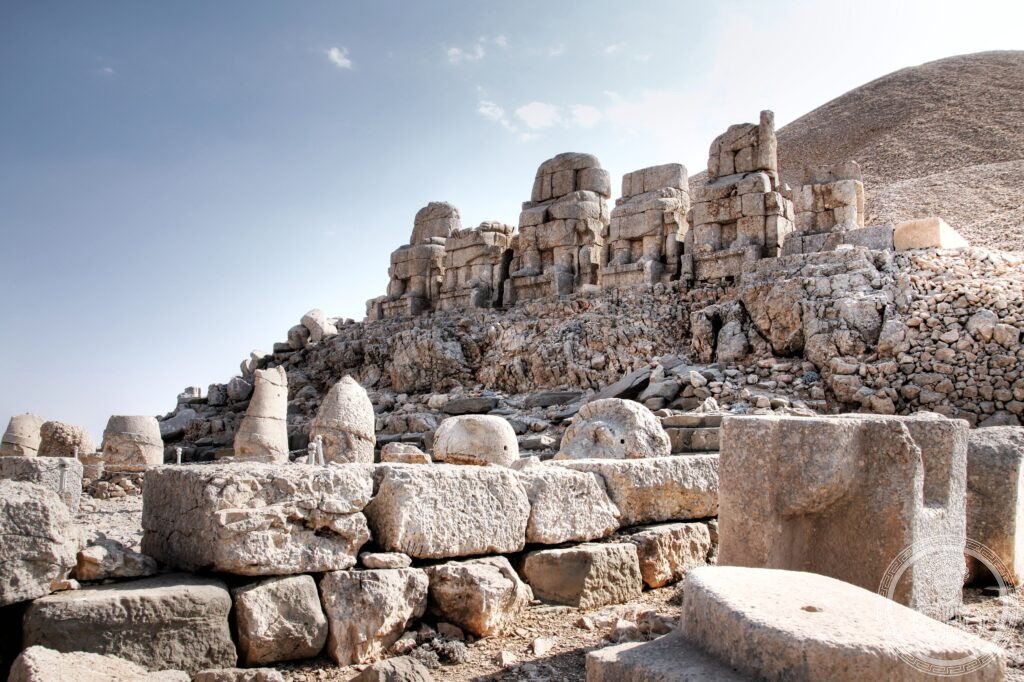
Mount Nemrut (Nemrut Dağı)
The most eccentric royal monument of the ancient world and the finest surviving expression of Hellenistic-Iranian religious syncretism — Mount Nemrut (Nemrut Dağı; Adıyaman Province, Turkey; UNESCO WHS 1987) is a 2,134-meter summit dominated by the colossal funeral tumulus and giant seated stone statues of King Antiochus I of Commagene (reigned 69-34 BCE), who declared himself the earthly equal of both Zeus and Ahura Mazda.
At a glance
Mount Nemrut (the most precisely NemrutDag single Antiochus I Commagene 69 BCE 34 BCE hierothesion royal sanctuary throne gods 2134m colossal statues 8m tall Greek Persian syncretic Zeus Oromasdes Apollo Mithras Hermes Tyche earthquake fallen heads East West North terraces stone inscription 50m tumulus UNESCO heritage: the Commagene Kingdom (Commagene was a small Hellenistic-Iranian kingdom in the upper Euphrates valley (approximately the area of modern Adıyaman and Malatya provinces in southeastern Turkey); it was wedged between the Seleucid Empire (Greek), the Parthian Empire (Iranian), the Kingdom of Armenia, and (later) Rome; the kings of Commagene deliberately presented themselves as heirs to both the Greek world (through the Seleucid royal family) and the Iranian world (through the Achaemenid Persian royal family); Antiochus I (reigned 69-34 BCE) was the most ambitious king: he built the Hierothesion (the royal sanctuary) on the summit of Mount Nemrut, the highest peak of the Commagene kingdom, as his funeral monument and a center for a new royal religion that merged Greek and Iranian divine traditions)); the statues (the East and West Terraces of the summit each have five colossal seated statues (originally 8-9 meters tall; the heads have fallen and lie in front of the bodies): Antiochus I himself (in the center), flanked by Apollo-Mithras-Helios-Hermes (the syncretized solar deity), Tyche (the goddess of fortune; the female figure), Heracles-Artagnes-Ares (the warrior god; the syncretized Heracles and Artagnes), and Zeus-Oromasdes (Zeus syncretized with the Zoroastrian chief deity Ahura Mazda); the guardian animals: an eagle and a lion on each terrace)) — the most precisely NemrutDag single Antiochus I Commagene 69 BCE 34 BCE hierothesion royal sanctuary throne gods 2134m colossal statues 8m tall Greek Persian syncretic Zeus Oromasdes Apollo Mithras Hermes Tyche earthquake fallen heads East West North terraces stone inscription 50m tumulus UNESCO heritage in any UNESCO world heritage site)).
Key facts
- The Inscription Steles: the most precisely NemrutDag single nomos law inscription Antiochus I Greek hierothesion royal cult festivals monthly calendar Antiochos self-deification throne gods equal Zeus 69 BCE discovery Karl Sester 1881 German engineer UNESCO heritage — the most important documents on the site: the inscription steles (on the North Terrace (the rear of the summit), a long inscription in Greek describes the Nomos (the “divine law”) of Antiochus: he declares his own divine status (as the equal of the gods on the thrones), establishes a monthly festival calendar (a festival to be held on the fifth of every month; the ninth of the month for his birthday), lists the priests who will maintain the sanctuary, and prescribes the offerings and the ritual clothing; the text is the most complete surviving description of a Hellenistic royal cult; the inscription was first read by the German engineer Karl Sester in 1881 CE (who was surveying the area for a telegraph line when he stumbled upon the monument; he took rubbings of the inscriptions and sent them to Berlin; the first scholarly publication appeared in 1882 CE; the first major archaeological expedition was German (Humann and Puchstein, 1881-1884 CE)))
- GPS: 37.9806° N, 38.7406° E
History
From Persian satrap to independent kingdom to Roman province (the most precisely NemrutDag single Antiochus I 69 BCE throne-friend commagenian kingdom Seleucid Parthian Rome buffer state 72 CE Vespasian Roman province Septimius Severus 2nd century CE Karl Sester 1881 Humann Puchstein 1882 American ASOR excavation 1953 Teresa Goell UNESCO heritage: the history of Commagene (the Commagene kingdom was created by Ptolemy (died approximately 163 BCE), a satrap (provincial governor) of the Seleucid Empire who declared independence as the Seleucid Empire weakened after the death of Antiochus IV (164 BCE); Commagene survived as an independent kingdom for approximately 180 years (163-72 CE) by playing the surrounding powers against each other; Antiochus I of Commagene (reigned 69-34 BCE) was the most successful king of the dynasty (he successfully defended the kingdom against both Pompey and Marcus Antonius (Mark Antony) by paying tribute when necessary and providing military assistance when profitable); the building of the Hierothesion (the royal sanctuary on Mount Nemrut) was begun in approximately 62 BCE (after Antiochus I defeated a Parthian invasion) and was probably completed by 34 BCE (when Antiochus died; the tumulus (the burial mound on the summit; 50m high; 150m in diameter; constructed from loose marble chips rather than soil; the burial chamber of Antiochus has never been found — ground-penetrating radar surveys suggest a chamber near the center of the tumulus but excavation would require removing part of the monument))); the Roman annexation (72 CE: the emperor Vespasian annexed Commagene after the last king, Antiochus IV, supported a Parthian incursion; the kingdom became the Roman province of Commagene; the Hierothesion was abandoned and forgotten; the statues were toppled by earthquakes and frost action over the following centuries) — the most precisely NemrutDag single Antiochus I 69 BCE throne-friend commagenian kingdom Seleucid Parthian Rome buffer state 72 CE Vespasian Roman province Septimius Severus 2nd century CE Karl Sester 1881 Humann Puchstein 1882 American ASOR excavation 1953 Teresa Goell UNESCO heritage in any UNESCO world heritage site)).
What you see
Fallen heads, lion horoscope, and sunrise over the Taurus (the most precisely NemrutDag single East Terrace West Terrace fallen heads eagle lion sunrise sunset 50m tumulus North Terrace inscription processional road lion horoscope star comet Zeus planets September 7 62 BCE American archaeologist Teresa Goell 1953 UNESCO heritage: the visitor experience: the East Terrace (the better-preserved terrace; the heads have been set upright in front of the seated bodies by Turkish archaeologists (1990s CE restoration); the sunrise (most tours arrive before dawn for the sunrise over the Taurus Mountains; the light turns the stone statues golden-orange)); the West Terrace (the best-preserved of the two; the eagle guardian in particularly fine condition; the sunset light is the traditionally preferred light for photography); the Lion Horoscope stele (on the North Terrace; a carved relief showing a lion with a crescent moon, a star-studded collar, and three planets (Jupiter, Mercury, Mars) identified by inscriptions; the most precise ancient astronomical document from this region; the astronomer Otto Neugebauer calculated in 1959 CE that the planetary configuration shown corresponds to July 7, 62 BCE (the date of the founding of the Hierothesion or a victory over Parthia)); the tumulus (the 50m-high mound of marble chips; all attempts to find the burial chamber have so far failed; the most exciting undiscovered royal tomb in Turkey)); the practical visit (the most popular tour is the 2-day tour from Kahta (the nearest town; 40 km from the summit): Day 1 afternoon visit to the lower monuments (Karakuş Tumulus (a satellite royal tomb with eagle-topped columns), Cendere Bridge (a Roman bridge from the reign of Septimius Severus, 193-211 CE), Arsemia (the ancient capital of Commagene)); Day 2 pre-dawn ascent to the summit for sunrise)) — the most precisely NemrutDag single East Terrace West Terrace fallen heads eagle lion sunrise sunset 50m tumulus North Terrace inscription processional road lion horoscope star comet Zeus planets September 7 62 BCE American archaeologist Teresa Goell 1953 UNESCO heritage in any UNESCO world heritage site)).
Practical information
- Getting there: from Kahta (Adıyaman Province; the gateway city for Mount Nemrut; accessible by bus from Adıyaman (50 km; 1h; ₺30) or from Malatya (160 km; 3h) or from Diyarbakır (250 km; 4h)); from Kahta to the summit (40 km by minibus or taxi; the road is paved to within 2 km of the summit; the final 2 km is on foot (20-30 min; moderately steep); the mini-bus tours from Kahta are the easiest option for independent travelers; the tours typically cost approximately ₺500-800 per person; the access season (the road is closed by snow from approximately November to April; the peak season is June-September)); the accommodation (Kahta has simple hotels; the summit area has a small car park and a tea house; no accommodation on the summit itself; the pre-dawn start for sunrise requires staying in Kahta and departing at approximately 03:00 AM); the altitude (2,134m; the summit is cold even in summer at night (approximately 5-10°C at 03:00 AM in July); bring warm layers for the dawn visit))
Getting there
Bus to Kahta from Adıyaman (1h) or Malatya (3h). Minibus tour from Kahta to summit (40 km). Pre-dawn start for sunrise. Bring warm clothes. Closed Nov-April. GPS: 37.9806, 38.7406.
Nearby
- Arsameia and Karakuş Tumulus — 20 km west of Mount Nemrut (the ancient capital of Commagene; a processional road with relief carvings (the most famous: the 3-meter-high bas-relief of Antiochus I shaking hands with Mithras); the Karakuş Tumulus (the burial mound of Antiochus I’s female relatives, marked by tall columns topped with animal sculptures including an eagle (the symbol of Zeus) and a bull (the symbol of the Euphrates)))
- Zeugma Mosaic Museum, Gaziantep — 150 km south (the most important mosaic museum in the world; the floor mosaics from the Roman city of Zeugma (1st-3rd century CE; submerged by the Birecik Dam in 2000 CE; the mosaics were salvaged in a rescue excavation; the 4,000 m² of mosaic on display; the famous Gypsy Girl mosaic (the portrait of a young woman in a polychrome mosaic (2nd century CE); the most reproduced mosaic fragment in Turkey)))
Sources
- Wikipedia, Mount Nemrut; Commagene; Antiochus I of Commagene, accessed June 2026
- UNESCO, Nemrut Dağ, WHS reference 448, inscribed 1987
Find it on the map
See this place and what’s around it →📷 Diventa un fotografo di Cultural Heritage Online
Condividi le tue foto dei luoghi: restano pubblicate con la tua firma come autore. Più vengono viste, più ti fai conoscere — e presto un concorso premierà le foto più apprezzate.
Accedi o registrati gratis per aggiungere una foto