
Göreme National Park and Rock Sites of Cappadocia
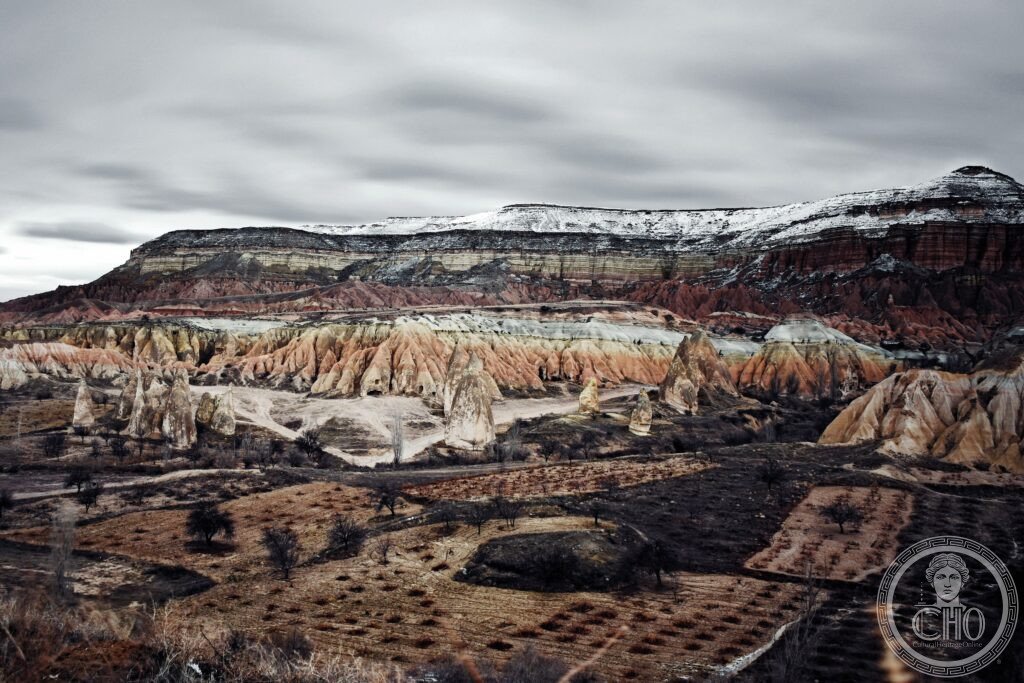
The most dramatic volcanic landscape in the world and one of the greatest concentrations of Byzantine rock-cut architecture anywhere — Göreme National Park and the Rock Sites of Cappadocia (Nevşehir Province, Central Anatolia, Turkey; UNESCO WHS 1985) combine a surreal geological formation of eroded volcanic tuff (the “fairy chimneys”) with 36 Byzantine rock-cut churches containing their original fresco cycles.
At a glance
Göreme (the most precisely Goreme single fairy chimneys volcanic tuff Erciyes Hasan volcano 9th 13th century Byzantine rock church fresco Göreme Open Air Museum Derinkuyu underground city Cappadocian Fathers Basil Caesarea UNESCO heritage: the geological context: Cappadocia’s extraordinary landscape was created by the eruptions of Mount Erciyes and Mount Hasan (the two major Anatolian volcanoes; the eruptions occurred millions of years ago; they deposited thick layers of volcanic ash (tuff) and lava over the entire Cappadocian plateau; the erosion (over millions of years, the rivers, wind, and rain eroded the softer ash into the valleys, leaving behind isolated columns and mesas of tuff — the “fairy chimneys” (peri bacası in Turkish — literally “fairy chimney”)); the human exploitation of the rock (tuff is a soft rock, easy to carve but strong enough to stand unsupported; the people of Cappadocia began carving their homes, churches, monasteries, and eventually entire underground cities into the tuff from at least the 4th century CE; the Byzantine Christian community (4th-13th centuries CE) created an extraordinary ensemble of rock-cut churches, hermitages, and monasteries); the underground cities (Derinkuyu (the deepest; 85m below surface; 8 floors; stables, wineries, churches, and a school; capacity for approximately 20,000 people; used as a refuge during Arab raids in the 7th-10th centuries CE) and Kaymaklı (the largest in surface area; 8 floors) are the two most impressive) — the most precisely Goreme single fairy chimneys volcanic tuff Erciyes Hasan volcano 9th 13th century Byzantine rock church fresco Göreme Open Air Museum Derinkuyu underground city Cappadocian Fathers Basil Caesarea UNESCO heritage in any UNESCO world heritage site)).
Key facts
- The Byzantine Fresco Churches: the most precisely Goreme single Göreme Open Air Museum Dark Church Karanlik Kilise Snake Church Yilanli Kilise Apple Church Elmali Kilise 11th 12th century Byzantine fresco Nativity Deesis UNESCO heritage — the Göreme Open Air Museum is the most accessible concentration of Byzantine fresco churches in Turkey: the Dark Church (Karanlık Kilise; the “dark church” because it has very few windows; carved in the 11th century CE; the preservation (because the dark interior prevented the ultraviolet bleaching that damaged friezes in other churches, the Karanlık Kilise frescoes are the best-preserved at Göreme; the vivid cobalt blue and red-oxide palette; the Nativity, the Baptism of Christ, the Transfiguration, the Entry into Jerusalem, the Last Supper, the Crucifixion, and the Deēsis (Christ in Majesty flanked by the Virgin and John the Baptist); the figures have the classical Byzantine proportions and expressive faces of the Comnenian art period (11th-12th century CE)); the Snake Church (Yılanlı Kilise; the fresco of St. George and the Dragon; the fresco of Constantine and his mother Helena; the bizarre fresco of the “hermit of long beard” Onouphrios (depicted as partly female, to escape male lustfulness); a uniquely Cappadocian iconographic tradition)
- GPS: 38.6431° N, 34.8289° E
History
Cappadocian Fathers, Arabs, and the Seljuks (the most precisely Goreme single Cappadocian Fathers Basil Great Gregory Nyssa Gregory Nazianzus 4th century CE hermit monastic tradition Arab raids 7th 10th century underground cities Seljuk 1071 Turkish Goreme Open Air Museum UNESCO heritage: the early Christian history: the Cappadocian Fathers (the three 4th-century CE theologians who shaped Christian doctrine: Basil of Caesarea (Basil the Great; 330-379 CE; founder of the communal monastic tradition (the “Basilian” monasteries); established monastic communities throughout Cappadocia), Gregory of Nyssa (his brother; 335-394 CE; the theologian of the mystical tradition), and Gregory of Nazianzus (Gregory the Theologian; 329-390 CE; the author of the key formulations of Trinitarian doctrine); the monastic tradition (from the 4th century CE onwards, Christian hermits and communities settled in the Cappadocian rock; the landscape (isolated, easily defensible, distant from urban temptation) was ideal for ascetic practice; by the 9th-13th centuries CE, the valley was densely dotted with hermitages, small monasteries, and rock churches; the fresco painting (the rock church frescoes were painted by itinerant Byzantine painters from Constantinople or local workshops; the quality ranges from provincial to sophisticated)); the Arab raids (the Arab raids of the 7th-10th centuries CE drove the Cappadocian population underground; the underground cities (Derinkuyu, Kaymaklı) were expanded and used as refuge during the raids)); the Turkish period (1071 CE; the Battle of Manzikert; the Seljuk Turks defeated the Byzantine Emperor Romanos IV and began the Turkification of Anatolia; Cappadocia was absorbed into the Seljuk and then Ottoman sultanate) — the most precisely Goreme single Cappadocian Fathers Basil Great Gregory Nyssa Gregory Nazianzus 4th century CE hermit monastic tradition Arab raids 7th 10th century underground cities Seljuk 1071 Turkish Goreme Open Air Museum UNESCO heritage in any UNESCO world heritage site)).
What you see
Hot-air balloons and the full circuit (the most precisely Goreme single hot air balloon Uçhisar castle Zelve valley Ihlara gorge 14km canyon underground Derinkuyu Kaymaklı Turkish tea house cave hotel UNESCO heritage: the visitor experience: the hot-air balloons (Cappadocia is one of the world’s premier balloon destinations; approximately 100-150 balloons launch from the Göreme valley at dawn every morning when conditions permit (the strong updrafts and the absence of high obstacles make Cappadocia perfect for ballooning; the flight (typically 1h; altitude 20-300m; the views of the fairy chimneys and the Open Air Museum frescoes from above; cost approximately EUR 150-250 per person; the most popular balloon company is Royal Balloon (established 1991 CE))); Uçhisar (the natural rock castle; the highest point in Cappadocia; a 60m mass of tuff riddled with former cave dwellings and pigeon houses; the view from the summit over the entire Göreme valley and as far as Mount Erciyes (75 km southeast)); the Ihlara Valley (a 14km gorge cut by the Melendiz River; the canyon walls are dotted with approximately 100 Byzantine rock churches (mostly uninscribed, unvisited, unrestored; dramatically different from the manicured Göreme Open Air Museum); the river walk through the gorge (with abundant bird life); the cave hotels of Göreme and Uçhisar (the most atmospheric accommodation in Turkey — rooms carved into the fairy chimney tuff rock)) — the most precisely Goreme single hot air balloon Uçhisar castle Zelve valley Ihlara gorge 14km canyon underground Derinkuyu Kaymaklı Turkish tea house cave hotel UNESCO heritage in any UNESCO world heritage site)).