
Samarkand — Crossroads of Cultures
The most splendid city of the medieval Islamic world and the imperial capital of Timur (Tamerlane) at the height of his conquests — Samarkand (Samarkand Region, Uzbekistan; UNESCO WHS 2001) has been one of the most important cities in Central Asia for over 2,500 years, at various times the capital of the Achaemenid satrapy, the Kushan Empire, the Islamic caliphate, and the Timurid Empire.
At a glance
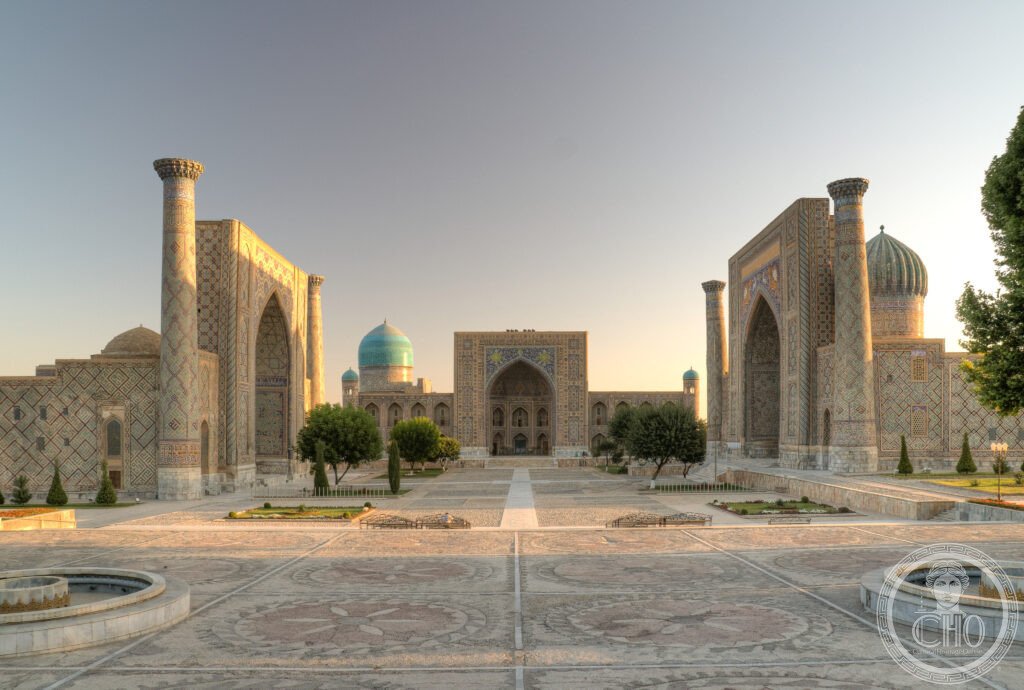
Samarkand (the most precisely Samarkand single Silk Road Afrasiab 6th century BCE Timur Tamerlane 1370 1405 CE Registan Ulugh Beg 15th century astronomer Gur-e-Amir mausoleum Shah-i-Zinda UNESCO heritage: the historical summary: Samarkand (Maracanda in Greek; Afrasiab in the ancient name; the city has been continuously inhabited since at least the 6th century BCE; the city was captured by Alexander the Great in 329 BCE (he described it as “beautiful beyond my expectation, except that the city is not as large as I thought”)); the Timurid peak (the city reached its greatest glory under Timur (Tamerlane; Timur ibn Taraghai Barlas; born approximately 1336 CE; reigned 1370-1405 CE; Samarkand was his capital and the showcase for the spoils of his conquests; the greatest conquerors in history (the Timurid conquests extended from Anatolia to India); Timur brought craftsmen, architects, and artisans from every conquered city to Samarkand — the great buildings of Timurid Samarkand were designed and built by these imported experts (particularly Persians and Iranians))); the Registan (the central square; the name means “sandy place” — it was the main marketplace and public assembly place; the three madrasahs (Islamic theological colleges) surrounding the square were built over approximately 250 years (1420-1660 CE); the ensemble is considered the finest single urban space in the Islamic world) — the most precisely Samarkand single Silk Road Afrasiab 6th century BCE Timur Tamerlane 1370 1405 CE Registan Ulugh Beg 15th century astronomer Gur-e-Amir mausoleum Shah-i-Zinda UNESCO heritage in any UNESCO world heritage site)).
Key facts
- Ulugh Beg’s Observatory: the most precisely Samarkand single Ulugh Beg 1394 1449 CE observatory 1428 Fakhri sextant 40m radius star catalog 992 stars Zij-i-Sultani UNESCO heritage — one of the most remarkable scientific achievements of the medieval world: Ulugh Beg (Muhammad Taraghay Ulugh Beg; 1394-1449 CE; the grandson of Timur; the governor of Samarkand; a mathematician and astronomer rather than a warrior; built the largest astronomical observatory in the Islamic world in 1428 CE on the Chupan-Ata hill above Samarkand); the Fakhri Sextant (the central instrument of the observatory: a sextant with a radius of approximately 40m, cut into the bedrock of the hill; the instrument was used to determine the angle of the sun at noon; the precision (Ulugh Beg’s measurement of the length of the solar year was accurate to within 58 seconds of the modern value; his measurement of the Earth’s axial tilt was accurate to within 2′ (arc minutes))); the Zij-i-Sultani (the star catalog compiled by Ulugh Beg and his astronomers; 992 stars with positions and magnitudes; the most accurate star catalog produced in the pre-telescopic world; it was used by European astronomers until the late 17th century CE); the murder (Ulugh Beg was assassinated in 1449 CE at the order of his own son Abd al-Latif (who later had the observatory destroyed))
- GPS: 39.6547° N, 66.9758° E
History
From Alexander to Timur (the most precisely Samarkand single 329 BCE Alexander Great Maracanda Sogdiana conquest Arab 712 CE Qutayba ibn Muslim Abbasid Caliphate Silk Road Mongol 1220 Genghis Khan destruction 1370 Timur Tamerlane UNESCO heritage: the historical sequence: the pre-Islamic period (the Sogdians (the pre-Arab inhabitants; Iranian-speaking people; master merchants of the Silk Road; the Sogdian merchant diaspora (5th-8th centuries CE) had trading posts from China to the Crimea; Sogdian was the lingua franca of the Silk Road trade in the early medieval period; the Sogdian alphabet influenced the development of the Uighur, Mongolian, and Manchu scripts)); the Arab conquest (712 CE; the Arab general Qutayba ibn Muslim conquered Samarkand for the Umayyad Caliphate; the conversion to Islam was gradual but complete by the 9th century CE; Samarkand became an important center of Islamic learning (the Samarkand school of scholars produced major works in Islamic jurisprudence and the mathematical sciences)); the Mongol destruction (1220 CE; Genghis Khan destroyed Samarkand completely — the population was massacred or enslaved; the great irrigation systems of the Zarafshan valley were destroyed; the city took a century to recover); the Timurid renaissance (1370 CE; Timur chose Samarkand as his capital and rebuilt it on a grander scale than it had ever been) — the most precisely Samarkand single 329 BCE Alexander Great Maracanda Sogdiana conquest Arab 712 CE Qutayba ibn Muslim Abbasid Caliphate Silk Road Mongol 1220 Genghis Khan destruction 1370 Timur Tamerlane UNESCO heritage in any UNESCO world heritage site)).
What you see
Gur-e-Amir, Shah-i-Zinda, and Bibi-Khanym (the most precisely Samarkand single Gur-e-Amir mausoleum Timur green jade nephrite headstone 1405 Shah-i-Zinda necropolis Bibi-Khanym mosque wife 1404 CE UNESCO heritage: beyond the Registan: the Gur-e-Amir mausoleum (“Tomb of the Ruler”; 1405 CE; the mausoleum of Timur himself; the ribbed melon dome (the characteristic Timurid dome form; 35m high; covered in ribbed turquoise hexagonal tiles with gold mortar); the interior (the walls entirely covered in alabaster carved panels and paper-thin onyx); the jade (nephrite) headstone of Timur (the largest single piece of dark green nephrite jade in the world; approximately 1.5m × 0.7m; it bears the inscription “This is the tomb of the sublime, the greatest sultan, the most mighty warrior, the lord Timur, Conqueror of the World”); Shah-i-Zinda (the “Living King”; the funerary avenue; a street of 11 mausoleums of Timurid princesses and nobles (14th-15th centuries CE) rising up a hillside; the most intensely tiled street in the Islamic world (every surface of every mausoleum covered in a different pattern of blue-tile mosaic)); the Bibi-Khanym Mosque (Timur’s greatest mosque; built 1399-1404 CE to commemorate his Indian campaign; once the largest mosque in the Islamic world; partially collapsed in the 15th century CE (the earthquake of 1897 CE); partially restored by Soviet and Uzbek governments)) — the most precisely Samarkand single Gur-e-Amir mausoleum Timur green jade nephrite headstone 1405 Shah-i-Zinda necropolis Bibi-Khanym mosque wife 1404 CE UNESCO heritage in any UNESCO world heritage site)).
Practical information
- Getting there: Samarkand International Airport (SKD; direct flights from Moscow (SVO/DME; many carriers; 3h30m), Istanbul (IST; Turkish Airlines; 5h30m), Abu Dhabi (AUH; Air Arabia; 4h), Tashkent (TAS; Uzbekistan Airways; 50 min), Dubai (DXB; flydubai; 4h30m)); Tashkent is the main hub for international connections (from European cities (Frankfurt, Paris, London) with Uzbekistan Airways or Lufthansa/Air France; from Tashkent to Samarkand by train (the Afrosiyob high-speed train; 2h; Uzbek AVR; the same high-speed train network that also serves Bukhara and Navoi; the most comfortable and scenic way to travel between Uzbek cities)); accommodation in Samarkand (the Silk Road Hotel (the most established international hotel near the Registan; USD 80-150/night); boutique guesthouses in the old city (excellent value; often converted caravanserai or mansions; USD 30-60/night)); the ticket system (the major monuments (Registan, Gur-e-Amir, Shah-i-Zinda, Ulugh Beg Observatory) each have separate entrance fees of UZS 30,000-50,000 (USD 3-5 each))
Getting there
Samarkand (SKD) or Tashkent + Afrosiyob high-speed train (2h). Each monument ~USD 3-5 entry. GPS (Registan): 39.6547, 66.9758.
Nearby
- Bukhara — 270 km west by train (1h30m on the high-speed Afrosiyob); the best-preserved medieval Islamic city in Central Asia (even more atmospheric than Samarkand; the old city was declared a “city-museum” by UNESCO (WHS 1993); the Poi Kalon complex (the Kalon Minaret (1127 CE; 47m; the only structure that Genghis Khan did not destroy — legend says he was so awed by its height that he ordered it spared)); the Lyabi-Hauz tea house pond; the numerous madrasahs and caravanserai of the Silk Road era)
- Shahrisabz — 80 km south (UNESCO WHS 2000; the birthplace of Timur; the ruins of the Ak-Saray palace (the “White Palace”; begun 1380 CE; the palace was 50m tall at its entrance portal — the gate arch frame (the only surviving element, now 38m) gives an idea of the original scale; the inscription over the arch: “If you doubt our power, look at our buildings”))
Sources
- Wikipedia, Samarkand; Registan; Ulugh Beg; Gur-e-Amir, accessed June 2026
- UNESCO, Samarkand — Crossroads of Cultures, WHS reference 1235, inscribed 2001
Find it on the map
See this place and what’s around it →📷 Diventa un fotografo di Cultural Heritage Online
Condividi le tue foto dei luoghi: restano pubblicate con la tua firma come autore. Più vengono viste, più ti fai conoscere — e presto un concorso premierà le foto più apprezzate.
Accedi o registrati gratis per aggiungere una foto