
On the morning of April 10, 1932, Benito Mussolini drove a shovel into the ground of the Agro Pontino — the ancient malarial swamp south of Rome that Julius Caesar had planned to drain and never did. Exactly 253 days later, he stood in front of a completed city. Littoria, now called Latina, had been built on reclaimed marshland in under nine months. A city of 50,000 inhabitants, with two squares, a cathedral, a prefecture, a post office, and a grid of colonnaded streets, had been raised from drained swampland on a schedule the regime described as miraculous. It was not a miracle: it was forced labour, military organisation, and the complete suppression of any material that could not be fabricated locally or transported fast. But it worked. The city stood.
Sabaudia came fourteen months later, built even faster, on a site between a lake and the sea with the Circeo promontory as a backdrop. Four young architects — Gino Cancellotti, Eugenio Montuori, Luigi Piccinato, and Alfredo Scalpelli — won a national competition and built their design without modification. Both cities survive almost entirely intact. They are the most complete experiments in Rationalist urbanism in Italy, and the most awkward part of its architectural inheritance.
Sabaudia — The Competition Winners and the Mediterranean Modern
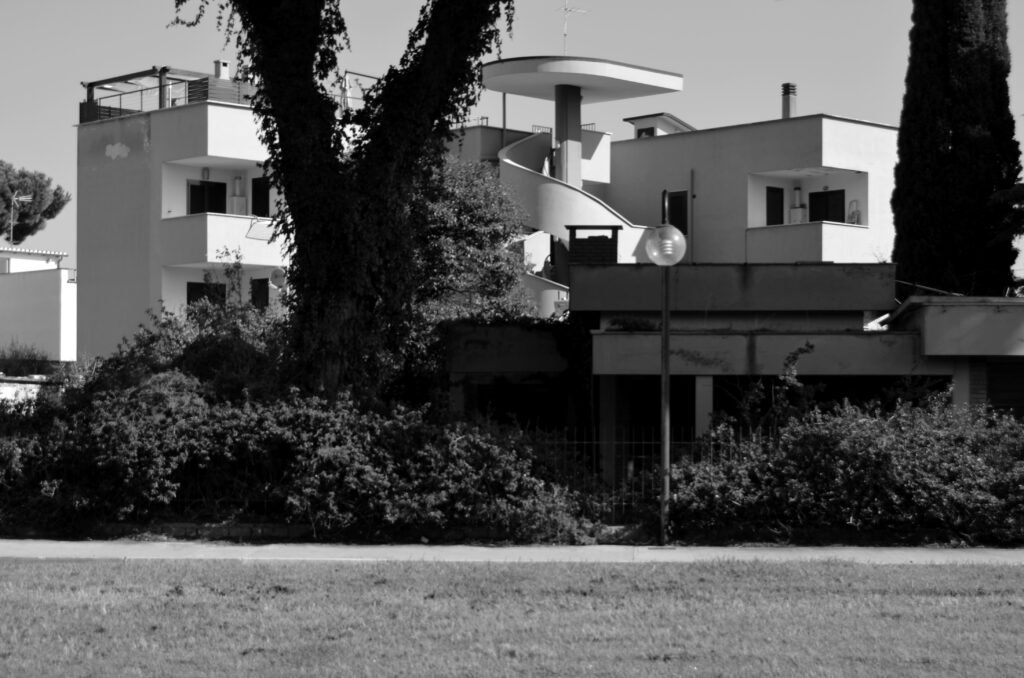
Sabaudia was the second of the five Pontine new towns and the most architecturally distinctive. Where Latina was designed by a single architect working within the regime’s administrative framework, Sabaudia was the product of a national competition — and the winning team was thirty years old on average. Cancellotti, Montuori, Piccinato, and Scalpelli submitted a design that was explicitly Rationalist: stripped of historicist ornament, composed around viewcones to the lake and the sea, organised by a hierarchy of squares rather than a single axial boulevard.
The city was founded on April 5, 1934, and built to completion in fewer than twelve months. Its site — a narrow strip between Lago di Sabaudia and the Tyrrhenian Sea, backed by the Circeo promontory — was more constrained than Latina’s flat farmland, and the architects used the constraint deliberately. The central piazza opens toward the lake on the north and toward the sea on the south through aligned streets. The Torre Civica of the Palazzo Comunale marks the civic centre and is visible from both water fronts. The layout is still entirely legible from street level, and almost no postwar development has entered the core.
The Tower and the Piazza
The Palazzo Comunale of Sabaudia, with its attached tower, was the founding-ceremony building — the structure that appeared in every regime photograph of the founding day. Mussolini stood at its base; the tower framed him against the sky; the photographs were distributed to newspapers across Italy as evidence that the regime could literally build cities. The tower was slightly modified after the first competition drawings: the original proportions were judged too stocky in the founding-day photographs, and the final version is taller and more slender.
The building itself is one of the most refined examples of Italian Rationalism in a civic programme. No columns, no historicist ornament: a loggia of flat arches at ground level, smooth lime plaster above, the tower as a pure vertical element. The original tiled floors and brass window fittings survive inside. Climb the tower when open — the panorama across the lake to the Circeo, and from there to the sea, is exactly what the architects designed toward. The building is in active municipal use and can be entered during office hours.
Littoria — The Capital of the New Province
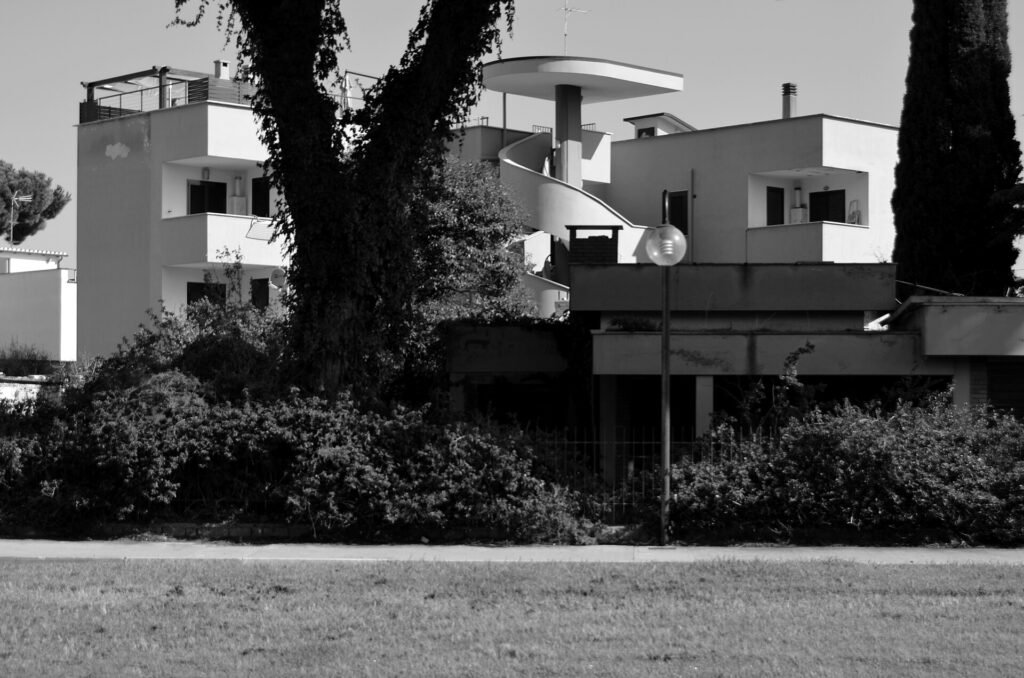
Latina was designed entirely by Oriolo Frezzotti, an architect from Viterbo who worked within the existing conventions of civic Rationalism rather than pushing against them. His city plan is more classical than Sabaudia’s: two squares connected by a single primary axis (Via Roma), a commercial street running parallel to the civic street, and a ring road enclosing the historic centre. The plan is readable from the street as a series of compressed vistas — each piazza closed by a building at the end, each loggia opening to the next colonnade.
The city was built in 253 days, from April to December 1932. The Provincia di Littoria was created in 1934 to administer the five new Pontine towns, with Littoria as the provincial capital. After 1945, Littoria became Latina, the province became Provincia di Latina, and the regime associations were nominally dissolved — but the urban fabric was left untouched. Latina today retains its entire 1932 centre, in active daily use, almost without modification. Via Roma is still colonnaded from end to end. The two main squares are still the gravitational centres of the city. The regime built well.
Palazzo M and the Letterform City
Palazzo M is the most unusual building in the Latina centre — unusual enough that its name is an explanation. The floor plan, seen from above, forms the letter M: the initial of Mussolini, with two projecting wings flanking an internal courtyard and a concave elevation facing the main piazza. The building was Frezzotti’s combined commercial and administrative complex, placed at the southern end of the civic axis as a counterweight to the Palazzo del Governo at the north end.
The M-shape is visible in the aerial photographs that the regime circulated as propaganda; at street level it reads as an architectural gesture — a building that opens itself to the public space it faces. The concave elevation creates a sense of enclosure on the piazza side without fully closing it. The original limestone cladding is intact; the ground-floor shops are still in commercial use. Palazzo M was renamed Palazzo della Banca d’Italia after 1945, and the M association was quietly dropped from official descriptions, but the floor plan has not changed.
San Marco — A Church That Looks Like a Courthouse
The Cattedrale di San Marco Evangelista was Frezzotti’s most difficult brief: a religious building that had to satisfy both the Vatican — which had signed the Lateran Pacts with the Italian state in 1929 — and the Rationalist principles that governed all other architecture in the new cities. The result is a building that is unmistakably a church and yet looks almost nothing like any church built before 1930. The facade is flat limestone, the bell tower is a stripped vertical element, and the main entrance is framed not by columns or pointed arches but by a simple projecting canopy of flat stone.
The interior is the most interesting part. The proportions are unusually wide relative to height, departing from the tall nave of Gothic-derived church architecture. Light enters through clerestory windows on the north wall that Frezzotti positioned to create a moving shadow pattern across the floor through the morning hours. There are no chapels, no figurative stained glass, no side altars: just limestone surfaces, wooden benches, and carefully managed natural light. The cathedral is still an active parish and is open most mornings. Go inside if it is open: the experience is not what any conventional image of a cathedral leads you to expect.
The Government Axis
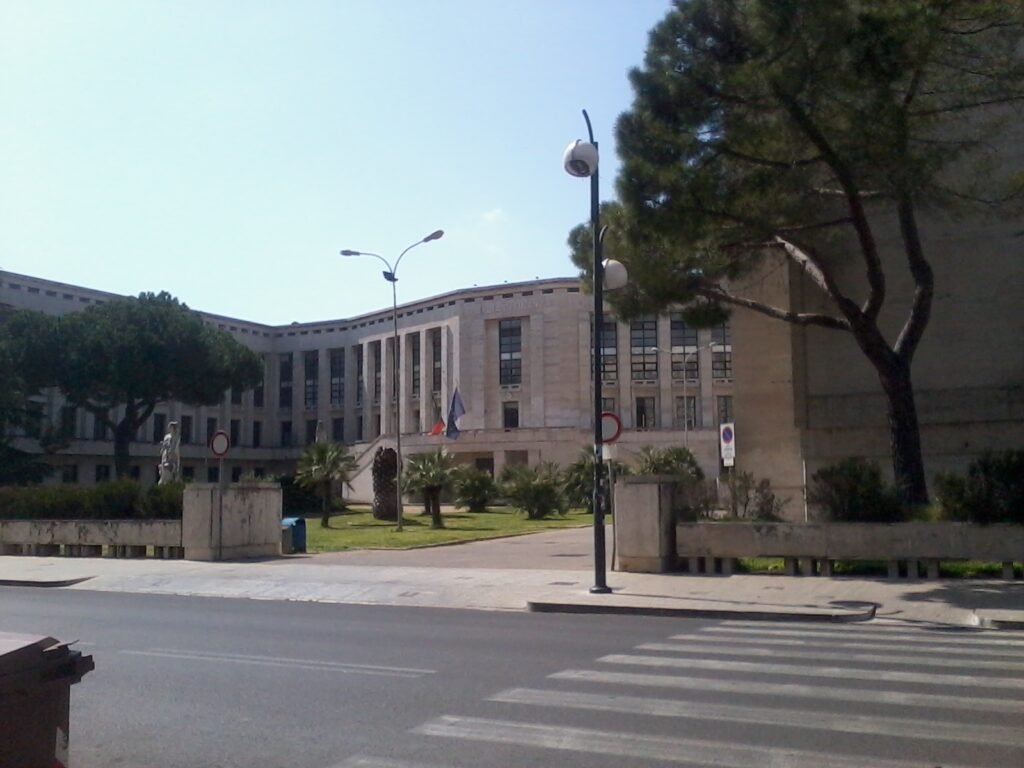
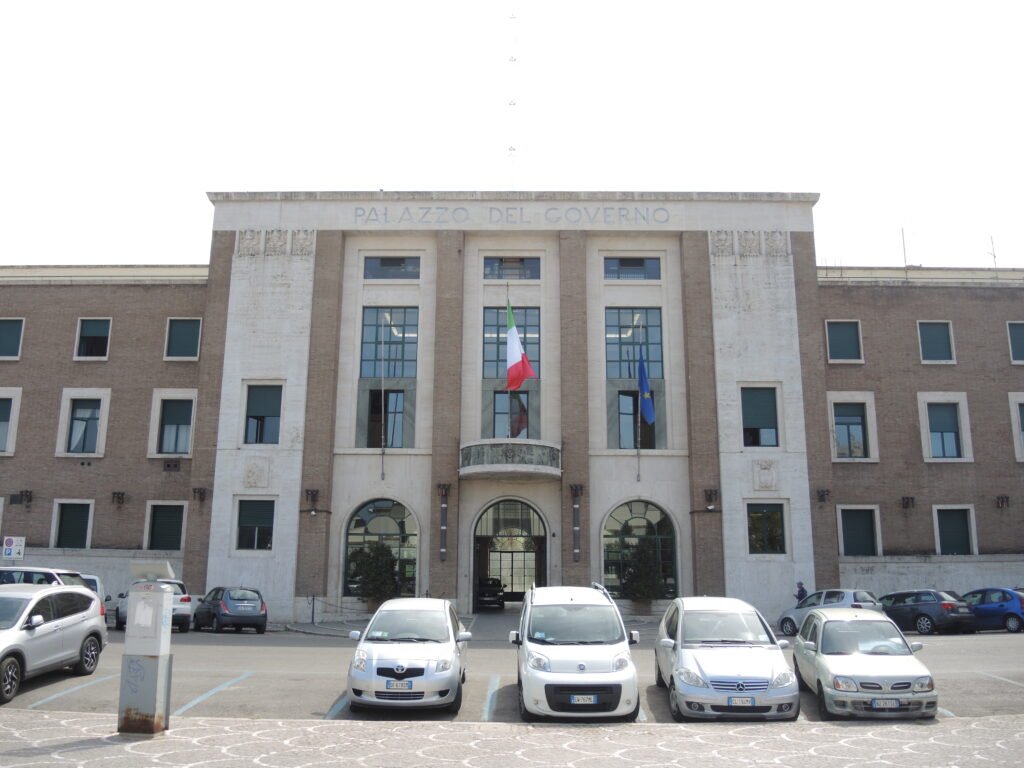
The Palazzo del Governo — now the Prefettura di Latina — closes the northern end of Via Roma and gives the civic axis its formal conclusion. Where Palazzo M at the south end is horizontal and embracing, the Palazzo del Governo is vertical and commanding: a projecting entrance loggia, a tall portal, limestone cladding without ornament. The building contains the apparatus of state — the prefecture has been here since 1932 — and its design communicates this in the only vocabulary the Rationalists permitted: proportion and material, nothing else.
Stand on the loggia steps and look south along Via Roma to Palazzo M at the far end: Frezzotti designed this perspective as the culminating view of the city, and it is still intact. The distance between the two buildings, the rhythm of the colonnaded ground floors, the alignment of the secondary streets — all of this is visible from this single position. Walk back south slowly. The ground-floor colonnades were designed to be experienced at walking pace, in shade, with the civic buildings visible at the end of each framed view. This is what a Rationalist city feels like when the architects were serious and the politics have aged enough to look at the buildings on their own terms.