
Behind the Old City walls of Sana’a rise thousands of tower houses in dark basalt and sun-dried mud brick, their upper storeys finished in white gypsum plaster and pierced by stained-glass windows. It is one of the world’s oldest continuously inhabited cities and a singular achievement in earthen architecture.
At a glance
The Old City of Sana’a occupies roughly one square kilometre within walls that date to the ninth century CE, though settlement on the site is said to reach back to the pre-Islamic Sabaean kingdom, the world associated with the Queen of Sheba and her capital at Ma’rib. Inscribed as a UNESCO World Heritage Site in 1986, the Old City has also featured on the List of World Heritage in Danger since 2015. It contains more than 6,000 multi-storey tower houses, 103 mosques and 14 hammams, and in 2010 its resident population was estimated at around 50,000.
The tower houses follow a distinctive Yemeni building method: a base of two or three storeys in dark basalt stone gives the structure strength, with four to six further storeys above in hand-shaped, sun-dried mud brick. The whole is coated in qadad, a waterproof lime and volcanic-ash plaster that protects the mud brick from rain, and decorated with bands of white gypsum plasterwork and coloured qamariyya windows.
Key facts
- Designation: UNESCO World Heritage Site, inscribed 1986; on the List of World Heritage in Danger since 2015
- Scale: more than 6,000 tower houses, 103 mosques and 14 hammams within an Old City of roughly 1 km²
- Population: around 50,000 residents recorded in 2010
- Coordinates: 15.3547° N, 44.2066° E
- Administration: Amanat Al-Asimah, the Capital Secretariat of the Republic of Yemen
History
Yemeni tradition holds that Sana’a was founded by Shem, son of Noah, on the site of a Sabaean sacred place. The pre-Islamic royal palace of Ghumdan, said by later Arab historians to have stood twenty storeys high, was demolished in the early Islamic period, reportedly on the order of Caliph Uthman, its stone reused for mosque building. The Great Mosque of Sana’a is said in Yemeni tradition to have been founded by the Prophet Muhammad himself, making it one of the oldest mosques anywhere, though its present structure is largely Ottoman; its old wooden minbar, now kept in storage, is among the oldest surviving wooden mosque furnishings in Islam.
The Ottomans occupied Yemen twice, from 1517 to 1635 and again from 1849 to 1918, each time expelled by the Zaydi imams of Yemen. They left their mark on the Old City in the form of minarets and the layout of the suq. Yemen became a republic in 1962, and North and South Yemen were reunited in 1990.
What you see
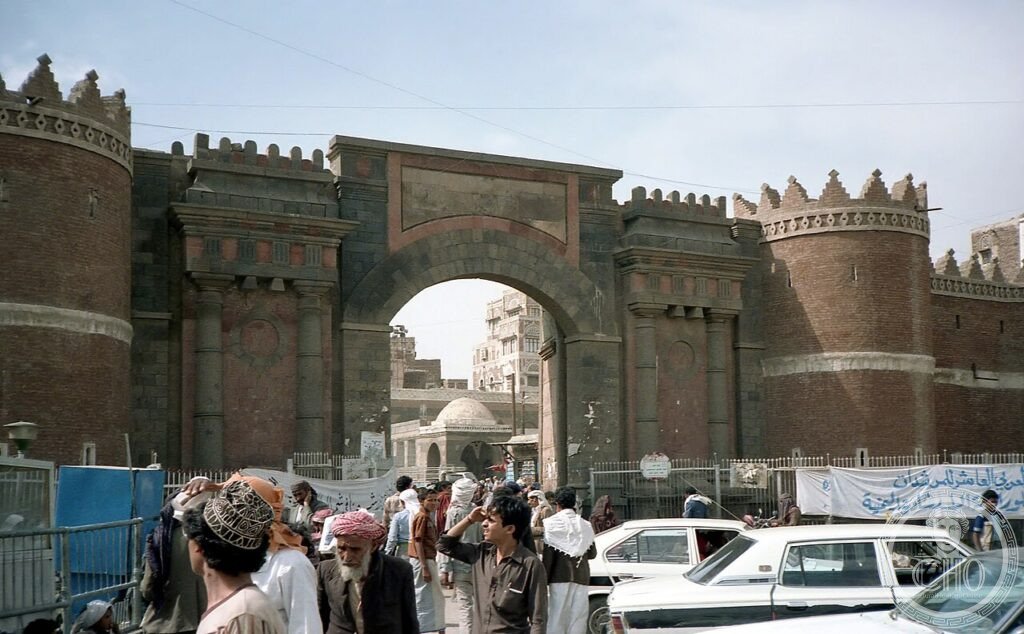
Visitors entering from the modern city pass through Bab al-Yemen, a massive double gateway in dressed stone bearing an inscription recording Ottoman rebuilding in 1881. Beyond it runs the suq, a market system of more than forty specialised streets and buildings that many regard as the most complete surviving medieval Arab market. Its oldest section, the Suq al-Milh or Salt Market, takes its name from the salt trade but today sells spices, silver jewellery, incense, textiles and the curved jambiya daggers that remain a Yemeni symbol of male status, their handles graded by material from wood to horn.
The former Jewish Quarter, Qa’al-Yahud, recalls one of the oldest Jewish communities in the world, said to have been present in Sana’a since before the destruction of the First Temple. Its craftsmen were renowned silversmiths, and the silver market, Suq al-Fud’a, remains the centre of the jewellery trade even though the community itself emigrated to Israel between 1949 and 1950 in what is known as Operation Magic Carpet. The buildings of the quarter survive structurally unchanged, now inhabited by Muslim families.
Above the rooftops the mafraj, the top-floor reception room found in every tower house, catches the eye with its windows on all four sides. Here families gather for the afternoon chewing of qat, the mildly stimulant leaf that is central to Yemeni social life, in rooms lined with cushioned banquettes and lit through coloured glass.
Practical information
- Access warning: Yemen has been in a severe civil war since 2014-15, and most Western governments advise against all travel to the country. Sana’a remains under Houthi control. Tourism to the Old City is not currently possible.
- Condition: the Old City has suffered confirmed damage from Saudi-led coalition airstrikes affecting some buildings and market areas, in addition to the neglect that led to its listing as a World Heritage Site in Danger.
- Conservation: the Arab Fund for Economic and Social Development and UNESCO maintain programmes for documentation and post-conflict conservation of the site.
- Reference use: this entry is maintained for historical and educational purposes; anyone considering future travel should check official advisories directly before making any plans.
Getting there
Sana’a is currently inaccessible to ordinary travel because of the ongoing civil war. The city’s international airport, which offered limited services before the conflict, closed following coalition airstrikes in 2015 and has not resumed normal operation.
Nearby
- Ma’rib — around 115 km east, the ancient Sabaean capital, home to the Great Dam of Ma’rib, an engineering feat of pre-Islamic Arabia whose catastrophic breach in 570 CE is recorded in the Quran; a modern dam built with Abu Dhabi funding now occupies the same site.
- Kawkaban — around 50 km west, a walled hilltop village perched on a cliff plateau, a classic example of a fortified Yemeni mountain settlement with views over the Sana’a basin.
Sources
- UNESCO
- Capital Secretariat of the Republic of Yemen
- Arab Fund for Economic and Social Development
Find it on the map
See this place and what’s around it →📷 Become a Cultural Heritage Online photographer
Share your photos of places: they stay published under your name as the author. The more they're seen, the more you get noticed — and soon a contest will reward the most appreciated photos.
Log in or sign up free to add a photo