
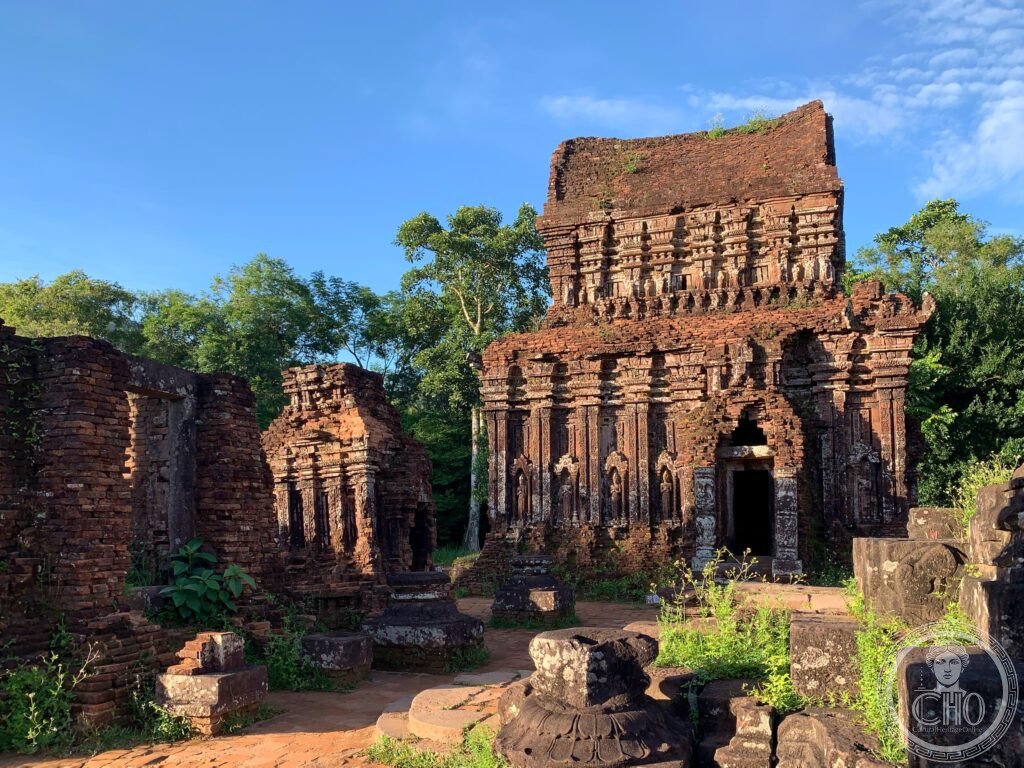
In a hidden valley ringed by mountains, the Cham kings of Champa built their sacred capital rather than their seat of power: over seventy Hindu towers raised between the 4th and 14th centuries, their brickwork fitted without visible mortar by a technique archaeologists still cannot fully explain.
At a glance
Mỹ Sơn was the religious capital of the Kingdom of Champa, a Hindu, Sanskrit-using, Malay-speaking Cham civilisation that controlled the central Vietnamese coast from roughly the 2nd to the 19th century CE. The political capital lay 15 kilometres east at Trà Kiệu, but Mỹ Sơn held the state temple, the site of royal coronations and cremations, dedicated to Bhadresvara, the Shaivite deity in whom Cham kings believed their own power was embodied.
The valley itself, enclosed by hills including the low rise known as Cat’s Tooth mountain, was chosen for both its sacred geography and its defensible position roughly 60 kilometres inland from the coast. Jungle vegetation still presses against the brick towers of Group B, the best-preserved cluster, where the main sanctuary tower stands alongside its ceremonial hall and treasure house.
Key facts
- Location: Duy Phú, Duy Xuyên District, Quảng Nam Province, central Vietnam, coordinates 15.7644° N, 108.1232° E.
- Status: UNESCO World Heritage Site, inscribed 1999.
- Extent: remains of more than seventy Hindu-Cham towers and monuments, built between the 4th and 14th centuries CE.
- Construction: hand-fired red brick laid with no visible mortar, a method still debated by archaeologists.
- Sculpture: sandstone bas-reliefs of apsaras and kala faces set into the brickwork, among the finest surviving examples of Cham figure carving.
- Best-preserved cluster: Group B, C and D, dating mainly from the 8th and 9th centuries CE.
History
The first stone temple at Mỹ Sơn was raised by the Cham king Bhadravarman I around the late 4th century CE. It was later destroyed by fire, probably from a lightning strike, and rebuilt in brick around 629 CE under King Sambhuvarman. The brick construction proved far more durable, and the surviving structures at the site date largely from the 7th and 8th centuries onward, with the technically most accomplished work belonging to the 8th to 11th centuries.
From the 15th century the Kingdom of Champa was steadily weakened by pressure from the Vietnamese state to the north, and the Vietnamese emperor Lê Thánh Tông conquered the northern Cham territories, including the Mỹ Sơn valley, in 1471. A smaller Cham kingdom survived further south around Phan Rang until 1832.
In a single week in 1969, United States Air Force B-52 bombers destroyed roughly two-thirds of the site’s buildings after Viet Cong forces had used Mỹ Sơn as a command post. Group A, once the largest and most elaborate cluster at the site, was reduced to a handful of fragments.
What you see
The site is organised into lettered groups running from A to L. Group A no longer stands. Most visitors concentrate on Groups B, C and D, with the further groups E, F, G, H, K and L requiring extra walking. In Group B, the B1 tower rises as the tallest surviving structure at Mỹ Sơn, its exterior carved with sandstone apsaras; in front of it stands B4, the entrance hall or mandapa, and nearby B5, the kosa-grha or treasure house that once held the sanctuary’s sacred objects.
The C group, just south of B, preserves a complete 8th-century sanctuary layout: a main tower, its mandapa, its treasure house and a gate tower, arranged so that the logic of a Cham temple complex is legible even to visitors unfamiliar with the architecture. Group G, set apart from the rest and dating from the 10th century, holds a single well-preserved tower carrying some of the finest apsara carving at the site.
Practical information
- Getting around the site: a small electric bus takes visitors from the entrance to the monument area; from the drop-off point the B-C-D complex is a short walk, with Groups G, H and K a further walk beyond.
- Time needed: allow two to three hours to see the main groups at an unhurried pace.
- Weather: the valley is hot and humid, particularly in summer, and afternoon thunderstorms are common between April and October; visitors are advised to carry water.
- Timing: arriving near opening brings cooler conditions and fewer visitors. Current opening times and entrance charges should be checked with the site’s official visitor information before travelling.
Getting there
Mỹ Sơn lies around 50 kilometres from Hội An, roughly an hour by car or tour bus along Highway 608, the final stretch on a dedicated road into the valley. Organised day tours run from Hội An, some returning by boat down the Thu Bồn River with a stop at a Cham cultural village; independent travel by private car or motorbike is also possible.
Nearby
- Hội An Ancient Town — about 50 kilometres southeast, a UNESCO World Heritage Site inscribed in 1999 and among the most complete surviving trading port towns in Southeast Asia, known for its Japanese Covered Bridge, five Chinese clan assembly halls and its Full Moon lantern festival.
- Trà Kiệu (Simhapura) — about 15 kilometres east, the ancient political capital of Champa, largely unexcavated. A hill retains traces of the old city walls, topped today by a Catholic church built directly on the former Cham citadel; the parish priest keeps a small collection of Cham carved stones found on the site.
Sources
- Wikipedia, Mỹ Sơn
Find it on the map
See this place and what’s around it →📷 Become a Cultural Heritage Online photographer
Share your photos of places: they stay published under your name as the author. The more they're seen, the more you get noticed — and soon a contest will reward the most appreciated photos.
Log in or sign up free to add a photoDo you manage this place?
This page is read by travellers and heritage enthusiasts who find it on Google. Keep it accurate — and make it work for you. Free for non-profit heritage institutions.