
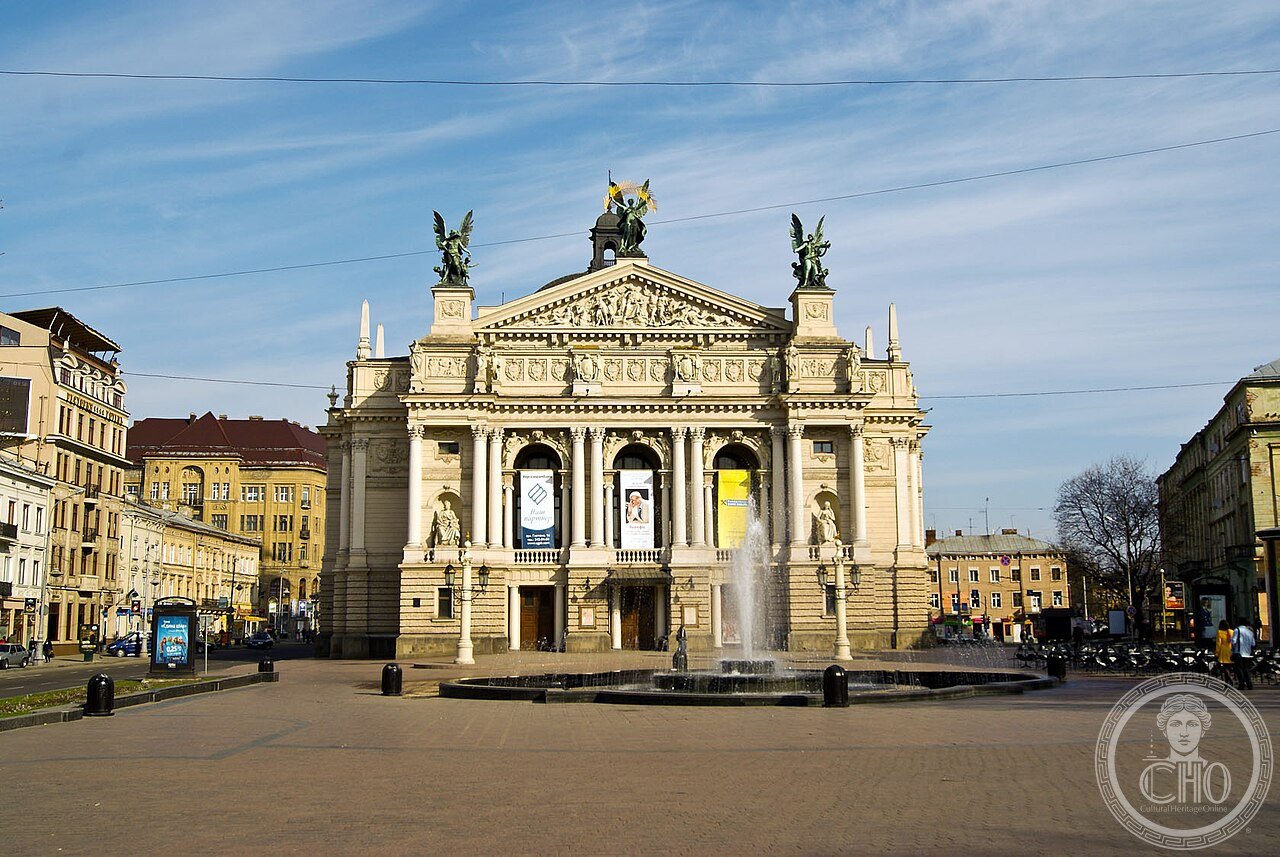
Lviv Theatre of Opera and Ballet
Designed by Polish architect Zygmunt Gorgolewski (1845–1903) and opened on 4 October 1900, this is the most celebrated opera house in Ukraine — a 1,100-seat monument to Habsburg cultural ambition set within a UNESCO World Heritage city.
At a glance
The Solomiya Krushelnytska Lviv National Academic Theatre of Opera and Ballet stands at the head of Svobody Avenue, the main boulevard of Lviv’s UNESCO-inscribed historic centre. Gorgolewski combined Renaissance Revival structure with Neo-Baroque decorative richness and incorporated Art Nouveau ornamental elements in the interior — an eclectic synthesis that places the building among the finest opera houses built in Central Europe at the turn of the twentieth century. The auditorium seats 1,100 and remains in continuous active use as both an opera house and ballet stage. Construction cost 2.4 million Austrian crowns and lasted three years, from the laying of the cornerstone in June 1897 to the gala opening in October 1900.
Key facts
- Built: 1897–1900 by Zygmunt Gorgolewski (1845–1903)
- Style: Renaissance Revival and Neo-Baroque with Art Nouveau elements
- Status: Active opera and ballet theatre, 1,100 seats; named after soprano Solomiya Krushelnytska since 2000
- Address: Svobody Avenue 28, Lviv 79008, Ukraine
- GPS: 49.84417, 24.02639 — Open in Google Maps
- UNESCO/Listed: Located within the UNESCO World Heritage historic centre of Lviv (inscribed 1998)
History
Gorgolewski submitted his competition entry under a false name from Leipzig — a strategic move in the politically charged atmosphere of Habsburg Galicia — and won the commission for what was then called the Grand Theatre of Lemberg (the German name for Lviv under Austrian rule). The building solved a formidable engineering problem: the site lay over the channelled Poltva River, making conventional foundations impossible. Gorgolewski instead employed a reinforced concrete base — the first time this technique had been used for a major European theatre, anticipating by years what became standard 20th-century practice. The gala opening on 4 October 1900 drew writer Henryk Sienkiewicz and composer Ignacy Jan Paderewski.
Under Soviet rule from 1939, the theatre was renamed multiple times: the Ivan Franko Lviv State Academic Theatre of Opera and Ballet from 1956. In April 1990, the first public performance of Ukraine’s national anthem since Soviet suppression took place on its stage — a moment of cultural defiance that preceded Ukrainian independence by a year. The centenary in 2000 prompted the renaming in honour of Solomiya Krushelnytska, the soprano born near Lviv in 1872 who became one of the great operatic voices of the early twentieth century.
Today the theatre is the flagship institution of Ukrainian lyric art and continues to perform a full season of opera and ballet productions, drawing international productions and soloists alongside its resident companies.
What you see
The exterior presents a layered facade of stone-clad pilasters, arched windows, and Corinthian columns rising to a crowning balustrade adorned with bronze allegorical statues representing Glory, Poetry, and Music. The stepped pediment and the richness of the stucco ornament give the building a sculptural mass unusual even among the great opera houses of Central Europe. Stand on Svobody Avenue and the theatre closes the visual axis of the boulevard with calculated theatrical effect.
Inside, the auditorium preserves its original horseshoe plan with tiered balconies, ornate stucco mouldings, oil paintings on the ceiling and box fronts, and gilded pilasters that frame the stage opening. The foyers retain marble floors and period plasterwork. The technical stage has been modernised over the decades, but the house itself remains substantially as Gorgolewski conceived it in 1897.
Practical information
- Active theatre: access via ticket purchase for performances; lobby viewable on performance evenings
- Performance season runs September through June; summer festival programming varies by year
- Guided tours available: daytime tours of the auditorium offered on selected days — check the theatre’s official website
- Estimated visit time: 3–4 hours for an evening performance; 1 hour for a daytime tour
Getting there
Lviv Danylo Halytskyi International Airport is approximately 6 km west; taxis reach the city centre in 15–25 minutes. The theatre stands on Svobody Avenue, a 12-minute walk from Lviv Central railway station. Trams 1, 6, and 9 serve the boulevard, with stops within 200 m of the theatre entrance.
Nearby
- Grand Hotel Lviv: The Neo-Baroque luxury hotel of 1894, a 3-minute walk south on Svobody Prospekt, shares the same Belle Époque boulevard streetscape.
- Rynok Square (Market Square): The UNESCO-listed medieval market square at the core of the old city, 8 minutes on foot from the theatre.
- Church of the Dominicans: A monumental Baroque church of the 18th century, a 7-minute walk into the old town fabric.
- Shevchenko Grove (Stryiskyi Park): A historic landscaped park designed for the 1894 provincial exhibition, 15 minutes south on foot.
Sources
Find it on the map
See this place and what’s around it →Events here — now on & upcoming
- Lviv National Opera — 2025-2026 Season21 Jun 2026 — 31 Aug 2026See the event →
Historical events at this place (1)
📷 Diventa un fotografo di Cultural Heritage Online
Condividi le tue foto dei luoghi: restano pubblicate con la tua firma come autore. Più vengono viste, più ti fai conoscere — e presto un concorso premierà le foto più apprezzate.
Accedi o registrati gratis per aggiungere una foto