
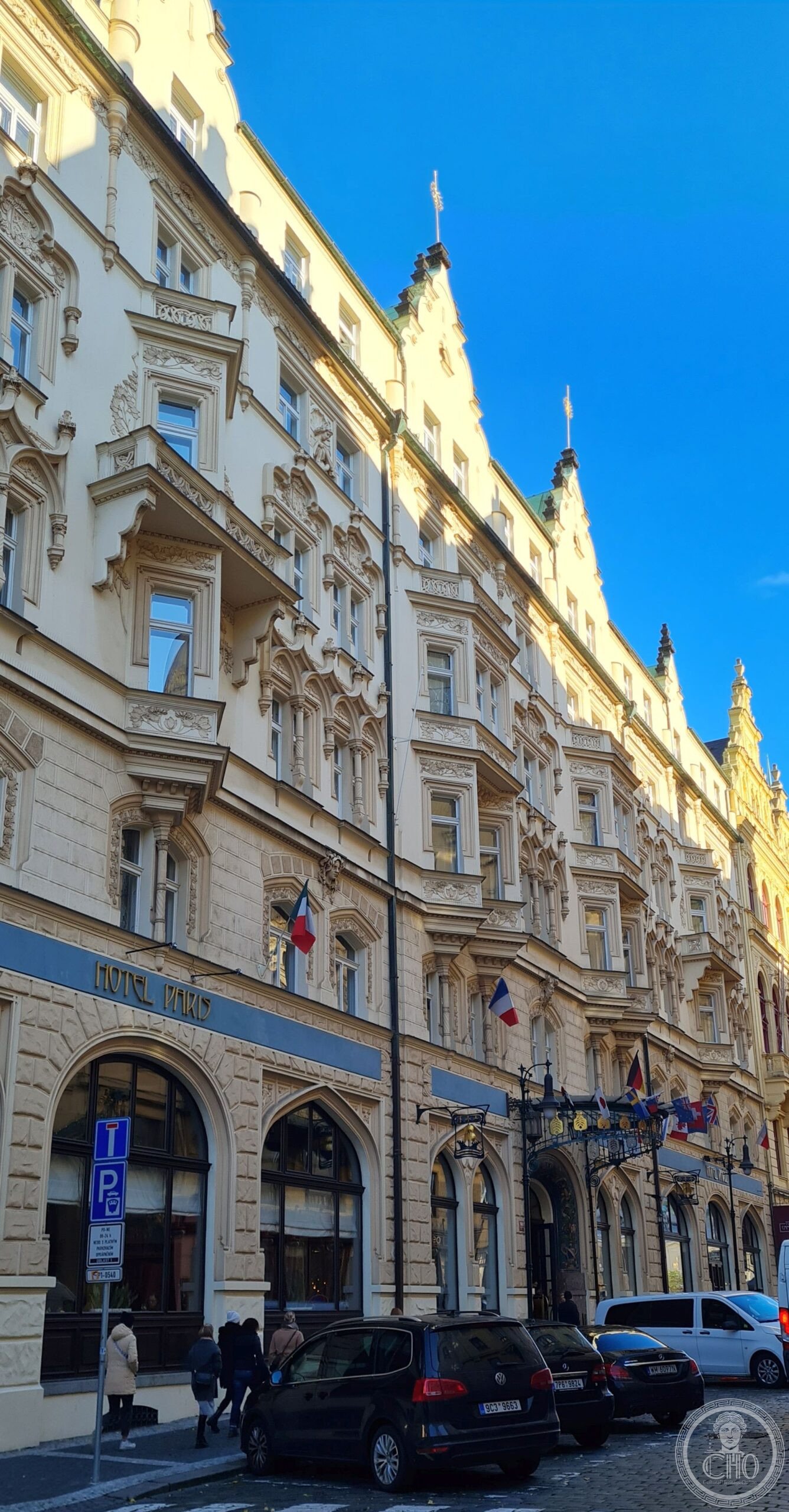
Where Art Nouveau sinuousness meets Gothic aspiration. Jan Vejrych’s 1904 tower hotel stands a street away from the Municipal House as one of Prague’s most coherent fin-de-siècle confections.
At a glance
Designed by Czech architect Jan Vejrych (1856–1926) and completed in 1904, Hotel Paris occupies a corner plot in Prague’s Old Town at U Obecního domu 1, steps from the celebrated Municipal House. The building fuses two currents that rarely share a wall: the organic ornamental vocabulary of Art Nouveau and the vertical energy of Neo-Gothic. Declared a Czech cultural monument in 1984, it has been owned by the Brandejs family for three generations and operates today as a five-star hotel with 86 rooms and suites. The building gained literary fame as the setting for Bohumil Hrabal’s novel I Served the King of England.
Key facts
- Built: 1904 by Jan Vejrych (1856–1926); interiors overseen by Antonín Pfeiffer
- Style: Art Nouveau with Neo-Gothic elements
- Status: Five-star hotel; Czech cultural monument (1984)
- Address: U Obecního domu 1, 110 00 Prague 1, Czech Republic
- GPS: 50.08822, 14.42711 — Open in Google Maps
- Listed: Czech Cultural Monument (designated 1984)
History
Jan Vejrych drew the plans for Hotel Paris at a moment when Prague’s bourgeoisie was commissioning buildings that announced civic confidence at every cornice. Completed in 1904, the hotel opened as a luxury address in the Staré Město district, its corner position on U Obecního domu giving maximum street presence. The ceramic mosaics that decorate the restaurant interior were created by painter Josef Köhler, whose work gives the ground-floor dining spaces a warmth that no later renovation has erased.
The hotel passed through the turbulence of the 20th century and, after the Velvet Revolution of 1989, was restituted to its pre-communist owners. In 1991 the Czech government returned the property to the Brandejs family, in whose hands it remains. The 1984 cultural monument designation had already protected the building from the homogenising pressures of the socialist era.
Literary renown arrived through Bohumil Hrabal, who used the hotel as a central location in I Served the King of England (1971) — a novel later adapted as an internationally released film. The association has made Hotel Paris a pilgrimage point for readers as well as architecture enthusiasts.
What you see
The corner tower is the building’s signature: its peaked Neo-Gothic crown pulls the eye upward while the floors below unfurl in Art Nouveau curves — foliate ironwork, arched windows with etched glass, and brass detailing that glints in Prague’s morning light. The facade combines render and stone in a palette of warm ochre and grey, anchoring the composition to the Old Town’s historic street scale without retreating into pastiche.
Inside, the staircase with its decorative iron railing and the Café de Paris retain much of their original atmosphere. Etched glass mirrors, mosaic floors, and Josef Köhler’s ceramic panels in the restaurant create an interior that feels continuous with the building’s exterior ambitions — ornament not as addition but as structure.
Practical information
- Hotel guests only for rooms; the restaurant and café are open to the public
- Best visited in spring (April–May) or autumn (September–October) to avoid peak tourist crowds
- Architectural tours of the building can be arranged through the hotel concierge
- Allow 30–45 minutes to appreciate the public interior spaces
Getting there
Václav Havel Airport Prague (PRG) is 17 km west of the city centre; the Airport Express bus connects directly to Náměstí Republiky metro station (line B), a 3-minute walk from the hotel. The Municipal House (Obecní dům) is immediately adjacent; the Old Town Square is 400 m on foot.
Nearby
- Municipal House (Obecní dům) — immediately adjacent; Prague’s finest Art Nouveau civic building (1912), with interiors by Alfons Mucha and Karel Špillar
- Powder Tower (Prašná brána) — 50 m; 15th-century Gothic gate tower marking the edge of the medieval Old Town
- Old Town Square — 400 m; the historic heart of Prague with the Astronomical Clock and Church of Our Lady before Týn
- Josefov (Jewish Quarter) — 600 m; six surviving synagogues and the Old Jewish Cemetery, a UNESCO-listed ensemble
Sources
Find it on the map
See this place and what’s around it →📷 Become a Cultural Heritage Online photographer
Share your photos of places: they stay published under your name as the author. The more they're seen, the more you get noticed — and soon a contest will reward the most appreciated photos.
Log in or sign up free to add a photoIs this page about you?
This page is read by travellers and heritage enthusiasts who find it on Google. Tell us how you are connected to this place and we will take it from there.