
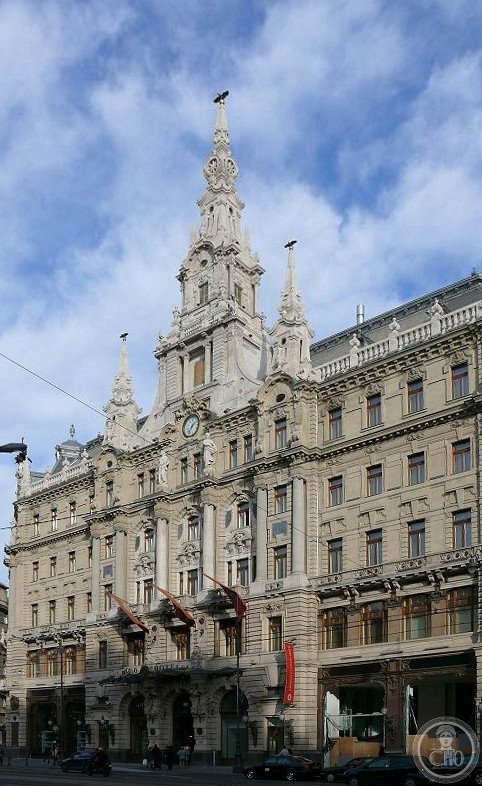
Alajos Hauszmann’s 1894 insurance palace on the Grand Boulevard holds one of Europe’s most celebrated café interiors — a gilded room that fed generations of Hungarian writers and poets.
At a glance
Commissioned by the New York Life Insurance Company and designed by Alajos Hauszmann with collaborators Flóris Korb and Kálmán Giergl, the palace opened on 23 October 1894 on the newly laid Erzsébet körút. The building combines eclectic historicism with Belle Époque exuberance: its multi-storey façade, sculptural programme by Károly Senyei, and the legendary New York Café on the ground floor made it a social and intellectual hub from the first day of opening. Today it operates as the Anantara New York Palace Budapest, a five-star hotel under Minor Hotels, while the café remains one of the city’s most visited heritage interiors.
Key facts
- Built: 1891–1894 by Alajos Hauszmann, Flóris Korb, and Kálmán Giergl
- Style: Belle Époque / Eclectic historicism
- Status: Luxury hotel (Anantara New York Palace, 185 rooms) with ground-floor café open to the public
- Address: Erzsébet krt. 9–11, Budapest 1073, Hungary (7th district)
- GPS: 47.4986, 19.0705 — Open in Google Maps
- UNESCO/Listed: No individual national listing confirmed
History
The New York Life Insurance Company, expanding aggressively into European markets in the 1890s, selected the most prominent stretch of Budapest’s emerging ring boulevard for its Hungarian headquarters. Hauszmann — already well known in Budapest for work on the Royal Palace — led the design team, delivering a structure whose ground-floor café became an immediate fixture of the city’s literary and journalistic life. Writers reportedly threw the café’s keys into the Danube on opening night so it could never close.
The Second World War damaged the building, and communist nationalisation in the years following saw the café renamed the Hungaria in 1954. The palace deteriorated steadily through the People’s Republic era. After 1989 it reverted to its original name. Boscolo Hotels purchased the property in 2001 for $8 million and funded a comprehensive restoration, reopening it on 5 May 2006 as the Boscolo Budapest. In 1957, Hungarian sculptors had carved replacement allegorical figures representing Thrift, Wealth, America and Hungary to replace war-damaged originals. Ownership passed through The Dedica Anthology and Covivio before Minor Hotels rebranded the hotel under the Anantara name in November 2021.
The New York Café retains its status as one of Budapest’s defining interiors, attracting visitors who come solely to take coffee beneath its frescoed ceiling.
What you see
The façade on Erzsébet körút rises across multiple storeys in a composition that layers Renaissance revival, Baroque and late 19th-century ornamental detail. Sculptor Károly Senyei’s programme covers the exterior with carved figures, masked keystones and — most characteristically — sixteen faun faces that mark the boundaries of the ground-floor arcade. The corner tower gives the building vertical punctuation on the boulevard, and large windows illuminate the café below street level from the arcade openings.
Inside the New York Café, a double-height hall opens through colonnaded galleries painted in ochre and gold, with frescoed vaults, marble tables and gilded ironwork that has survived more than a century of use, war and renovation. The hotel floors above retain high ceilings and period proportions, finished with Murano glass chandeliers, silk drapery and marble bathrooms that reference the original luxury of the insurance palace.
Practical information
- New York Café open daily to the public; hotel access for guests only
- Spring and early autumn recommended — the boulevard is pleasant for walking and the café less crowded than peak summer
- Guided heritage tours of the café available; check with concierge for architectural group visits
- Estimated visit time: 1–2 hours for the café and exterior; overnight stay for full hotel experience
Getting there
Budapest Ferenc Liszt International Airport is roughly 10 km east; the Airport Shuttle (100E) reaches Keleti railway station in about 30 minutes. From Keleti, the Erzsébet körút is a short walk or one stop on Metro line M4 to Kelvin tér. The palace stands on the Grand Boulevard at the junction of Akácfa utca, easily identifiable by its ornate corner tower. Tram lines 4 and 6 run along the boulevard and stop directly outside.
Nearby
- Dohány Street Synagogue (1859) — Europe’s largest synagogue, a ten-minute walk south-west into the 7th district
- Keleti Railway Station (1884) — the grand eclectic terminus five minutes on foot to the north-east, with its own sculptural programme
- Rumbach Street Synagogue (1872) — Moorish-revival gem by Otto Wagner, eight minutes’ walk into the Jewish Quarter
- Hungarian State Opera House (1884) — Miklós Ybl’s neo-Renaissance opera house, fifteen minutes west along Andrássy út
Sources
Find it on the map
See this place and what’s around it →📷 Become a Cultural Heritage Online photographer
Share your photos of places: they stay published under your name as the author. The more they're seen, the more you get noticed — and soon a contest will reward the most appreciated photos.
Log in or sign up free to add a photoIs this page about you?
This page is read by travellers and heritage enthusiasts who find it on Google. Tell us how you are connected to this place and we will take it from there.