
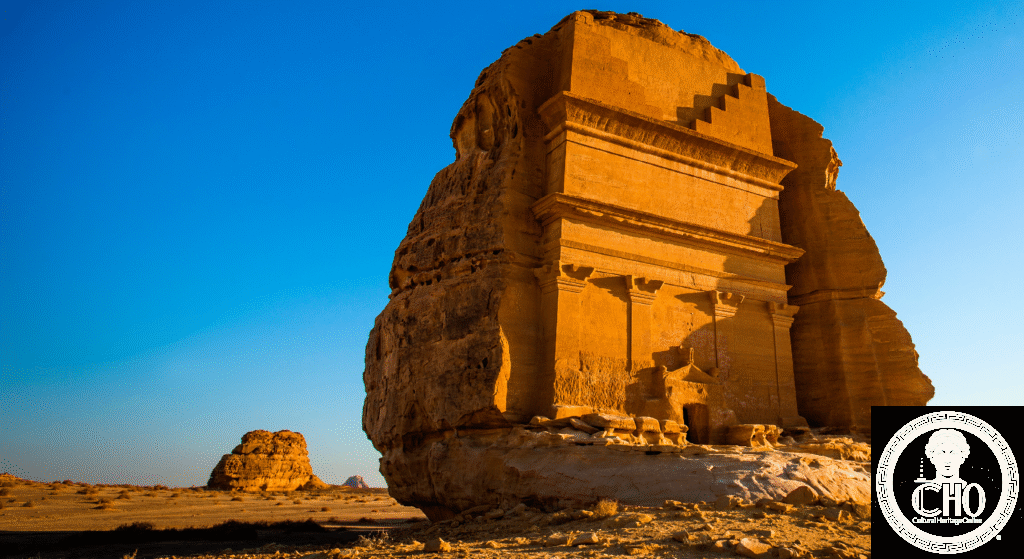
Carved into isolated sandstone outcrops across the open desert of AlUla, Al-Hijr preserves 131 monumental Nabataean tomb facades, more than at Petra itself. Closed to almost all outsiders for most of the twentieth century, it became accessible to international visitors only in 2020, making it one of the least known great archaeological sites of Arabia.
At a glance
Al-Hijr, also called Hegra or Madain Salih, was the second city of the Nabataean kingdom after Petra, and served as the administrative and commercial centre for the Hejaz section of the incense road. Its 131 rock-cut tomb facades are carved into around a hundred free-standing sandstone outcrops rising from the desert floor, rather than clustered in a single valley as at Petra, giving the site an unusually open and dramatic setting.
The facades range from small, plain cuts to the 22-metre Qasr al-Farid, the largest and most photographed tomb at Al-Hijr, left unfinished when the site was abandoned. Around 2,000 Nabataean inscriptions survive here, more than at any other Nabataean site, recording tomb owners’ names, construction dates and penalties for disturbing the graves.
Key facts
- Civilisation: Nabataean kingdom, an Arab trading power controlling caravan routes through the Hejaz and Negev deserts, with its capital at Petra.
- Role of Al-Hijr: second city of the kingdom and hub for the incense trade, carrying frankincense and myrrh from southern Arabia and the Horn of Africa to the Mediterranean.
- End of the kingdom: annexed by Rome as the Province of Arabia Petraea in 106 CE, under Emperor Trajan, after the death of the last Nabataean king, Rabel II, without an heir.
- UNESCO status: inscribed as a World Heritage Site in 2008, the first in Saudi Arabia.
- Modern access: opened to international visitors in October 2020 as part of the Saudi Vision 2030 programme and the development of AlUla by the Royal Commission for AlUla.
History
Al-Hijr carries a complicated relationship with Islam. The Quran, in Surah Al-Hijr, names the site as the home of the Thamud, a pre-Islamic people said to have been punished for rejecting the prophet Salih. It also records that the Prophet Muhammad passed through during the Tabuk expedition in 628 CE and instructed his companions not to drink or reuse the water, to cover their faces and to move on quickly. This passage was long invoked to justify avoiding the site, and Saudi religious authorities discouraged tourism here for decades.
For most of the twentieth century the area was effectively closed to non-Saudis, accessible only to nationals and to archaeologists under special permit. Its opening to international visitors in 2020 marked the first time in Saudi history that a pre-Islamic site was officially promoted as a tourist destination, part of a wider push to diversify the economy through the AlUla valley’s heritage and luxury tourism infrastructure.
What you see
The tomb facades follow a recognisable progression. The simplest are flat-cut rock faces with a single plain chamber. The standard Nabataean type is tripartite, with a base zone, a middle zone holding the entrance portal flanked by pilasters or engaged columns, and an upper zone crowned by the characteristic stepped crow-step parapet. The most elaborate tombs carry a double cornice, Doric friezes with triglyphs and metopes, and carved lion and eagle protomes at the upper corners, reflecting the Hellenistic influences absorbed into Nabataean funerary architecture.
Inside, the burial chambers are simple rectangular cuts lined with niches, or loculi, for coffins, some tombs holding as many as twenty-six. Many chambers retain their inscribed stone door slabs, naming the owner and warning against violation of the tomb under threat of a fine.
Practical information
- Booking: entry to the Hegra site requires advance booking, arranged through the official AlUla Experience channel.
- Season: the Heritage Season, running roughly December to March, is when the main events, concerts and guided experiences take place; summer months are extremely hot and not recommended for visiting.
- On site: tombs are spread across a wide desert area, and visits are conducted by guided electric golf cart; sunset and stargazing tours are also offered.
- Accommodation: options in AlUla include eco-resort tented accommodation near the palm grove, along with other resorts in the valley.
Getting there
AlUla is served by its own airport, with direct connections from Riyadh and Jeddah, both of which have onward international links. Entry to the archaeological site itself should be booked in advance through the official AlUla channel before travelling.
Nearby
- AlUla Old Town — around 20 km south, a mud-brick town inhabited until 1983 and now under restoration, with its old mosque, original mihrab and fortified hilltop.
- Dadan — around 22 km south, capital of the earlier Lihyanite kingdom, known for its rock-cut lion statues and the Temple of Dhu-Ghabat; it forms part of the wider AlUla archaeological landscape.
Sources
- Wikipedia, Hegra
- Wikipedia, Nabataeans
- Wikipedia, AlUla
- UNESCO, Hegra Archaeological Site (Al-Hijr/Madâin Sâlih), WHS reference 1293
Find it on the map
See this place and what’s around it →📷 Become a Cultural Heritage Online photographer
Share your photos of places: they stay published under your name as the author. The more they're seen, the more you get noticed — and soon a contest will reward the most appreciated photos.
Log in or sign up free to add a photoDo you manage this place?
This page is read by travellers and heritage enthusiasts who find it on Google. Keep it accurate — and make it work for you. Free for non-profit heritage institutions.