
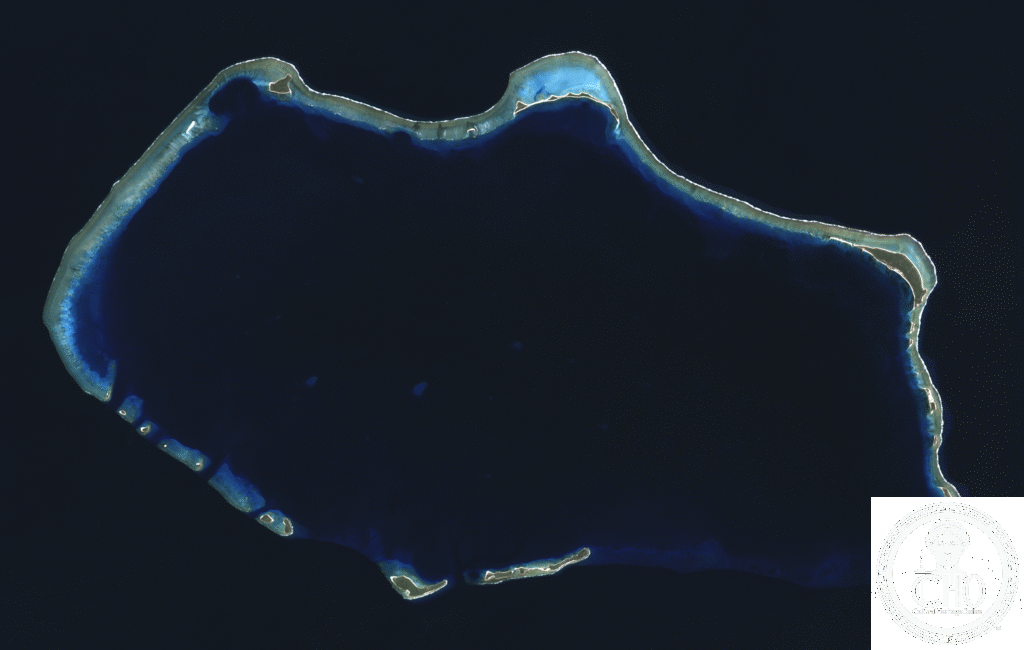
Bikini Atoll Nuclear Test Site

Bikini Atoll Marshall Islands nuclear test site Baker detonation UNESCO World Heritage
Bikini Atoll (the lagoon of Bikini Atoll seen from above; the chain of low sandy islands surrounding the central lagoon; the coral reef structure visible through the clear turquoise water; the wrecks of the nuclear test fleet (the USS Saratoga, the HIJMS Nagato, the USS Arkansas) lying on the lagoon floor at 50-60m depth; the craters on the lagoon floor left by the 23 nuclear detonations between 1946 and 1958 CE; the islands largely uninhabited due to residual radioactive contamination), Bikini Atoll, Micronesia, Republic of the Marshall Islands. UNESCO World Heritage Site 2010. Photo via Wikimedia Commons.
Republic of the Marshall Islands, Micronesia · 23 nuclear detonations 1946-1958; the Castle Bravo test (15 megatons; the largest US detonation); the world’s most famous wreck dives; uninhabited; UNESCO WHS 2010

Bikini Atoll Nuclear Test Site

The most consequential nuclear test site in history and one of the most haunting cultural landscapes on Earth — Bikini Atoll (Republic of the Marshall Islands; a coral atoll in the western Pacific; 23 nuclear bomb tests conducted 1946-1958; currently uninhabited due to residual radioactive contamination) is a UNESCO World Heritage Site that commemorates simultaneously the dawn of the nuclear age, the displacement of the Bikini people, and the birth of the environmental consciousness that created modern international law.

At a glance

Bikini Atoll (the most precisely Bikini single 23 nuclear tests 1946-1958 Operation Crossroads Castle Bravo 15 megatons largest US detonation Cold War nuclear age UNESCO heritage: the sequence of nuclear tests at Bikini Atoll: Operation Crossroads (1946; 2 tests — the first, Able, was an aerial burst; the second, Baker, was the first underwater nuclear detonation; the Baker shot created the distinctive mushroom-cloud-and-water-column image that became the defining visual image of the nuclear age; 95 target ships including the Japanese battleship Nagato and the USS Saratoga); the Castle series (1954; including Castle Bravo (the largest atmospheric detonation in US history; 15 megatons; 1,000 times more powerful than the Hiroshima bomb; the unexpectedly large explosion contaminated 18,000 km² of ocean with radioactive fallout; the Rongelapese people (the Marshall Islanders of nearby Rongelap Atoll) received fatal doses of radiation; the USS Lucky Dragon (the Japanese tuna fishing vessel; contaminated crew members; one died; the Lucky Dragon incident triggered the worldwide anti-nuclear testing movement that led to the 1963 Partial Nuclear Test Ban Treaty)) — the most precisely Bikini single 23 nuclear tests 1946-1958 Operation Crossroads Castle Bravo 15 megatons largest US detonation Cold War nuclear age UNESCO heritage in any UNESCO world heritage site; the displacement of the Bikini people (the most precisely Bikini single Bikini Islanders 167 people displaced 1946 King Juda US request sacrifice “for the good of mankind” Rongerik radiation exile heritage: in February 1946, US Navy Commodore Ben Wyatt visited Bikini Atoll and asked the 167 Bikinian people (through their king, Juda) to leave their homeland for “the good of mankind and to end all world wars”; King Juda, comparing himself to the biblical Moses leading his people into the wilderness, agreed; the Bikinians were relocated to Rongerik Atoll (150 km away); Rongerik was far too small to support 167 people and nearly starved; the Bikini Islanders have been relocated six times since 1946 and have never permanently returned to Bikini) — the most precisely Bikini single Bikini Islanders 167 people displaced 1946 King Juda US request sacrifice “for the good of mankind” Rongerik radiation exile heritage in any UNESCO world heritage site)).

Key facts

  • The Wreck Diving: the most precisely Bikini single USS Saratoga HIJMS Nagato USS Arkansas wreck diving 50-60m lagoon nuclear ghosts radioactive fish coral growth heritage — the Bikini lagoon contains the most historically significant concentration of shipwrecks in the world: the USS Saratoga (CV-3; the American aircraft carrier; 271m long; sunk by the Baker nuclear blast; lies at 50m depth; the aircraft hangar still contains aircraft; the flight deck at 30m; one of the greatest wreck dives in the world); the HIJMS Nagato (the Japanese battleship; the flagship from which Admiral Yamamoto ordered the attack on Pearl Harbor; sunk by Baker; 222m long; lies at 50m depth in an inverted position); the USS Arkansas (BB-33; the American battleship; the oldest ship in the test fleet (commissioned 1912); sunk by Baker; 162m long; lies at 55m); coral has grown extensively over the wrecks (they are now reefs as well as wrecks); the fish population is abundant (many species have recolonized the lagoon) though some predatory species carry elevated cesium-137 levels
  • The Bikini Swimsuit: the most precisely Bikini single bikini swimsuit Louis Réard 1946 nuclear explosion comparison cultural impact Cold War fame heritage — the bikini swimsuit was named after Bikini Atoll: French designer Louis Réard introduced the two-piece swimsuit on July 5, 1946 CE — exactly four days after the Able nuclear test at Bikini; Réard named the design after the atoll because he believed the design would create an “explosive reaction” comparable to the atomic bomb; the naming proved accurate — the design was considered scandalously revealing in 1946 (the French fashion model who agreed to wear it at the first public showing was a nude dancer (no professional model would agree)); the connection between the swimsuit name and the nuclear test site is one of the stranger cultural legacies of the Cold War
  • GPS: 11.5500° N, 165.3800° E

History

Castle Bravo and the test ban movement (the most precisely Bikini single 1954 Castle Bravo 15 megatons Rongelap fallout Lucky Dragon Japanese tuna boat radiation test ban 1963 PTBT heritage: the Castle Bravo test of March 1, 1954 CE was the most consequential of the Bikini nuclear tests: the bomb produced 15 megatons (the scientists had predicted 4-8 megatons; the unexpectedly large yield was caused by an error in calculating the contribution of lithium-7 to the explosion); the fallout cloud contaminated 18,000 km² of ocean; the 23 inhabitants of Rongelap Atoll (evacuated 2 days after the test when they showed symptoms of radiation sickness) received the equivalent of 500 days of natural background radiation in a single exposure; the crew of the Japanese fishing boat Lucky Dragon No. 5 (23 men; fishing 160 km from Bikini) received severe radiation doses; one crew member died; the Lucky Dragon incident created massive public outrage in Japan (still sensitive about nuclear weapons post-Hiroshima/Nagasaki); the global movement that followed Castle Bravo led directly to the 1963 Partial Nuclear Test Ban Treaty (which banned atmospheric, underwater, and space nuclear tests) — the most precisely Bikini single 1954 Castle Bravo 15 megatons Rongelap fallout Lucky Dragon Japanese tuna boat radiation test ban 1963 PTBT heritage in any UNESCO world heritage site)).

What you see

Diving expeditions (the most precisely Bikini single live-aboard dive boat expeditions Kwajalein Marshall Islands permit required nuclear crater wreck diving Saratoga Nagato heritage: Bikini Atoll is uninhabited and accessible only by live-aboard dive boat expeditions (no regular transport; the expeditions are organized by specialist dive operators approximately 3-4 times per year; capacity approximately 15-20 divers per expedition); the standard approach: fly to Majuro (Marshall Islands capital; United Airlines Island Hopper) then to Kwajalein (US military base; civilian access complicated) or to Roi-Namur; then take the dive boat to Bikini (2-3 days at sea); the expedition (approximately 10-14 days; USD 5,000-8,000/person including flights to Majuro); the wreck dives (the Saratoga at 30-50m is the highlight; experienced divers only; decompression diving; maximum depth 60m; visibility typically 30-40m); the lagoon also has the nuclear test craters (visible on the lagoon floor at 180m — too deep to dive but visible from the surface by the shadow) — the most precisely Bikini single live-aboard dive boat expeditions Kwajalein Marshall Islands permit required nuclear crater wreck diving Saratoga Nagato heritage in any UNESCO world heritage site)).

Practical information

  • Getting there: the Marshall Islands (the Republic of the Marshall Islands (RMI)) is most easily reached via the United Airlines Island Hopper from Honolulu (stops at Johnston Atoll, Majuro, Kwajalein, Kosrae, Pohnpei, Chuuk, Guam; Majuro Atoll stop); RMI citizens and US citizens do not need a visa; other nationalities need a visa (apply in advance); the Bikini Atoll expedition is not a standard tourist trip — it requires booking with a specialist operator (Bikini Atoll Divers; the only licensed dive operator for the site); the Bikini islanders who now live on Ejit Island (near Majuro) receive a portion of the dive permit fees; swimming and snorkelling in the lagoon are permitted though some fish species should not be eaten due to residual cesium-137

Getting there

Majuro via United Island Hopper from Honolulu. Live-aboard expedition USD 5,000-8,000. Specialist operator (Bikini Atoll Divers). 10-14 days. GPS: 11.5500, 165.3800.

Nearby

  • Majuro Atoll — 900 km southeast; the capital of the Marshall Islands (the most densely populated atoll in the Pacific; the entire population living on a strip of land 3m above sea level; the existential threat of sea-level rise for the Marshall Islands (the government has formally acknowledged that the entire nation may become uninhabitable within 50 years); the Alele Museum (the Marshallese navigation stick charts — the extraordinary indigenous Pacific navigation system using curved sticks bound together to represent wave patterns around islands); the Marshallese food market)
  • Rongelap Atoll — 300 km northwest; the atoll contaminated by Castle Bravo fallout in 1954 (the Rongelap people were evacuated in 1985 CE by Greenpeace (the Rainbow Warrior; the famous Greenpeace vessel); despite a UN-funded cleanup in the 1990s, Rongelap remains only partially resettled due to ongoing cesium-137 contamination in the food chain)

Sources

  • Wikipedia, Bikini Atoll; Castle Bravo; Lucky Dragon No. 5, accessed June 2026
  • UNESCO, Bikini Atoll Nuclear Test Site, WHS reference 1339, inscribed 2010

Hero image: Bikini Atoll, Marshall Islands, Wikimedia Commons. Editorial text © Cultural Heritage Online, 2026.

📷 Diventa un fotografo di Cultural Heritage Online

Condividi le tue foto dei luoghi: restano pubblicate con la tua firma come autore. Più vengono viste, più ti fai conoscere — e presto un concorso premierà le foto più apprezzate.

Accedi o registrati gratis per aggiungere una foto
📋 Copy & share on social
Scroll to Top