

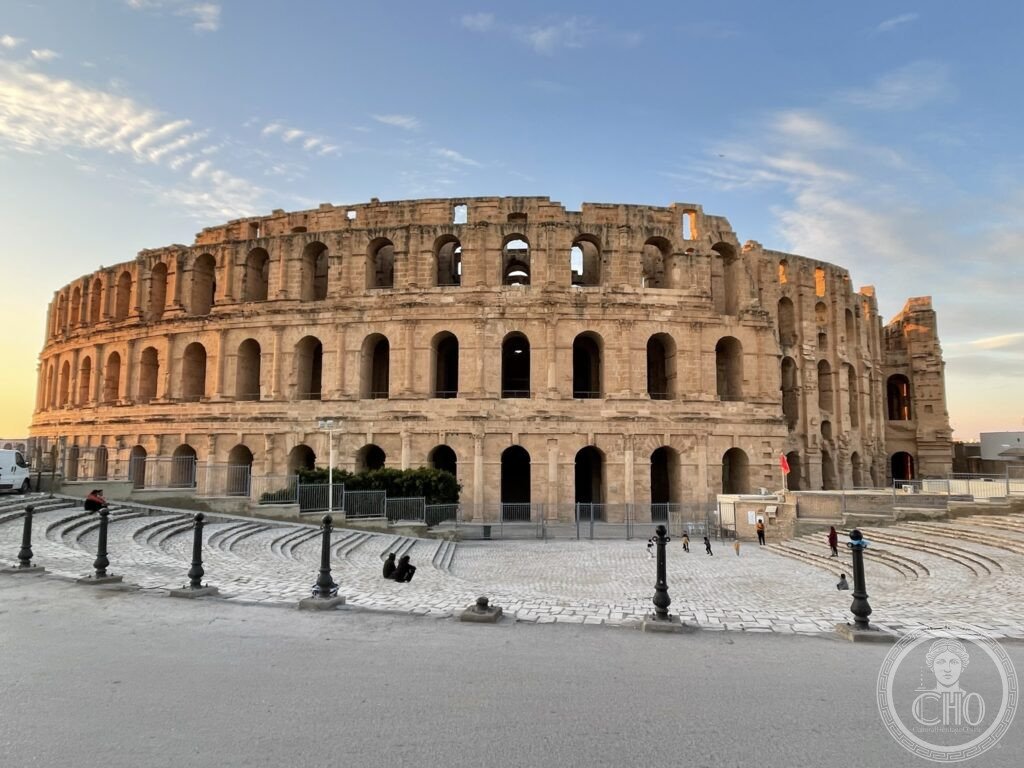
The amphitheatre of El Djem rises unexpectedly from the flat olive groves of central Tunisia, the third-largest ever built and the most completely preserved Roman amphitheatre anywhere outside the Colosseum. It stands as the last great monument of Thysdrus, once the wealthiest city in Roman Africa after Carthage.
At a glance
The amphitheatre was built around 230–238 CE, though the exact date remains debated among historians. Its construction coincided with the peak prosperity of Thysdrus, a city whose wealth rested on the olive oil trade and which ranked second only to Carthage among the cities of Roman Africa. With an exterior measuring 148 by 122 metres and a capacity of around 35,000 spectators, it is the largest amphitheatre in Africa and the third-largest in the Roman world, after the Colosseum in Rome and the amphitheatre at Capua.
In March 238 CE, during the chaotic Year of Six Emperors, the elderly proconsul Marcus Antonius Gordianus Sempronianus, known to history as Gordian I, was proclaimed emperor here by local aristocrats in revolt against the emperor Maximinus Thrax. He was around 79 at the time, making him the oldest man ever to become Roman emperor. His reign lasted only three weeks: his son Gordian II died in battle at Carthage, and Gordian I took his own life shortly afterwards.
Key facts
- Date: built c.230–238 CE, under the later Severan or early Gordian period.
- Scale: exterior 148m × 122m, three tiers of 64 arches each, original height around 36m, capacity roughly 35,000.
- The hypogeum: two parallel underground corridors around 70 metres long beneath the arena floor, used for animals and gladiators awaiting the games, with trap doors that once raised cages to the surface.
- Thysdrus and olive oil: the ancient city was a major centre of the Roman olive oil trade, its wealth reflected in the amphitheatre and in mosaics now held at the Bardo National Museum in Tunis.
- Location: 35.2961° N, 10.7065° E.
History
After the fall of the Western Roman Empire in 476 CE, the amphitheatre was converted into a Byzantine fortress, with part of the arena walled off to form a defensive compound. In the late 7th century, during the final phase of Berber resistance to the Arab conquest of North Africa, the structure is thought to have been used as a stronghold by the Berber leader known as Al-Kahina, whose coalition held off the Arab advance for several years before her defeat around 703 CE.
In 1695, the Bey of Tunis ordered part of the amphitheatre demolished so its cut stone could be reused in the construction of a mosque elsewhere in Tunisia. The missing section, roughly a third of the original building, left the structure looking as though it had been sliced open, and it is this exposed cross-section that visitors see today alongside the three intact sides.
What you see
Three sides of the amphitheatre still rise almost to their original height, their three tiers of arches divided by Corinthian pilasters. The fourth, demolished side reveals the vaulted corridors that once carried spectators to their seats, built in stone and concrete construction typical of large Roman public buildings.
The arena floor, measuring 60 by 38 metres, is now covered with gravel and sand, with the central drain and the positions of the old trap doors still visible. Below it, the hypogeum can be explored along its full length from the museum entrance, its two corridors giving a direct sense of the cramped, unseen world of animals and performers beneath the games above.
Practical information
- Combined ticket: a single ticket covers the amphitheatre and the nearby archaeological museum; check current prices and hours through the site’s official channels before visiting.
- Museum: the El Djem Archaeological Museum, about 400 metres from the amphitheatre, occupies a former governor’s palace and holds one of the most important Roman mosaic collections after the Bardo, alongside in situ floor mosaics in excavated villas next door, including the Villa of Afrika and the Villa of the Procession of Venus.
- Festival: the International Festival of Symphonic Music brings orchestral concerts into the arena in late summer.
- Coordinates: 35.2961° N, 10.7065° E.
Getting there
El Djem lies around 200 kilometres south of Tunis on the Tunis–Sfax railway line, with the station a short walk from the amphitheatre; the journey passes through the olive groves of the Sahel region. It can also be reached from Sfax, roughly two hours away by road or a shorter journey by train or shared taxi. Current timetables and fares are best checked directly with the Tunisian national rail operator.
Nearby
- Dougga — about 110 kilometres north, roughly two hours by car; a UNESCO World Heritage Site since 1997, and the best-preserved Roman city in Africa, with its Capitol, theatre, forum and Libyco-Punic mausoleum.
- Mahdia — about 60 kilometres east, roughly one hour by car; a coastal town founded by the Fatimid caliph Al-Mahdi Billah in 916 CE, with its fortified medina entrance, the Skifa el-Kahla, and a long sandy beach.
Sources
- Wikipedia, Amphitheatre of El Jem.
- Wikipedia, Thysdrus.
- Wikipedia, Gordian I.
- UNESCO, Amphitheatre of El Jem, WHS reference 38.
Find it on the map
See this place and what’s around it →📷 Become a Cultural Heritage Online photographer
Share your photos of places: they stay published under your name as the author. The more they're seen, the more you get noticed — and soon a contest will reward the most appreciated photos.
Log in or sign up free to add a photoIs this page about you?
This page is read by travellers and heritage enthusiasts who find it on Google. Tell us how you are connected to this place and we will take it from there.