

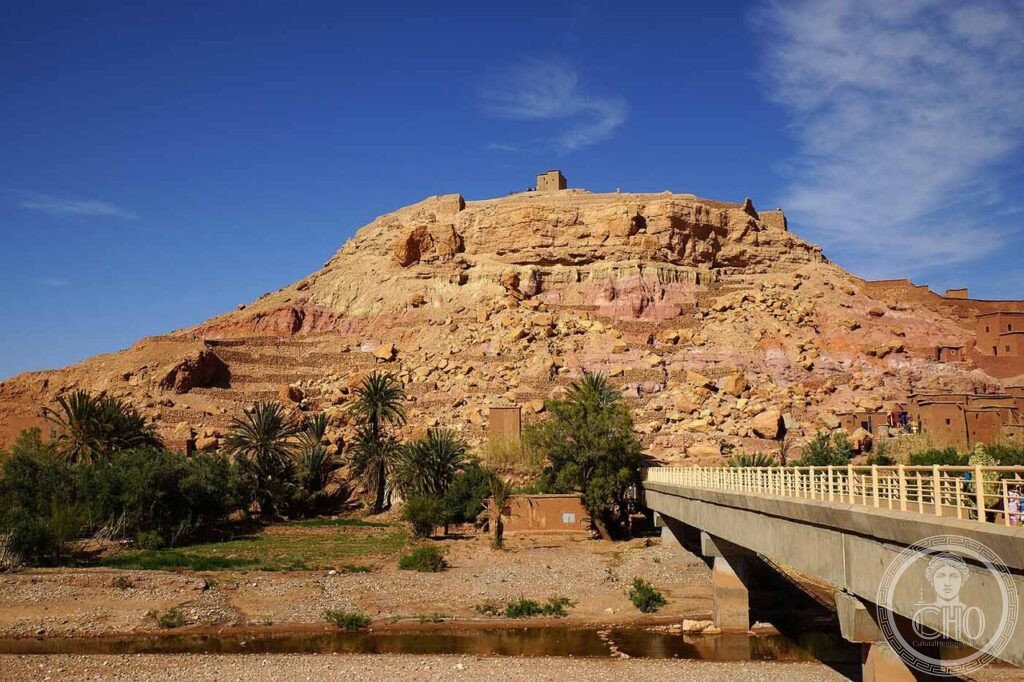
A fortified village of earthen kasbahs and granary towers rising above the Ounila River, Aït-Benhaddou survives as one of the finest examples of pre-Saharan mud-brick architecture in Morocco. Once a staging post on the trans-Saharan caravan route, it is now inhabited by only a handful of families and has become one of the country’s most filmed landscapes.
At a glance
Aït-Benhaddou is a ksar, the Berber term for a collective fortified village, built from pisé, adobe and straw on a rocky hill above the Ounila River in Ouarzazate Province. Its kasbahs rise four to six storeys, their facades decorated with geometric patterns worked in clay bas-relief, while a granary tower, the agadir, crowns the hill. A single fortified gate and corner towers formed the original defensive system. Today only four families still live within the walls, the rest of the community having moved to the modern village across the river.
Key facts
- Type: fortified collective village (ksar) of kasbahs and granaries
- Materials: pisé (rammed earth), adobe and straw
- Founded: around the 11th century, during the Almoravid period
- Residents: four families remain inside the ksar; the wider area has a population of roughly 3,000, mostly across the river
- Recognition: UNESCO World Heritage Site, inscribed 1987
History
The Ounila Valley formed part of a trans-Saharan caravan route linking the Draa Valley oases across the Atlas Mountains to Marrakech, along which gold, salt, ivory and other goods moved north from West Africa. Aït-Benhaddou served as a fortified staging point on this route, a relay between the Saharan caravanserais and the markets of Marrakech, and was founded around the 11th century during the Almoravid period.
In the early 20th century the ksar came under the administration of the Glaoui family, the Berber lords who controlled the Atlas passes and much of southern Morocco’s caravan routes during the French Protectorate era. It was maintained as part of their wider network of Atlas kasbahs.
What you see
Visitors approach from the modern village on the opposite bank, crossing the Ounila River by ford or footbridge before entering the ksar itself, which functions as a living settlement rather than a museum. A path climbs through narrow alleys between the kasbahs to the summit, where the agadir, the collective granary, offers views over the ksar, the valley and the plains beyond. The pisé walls, layered with straw, wood and animal hair and up to a metre and a half thick, take on the ochre tones of the surrounding landscape and are especially striking in low light.
Practical information
- Entry: there is no formal admission fee, though donations to the families living within the walls are customary; check current arrangements with local guides or official tourism channels
- Best times to visit: early morning and late afternoon, when the light brings out the red-ochre colour of the earth
- River crossing: the Ounila is usually shallow or dry for much of the year but can rise substantially in the wetter summer months
- Conservation: the pisé walls require regular replastering to withstand seasonal rain, and restoration work has been ongoing since the early 1990s
Getting there
Aït-Benhaddou lies a short drive from Ouarzazate, which has its own airport with connections to Casablanca and Marrakech. It also sits on the classic overland route between Marrakech and the Sahara, reached via the Tizi n’Tichka pass, and is a common stop for travellers touring the Draa Valley and the southern desert.
Nearby
- Ouarzazate — a short distance east, the regional base known as the gateway to the desert, home to the Taourirt Kasbah and the Atlas Studios, one of the world’s largest film studios, with sets from past productions kept on permanent display
- Draa Valley — south of Ouarzazate, the longest palm oasis valley in Morocco
- Tizi n’Tichka Pass — north on the road to Marrakech, the highest paved mountain pass in Africa, with views over the High Atlas
- Telouet — a detour south of the pass, the former personal kasbah of Thami El Glaoui, partly open to visitors, notable for its tilework and stucco interiors
Sources
- Wikipedia, Ksar of Aït-Ben-Haddou
- Wikipedia, Ouarzazate
- Wikipedia, Glaoui
- UNESCO, Ksar of Aït-Ben-Haddou
Find it on the map
See this place and what’s around it →📷 Become a Cultural Heritage Online photographer
Share your photos of places: they stay published under your name as the author. The more they're seen, the more you get noticed — and soon a contest will reward the most appreciated photos.
Log in or sign up free to add a photoIs this page about you?
This page is read by travellers and heritage enthusiasts who find it on Google. Tell us how you are connected to this place and we will take it from there.