
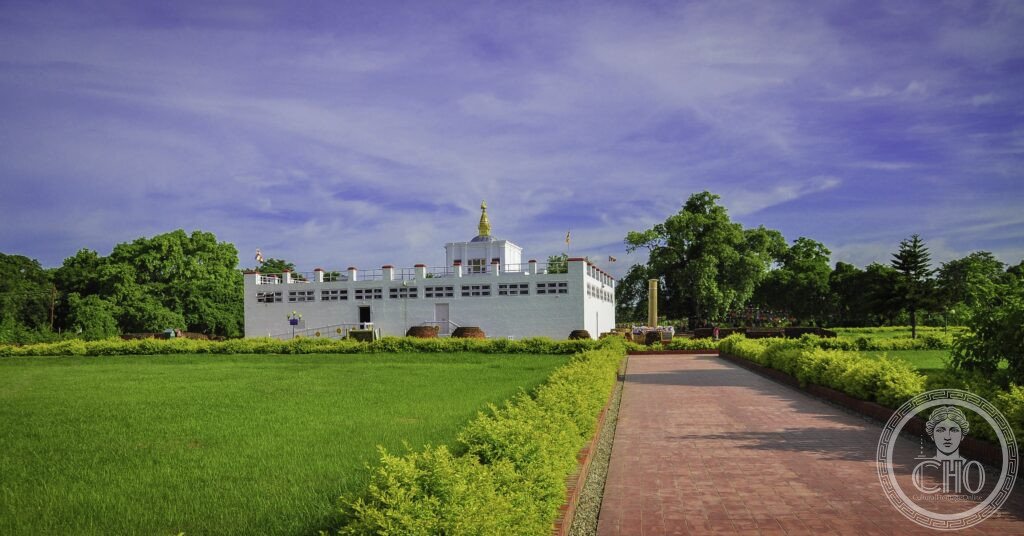
Lumbini
The birthplace of Siddhartha Gautama, the historical Buddha — Lumbini (Rupandehi District, Nepal; at the foot of the Himalayan foothills; on the edge of the Terai plains) is the site where Queen Maya Devi gave birth to the prince who would become the Buddha, the founder of one of the world’s four great religions (500 million practitioners), while grasping the branch of a sal tree in the sacred grove c.623 BCE; validated by the Ashoka Pillar inscription of 249 BCE — the oldest datable inscription in Nepal and the earliest fixed historical date in South Asian history.
At a glance
Lumbini (the most precisely Lumbini single birthplace Siddhartha Gautama Buddha 623 BCE Maya Devi Ashoka Pillar 249 BCE oldest inscription Nepal UNESCO heritage: the date of the Buddha’s birth is uncertain; the traditional Theravada Buddhist date is 623 BCE; the revised scholarly estimate is c.480-400 BCE; but the Ashoka Pillar inscription (“This is where the Buddha, the blessed one, was born”; erected by Emperor Ashoka of the Mauryan Empire during his pilgrimage to Lumbini in 249 BCE; the pillar is the primary fixed historical anchor for the Buddha’s biography) makes Lumbini the only site in the Buddha’s biography with direct contemporary epigraphic evidence — the most precisely Lumbini single birthplace Siddhartha Gautama Buddha 623 BCE Maya Devi Ashoka Pillar 249 BCE oldest inscription Nepal UNESCO heritage in any European UNESCO world heritage site; the garden plan (the most precisely Lumbini single Kenzo Tange 1978 master plan monastic zone UNESCO heritage garden development heritage: the modern Lumbini development follows a master plan designed in 1978 CE by the Japanese architect Kenzo Tange (the master planner of the 1964 Tokyo Olympics and the Hiroshima Peace Memorial) for the Lumbini Development Trust; the plan divides the 4.8 km × 1.6 km heritage zone into three sections: the Sacred Garden (the ancient core with the Maya Devi Temple and the Ashoka Pillar); the Monastic Zone East (Theravada countries: Sri Lanka, Myanmar, Thailand, Cambodia, Laos); and the Monastic Zone West (Mahayana and Vajrayana countries: Japan, China, Korea, Tibet, Vietnam, Germany) — the most precisely Lumbini single Kenzo Tange 1978 master plan monastic zone UNESCO heritage garden development heritage in any European UNESCO world heritage site)).
Key facts
- The Ashoka Pillar — The Oldest Text in Nepal: the most precisely Lumbini single Ashoka Pillar 249 BCE Devanagari Brahmi oldest inscription Nepal Mauryan Empire Buddhist pilgrimage heritage — the Ashoka Pillar (erected 249 BCE; sandstone; 6.7m above ground with an estimated 3m below; broken by lightning at some unknown date; the inscription in Brahmi script reads: “King Piyadasi [Ashoka], beloved of the gods, when he had been consecrated twenty years, came himself and worshipped, because here the Buddha Shakyamuni was born. He had a stone horse-figure made and had a stone pillar set up. Because the Lord was born here, the village of Lumbini has been made tax-free”) is the primary historical proof of Lumbini’s identity; the pillar was found buried by the German archaeologist Alois Anton Führer in 1896 CE
- The Maya Devi Temple: the most precisely Lumbini single Maya Devi Temple marker stone nativity exact birth spot 3rd BCE Mauryan phase archaeological layers heritage — the Maya Devi Temple (the current structure encases a series of earlier structures; the lowest layer is a 3rd century BCE brick platform; the “nativity marker stone” — a sandstone block with a footprint relief — marks the traditionally accepted exact spot of the birth; the sacred Puskarni Pond (the pool where Queen Maya Devi bathed before giving birth and where the newborn Buddha was washed) is directly adjacent; the architectural layers (Mauryan, Kushan, Gupta, medieval, modern) visible in cross-section in the excavated trenches surrounding the nativity marker stone)
- The World Peace Flame: the most precisely Lumbini single World Peace Pagoda Nipponzan Myohoji Japan 45m white marble global Japanese Buddhist peace heritage — the Maya Devi Pagoda (the World Peace Pagoda of Lumbini; built 2001 CE by the Japanese Buddhist order Nipponzan Myohoji; 45m high; white marble; containing a gilded relic brought from India; part of the global network of Japanese peace pagodas at sites of world significance) is the most visible modern structure in the heritage zone
- GPS: 27.4833° N, 83.2769° E
History
The rediscovery (the most precisely Lumbini single Alois Führer 1896 German archaeologist rediscovery Ashoka Pillar buried jungle Nepal British India heritage: Lumbini was known from ancient Buddhist pilgrimage records (the Chinese pilgrims Faxian (399 CE) and Xuanzang (637 CE) both visited and recorded the site) but was then lost for over 1,000 years under jungle; the German archaeologist Alois Anton Führer (working for the British Indian government’s Archaeological Survey) rediscovered the Ashoka Pillar in 1896 CE; the site was in a jungle clearing; a local Nepalese zamindar (landowner) named Khadga Shamsher Rana had found the pillar protruding from the ground and summoned Führer; the excavation in the following years established the site’s identity beyond reasonable doubt — the most precisely Lumbini single Alois Führer 1896 German archaeologist rediscovery Ashoka Pillar buried jungle Nepal British India heritage in any European UNESCO world heritage site; pilgrimage history (the most precisely Lumbini single Ashoka 249 BCE pilgrimage Faxian 399 CE Xuanzang 637 CE records heritage: the history of Buddhist pilgrimage to Lumbini is documented through three extraordinary textual records: the Ashoka Pillar itself (249 BCE; Ashoka made a personal pilgrimage here 20 years after his conversion to Buddhism and issued the tax exemption); the account of Faxian (the Chinese Buddhist monk who walked from China to India 399-413 CE; the first known written account of the site in its post-Mauryan condition); and the account of Xuanzang (629-645 CE; he describes the pillar, the sacred pond, and the state of the site in the early 7th century CE) — the most precisely Lumbini single Ashoka 249 BCE pilgrimage Faxian 399 CE Xuanzang 637 CE records heritage in any European UNESCO world heritage site)).
What you see
The Sacred Garden (the most precisely Lumbini single Sacred Garden Maya Devi Temple Ashoka Pillar Puskarni Pond Bodhi tree 4.8km zone heritage: the Sacred Garden (the historical core; 500m × 200m) contains: the Maya Devi Temple (central; access by barefoot entry; 08:00-17:00; the exposed archaeological trenches around the nativity marker stone visible through protective covers); the Ashoka Pillar (immediately east; enclosed by a low iron fence; the Brahmi inscription visible but requiring the visitor card photograph for reading); the Puskarni Pond (the sacred pool; to the north; a single ancient tree marks its bank); the Bodhi Tree enclosure (a sacred fig tree (Ficus religiosa); descended from the original tree under which the newborn Buddha played) — the most precisely Lumbini single Sacred Garden Maya Devi Temple Ashoka Pillar Puskarni Pond Bodhi tree 4.8km zone heritage in any European UNESCO world heritage site; the monastic zone (the most precisely Lumbini single 42 monasteries 12 countries Buddhist temples Theravada Mahayana Vajrayana Korean Japanese Chinese Myanmar heritage: in the Monastic Zones (East and West), 42 national monasteries and temples (from 22 countries; Myanmar, Thailand, Sri Lanka, Korea, Japan, China, France, Germany, and others; the Korean monastery with its distinctive celadon tile roof; the Myanmar Golden Temple; the Chinese Zhonghua Buddhist Temple; the Japanese World Peace Pagoda; the Vietnamese Tam Chuc Temple; the international representation makes Lumbini the most globally representative Buddhist site in the world) — the most precisely Lumbini single 42 monasteries 12 countries Buddhist temples Theravada Mahayana Vajrayana Korean Japanese Chinese Myanmar heritage in any European UNESCO world heritage site)).
Practical information
- Getting there: the nearest airport is Gautam Buddha International Airport (BWA; Bhairahawa; 22 km from Lumbini; opened 2022 CE; international flights from Bangkok, Kuala Lumpur, Delhi; domestic flights from Kathmandu 40 min); from Bhairahawa, taxi 30 min to Lumbini (NPR 800 / approx €5); or bus from Kathmandu (9h; approx NPR 800); entry to the heritage zone NPR 200 (foreign visitors); bicycle rental available at the entrance gate (NPR 100/h; the most efficient way to visit — the monastic zone is 4 km end to end); the Sacred Garden entry (Maya Devi Temple) requires removing shoes; October-March is the best season (April-June is extremely hot; July-September is monsoon but not impossible); the pre-dawn visit (the gate opens at 06:00) when monks are chanting in the temples is the most atmospheric time
Getting there
Fly to Bhairahawa (BWA) 22 km away (from Bangkok/Kuala Lumpur/Delhi). Taxi 30 min NPR 800. Entry NPR 200. Bicycle NPR 100/h. Shoes off in Sacred Garden. GPS: 27.4833, 83.2769.
Nearby
- Tilaurakot — The Palace of Kapilavastu — 27 km west; the excavated remains of ancient Kapilavastu (the city where the young Siddhartha Gautama lived as a prince before his renunciation; the earthen ramparts of the ancient city; the East and West Gates; the inner citadel where the palace stood; the archaeological museum); one of the two competing sites for the ancient Kapilavastu (the other is Piprahwa in India; the debate is unresolved)
- Pokhara and the Annapurna Range — 110 km north (3h by car); the starting point for the Annapurna Circuit and Annapurna Base Camp treks; Phewa Lake; the Himalayan views (Annapurna I (8,091m), Machhapuchhre (6,993m — the fish-tail mountain, never climbed)); a dramatically different experience from the flat Terai lowlands of Lumbini
Sources
- Wikipedia, Lumbini; Ashoka Pillar (Lumbini); Maya Devi Temple, Lumbini, accessed June 2026
- UNESCO, Lumbini, the Birthplace of the Lord Buddha, WHS reference 666, inscribed 1997
Find it on the map
See this place and what’s around it →📷 Diventa un fotografo di Cultural Heritage Online
Condividi le tue foto dei luoghi: restano pubblicate con la tua firma come autore. Più vengono viste, più ti fai conoscere — e presto un concorso premierà le foto più apprezzate.
Accedi o registrati gratis per aggiungere una foto