

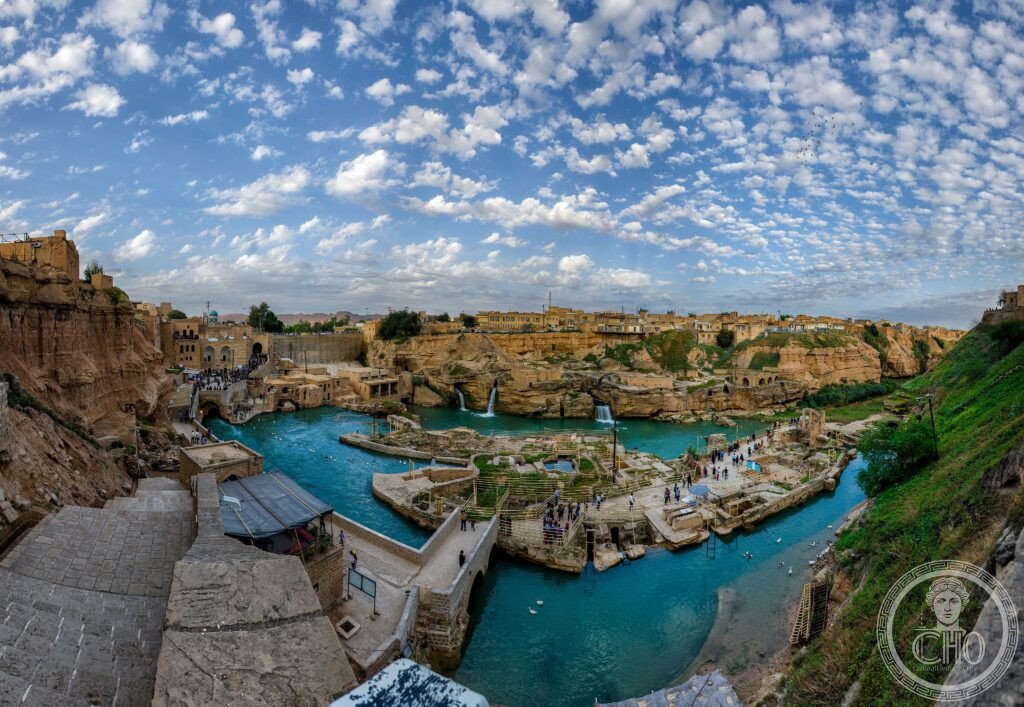
On the Karun River in south-western Iran, a network of dams, tunnels and canals begun under the Achaemenids and expanded by the Sassanids still channels water through the city of Shushtar, driving artificial waterfalls and watermills that have worked, in some form, for over two thousand years.
At a glance
The Shushtar Historical Hydraulic System is a complex of dams, weirs, tunnels, irrigation canals and watermills built on the Karun River, developed from the Achaemenid period through the Sassanid empire and into the Islamic era. Its best-known structure, the Band-e Kaisar, is thought to be the first dam-bridge built in Iran, raised by Roman prisoners of war after the defeat of the Emperor Valerian. The system still functions, and its cascading waterfalls remain the most striking feature of the site.
Key facts
- Location: Shushtar, Khuzestan Province, south-western Iran, on the Karun River
- Origins: canal system begun under the Achaemenid king Darius I to supply the city
- Major expansion: undertaken by the Sassanid king Shapur I using Roman prisoners of war
- Band-e Kaisar: a combined dam and bridge, roughly 500 metres long, built around 260 CE
- Watermills: some 40 mills once driven by the artificial falls, partly preserved today
- Recognition: inscribed as a UNESCO World Heritage Site in 2009
History
The system’s origins lie with Darius I, who had a canal dug to bring the Karun’s water into Shushtar. It was the Sassanid king Shapur I, ruling from 241 to 272 CE, who transformed this modest beginning into a much larger network of dams, weirs and diversion canals. Shapur put to work Roman soldiers and engineers captured at the Battle of Edessa in 260 CE, after the Sassanids inflicted on Rome the only defeat in its history in which a reigning emperor, Valerian, was taken prisoner. Shapur commemorated the victory in rock reliefs at Naqsh-e Rostam, showing Valerian kneeling before him. The captured Romans built the Band-e Kaisar at Shushtar and a further bridge at Dezful, bringing with them recognisable techniques such as vaulted arches and pozzolana concrete.
Under the Sassanid empire, the irrigation fed by this system helped make the plains of Khuzestan one of the most productive agricultural regions of the ancient world, and the Sassanids introduced sugarcane from India as a major cash crop. Shushtar remained an important Sassanid city. After the Arab conquest of 642 CE, the hydraulic system continued in use under Islamic administration; the twelfth-century geographer al-Idrisi described Shushtar as the largest city in Khuzestan, and the Abbasid Caliphate maintained its mills and canals as essential infrastructure.
What you see
The Gargar Canal is the engineering spine of the site, a long diversion channel drawing water from the Band-e Mizan weir on the Karun. Its oldest section, an underground tunnel with vertical maintenance shafts, dates from the Achaemenid period and may have been extended by Darius I. The canal feeds the eastern part of Shushtar’s agricultural land before discharging through the site’s famous waterfalls.
A visit typically takes in the waterfalls and the surviving mill complex, where mill chambers are cut into the rock face below the falls; the Band-e Kaisar itself, visible from the cliff above and reachable a short distance north; the Salasel Castle, an Achaemenid-period fortress that once commanded the dam and the Gargar Canal; and the Shushtar National Museum, which holds models explaining the hydraulic engineering along with Sassanid artefacts.
Practical information
- Site location: the hydraulic system and waterfalls lie in the centre of Shushtar town
- Best season: spring, when the Karun runs high after winter rains and the waterfalls are at full volume
- Climate warning: Khuzestan summers are extremely hot and best avoided
- Also in town: a historic covered bazaar, among the longest in Iran, and the old Pol-e Shador bridge
Getting there
Shushtar lies north of Ahvaz, the capital of Khuzestan Province, which has an airport served by domestic flights from Tehran and other Iranian cities. Onward travel to Shushtar is by bus or shared taxi. Visitors should check current transport options and site access through official Iranian tourism channels before travelling.
Nearby
- Chogha Zanbil — a UNESCO World Heritage Site south of Shushtar, the best-preserved ziggurat outside Mesopotamia, built by the Elamite king Untash-Napirisha around 1250 BCE, with three of its original five stages still standing
- Susa (Shush) — a UNESCO World Heritage Site north-west of Shushtar, the ancient Elamite capital and later an Achaemenid winter residence, and the findspot of the Code of Hammurabi, now in the Louvre
Sources
- Wikipedia, Shushtar Historical Hydraulic System
- Wikipedia, Band-e Kaisar
- Wikipedia, Battle of Edessa (260)
- UNESCO, Shushtar Historical Hydraulic System, WHS reference 1315
Find it on the map
See this place and what’s around it →📷 Become a Cultural Heritage Online photographer
Share your photos of places: they stay published under your name as the author. The more they're seen, the more you get noticed — and soon a contest will reward the most appreciated photos.
Log in or sign up free to add a photo