
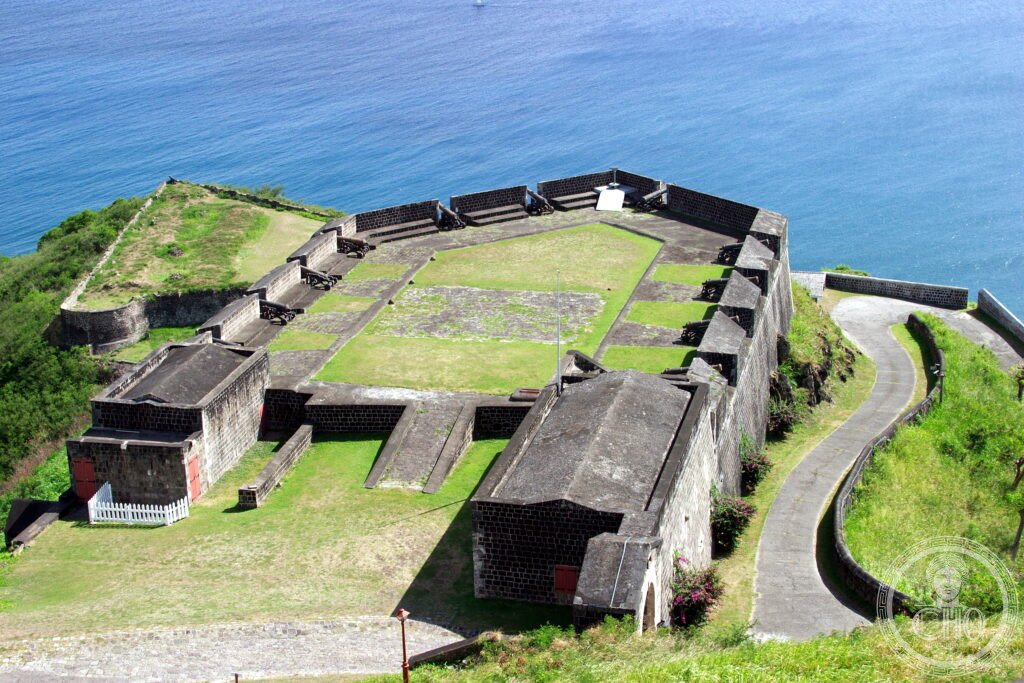
Brimstone Hill Fortress crowns a volcanic plug above the Caribbean Sea, its bastions and citadel built by enslaved Africans under British military direction. It survived a month-long French siege in 1782 and remains one of the best-preserved colonial fortifications in the Americas, with views stretching to four neighbouring islands.
At a glance
Brimstone Hill Fortress was built in stages between 1690 and 1790 to protect the sugar plantations and harbour of Saint Kitts, the first British colony in the Caribbean. Enslaved Africans quarried the volcanic basalt from the hill itself and raised the walls under the supervision of British Royal Engineers. The finished complex held five bastions, a citadel, barracks and a water cistern.
In January 1782 a French force under the Marquis de Bouillé besieged the fortress. Roughly 350 British soldiers and 700 militia held out for a month before surrendering when food and ammunition ran low. France held Saint Kitts for a year until the Treaty of Paris in 1783 returned it to Britain.
Key facts
- Built: 1690–1790, in phases, by the British using enslaved African labour
- Nickname: the “Gibraltar of the West Indies”
- Elevation: the fortress sits on a volcanic plug roughly 240 metres above the sea
- Status: UNESCO World Heritage Site, inscribed 1999
- Key structures: the Fort George Citadel and the Prince of Wales Bastion
- Defining event: the French siege of 1782, when around 1,050 defenders held off some 8,000 attackers for a month
History
Saint Kitts, settled by Sir Thomas Warner in 1623, was the first British colony in the Caribbean and became known as the “mother colony”, from which settlers went on to establish Nevis, Antigua, Montserrat and part of Barbados. Its early sugar wealth gave the island outsized importance within the British Atlantic empire, and Brimstone Hill was built to defend that wealth.
The fortress was constructed specifically to protect the plantations that made Saint Kitts one of the most densely enslaved islands in the Caribbean relative to its size. The same enslaved community that produced the sugar profits funding the fort’s construction also built it, making Brimstone Hill both a monument to British military engineering and to enslaved African labour.
Vice-Admiral Horatio Nelson, later victor of Trafalgar, was stationed at Nevis and Saint Kitts between 1785 and 1787. He married the widow Frances Nisbet at the Montpelier Estate on Nevis in March 1787; the church where they married and the house where Alexander Hamilton was born both lie a short distance from Brimstone Hill across the Narrows channel.
What you see
The Fort George Citadel occupies the summit of the volcanic plug, the fortress’s most defensible point, and is reached by a stone ramp from the Middle Citadel below. Its officers’ quarters, magazine and guardroom now house a museum displaying original cannon, military artefacts and period maps. The Prince of Wales Bastion, named for the future King George IV who visited in 1783, is the best preserved of the fortress’s five bastions and commands the widest view.
An underground powder magazine, cut directly into the volcanic rock, was built to withstand direct cannon fire. The gun terraces still carry original eighteenth-century British iron cannon, each weighing several tonnes, positioned to cover the sea approaches from the direction of Nevis and Sint Eustatius.
Practical information
- Access: the fortress lies inland from Basseterre and is reached by road; a taxi or hire car is the usual option
- Time needed: visitors typically spend a couple of hours exploring the site
- Entry and hours: check the current admission arrangements and opening times through the Brimstone Hill Fortress National Park’s own channels
- Combine with Nevis: a ferry from Basseterre links Saint Kitts to Nevis for those wanting a two-island visit
Getting there
Visitors fly into Basseterre on Saint Kitts, then travel northwest by road along the Caribbean coast, passing former plantation estates now converted into hotels, to reach Brimstone Hill.
Nearby
- Nevis — a short ferry crossing south of Saint Kitts; birthplace of Alexander Hamilton, with a museum in Charlestown, plus Nevis Peak and several plantation-house hotels
- Sint Eustatius (Statia) — a short flight northwest; once the largest free port in the eighteenth-century Caribbean and known as “The Golden Rock”, with a high concentration of colonial archaeological sites
Sources
- Wikipedia, Brimstone Hill Fortress National Park
- Wikipedia, Saint Kitts
- Wikipedia, 1782 Siege of Brimstone Hill
- UNESCO, Brimstone Hill Fortress National Park (WHS reference 910)
Find it on the map
See this place and what’s around it →📷 Become a Cultural Heritage Online photographer
Share your photos of places: they stay published under your name as the author. The more they're seen, the more you get noticed — and soon a contest will reward the most appreciated photos.
Log in or sign up free to add a photoDo you manage this place?
This page is read by travellers and heritage enthusiasts who find it on Google. Keep it accurate — and make it work for you. Free for non-profit heritage institutions.