
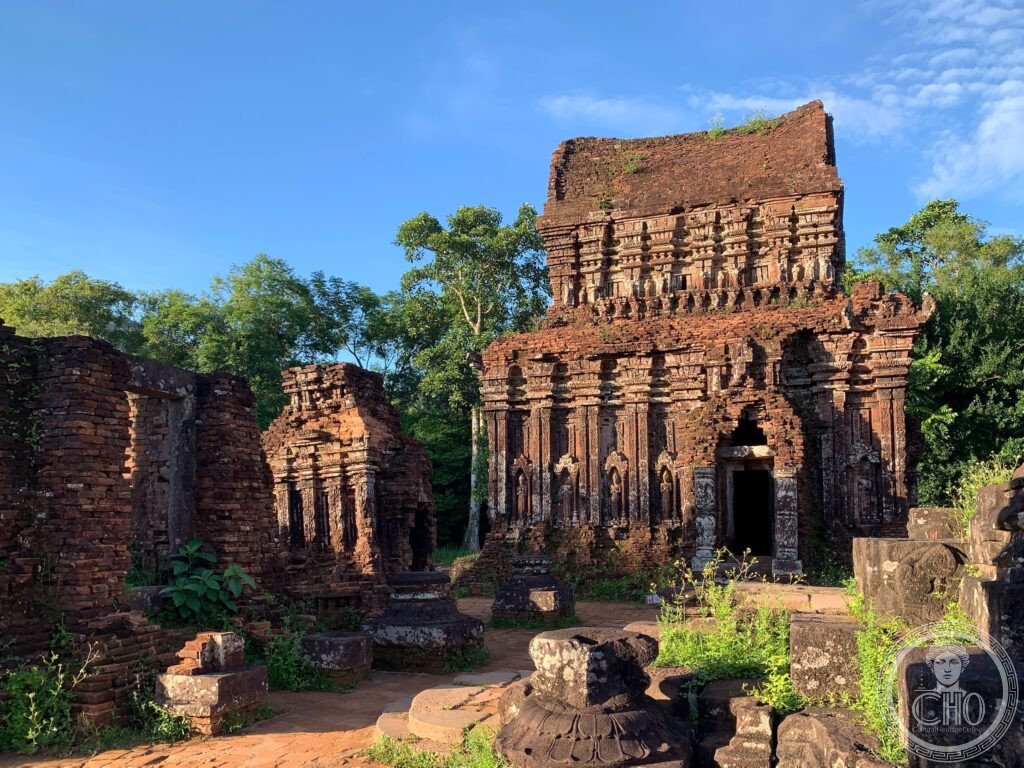
In a forested valley of central Vietnam stand the brick towers the Cham kings raised to Shiva across nine centuries. War destroyed much of the finest group in 1969, but what survives, wrapped in jungle and silence, remains the most important Hindu sanctuary in Southeast Asia after Angkor.
At a glance
My Son was the religious and ceremonial capital of the Cham Kingdom, known as Champa, from the 4th to the 13th century CE. Over nine centuries Cham kings built more than seventy brick towers here, each dedicated to a form of Shiva. Around twenty survive today in varying states of repair, standing among dense forest in a valley enclosed by hills.
The site was inscribed as a UNESCO World Heritage Site in 1999.
Key facts
- Longest building history in Southeast Asia: the first sanctuary dates to the 4th century CE and the last major phase to the 13th century, with styles evolving from the angular early Mỹ Sơn A1 manner to a later, more ornate style showing Khmer influence.
- Brick without mortar: the towers are built of red brick fitted so precisely that no binding agent has ever been conclusively identified, and modern repairs using ordinary mortar have proved structurally weaker than the original work.
- Companion museum: the Museum of Cham Sculpture in Đà Nẵng holds sandstone figures of Shiva, Ganesha and Vishnu, along with lintels and pediments removed from My Son for conservation.
- Location: 15.7656° N, 108.1215° E.
History
The French archaeologist Henri Parmentier, of the École française d’Extrême-Orient, carried out the first systematic survey of My Son in 1904, publishing his findings in the two-volume Inventaire descriptif des monuments Čams de l’Annam between 1909 and 1918. He described one tower in Group A as the finest monument in the whole of Cham art. That same tower was among those destroyed when American B-52 bombers targeted the site in August 1969, after it had been used as a Viet Cong communications base.
Long before that, in 1283, the Cham Kingdom faced Kublai Khan’s Mongol invasion of Southeast Asia. Unlike the Khmer Empire, which was not directly attacked, Champa fought the Mongol navy at its coast and repelled it, preserving its independence until the Vietnamese conquest of the 15th century.
What you see
Group B, C and D form the most intact cluster at My Son and date from the 10th and 11th centuries. Together they show the classic Cham sanctuary arrangement: the kalan, or main tower, dedicated to Shiva Bhadresvara, alongside a vestibule and a treasure house. The bas-reliefs here, showing dancers and Shiva iconography, are the finest Cham sculpture still in place at the site.
Group A tells a different story. Largely destroyed in the 1969 bombing, it is marked by a large crater and by the broken remains of the Group A1 kalan, the tower Parmentier had called the finest ever built by Cham hands. Standing among the fragments, close to the crater, is widely described as the most affecting part of a visit to My Son.
Practical information
- Best time to visit: the site is quieter early in the morning, before tour groups arrive, when mist often hangs among the towers.
- Cham dance performances: traditional Cham dance is staged at the Group B/C/D area on most mornings; check current times with the site.
- Tickets and access: entrance fees and current opening times are set by the site management and are best confirmed through official channels before travelling.
Getting there
My Son lies south-west of Hội An, reached by car or motorbike either independently or as part of an organised tour from Hội An. Current transport options, routes and any associated costs are best checked directly with tour operators or the site’s official visitor information.
Nearby
- Hội An Ancient Town — around 40 km north-east, a UNESCO-listed trading port and one of the best-preserved historic towns in Southeast Asia; commonly paired with a morning visit to My Son.
- Museum of Cham Sculpture, Đà Nẵng — around 60 km north-east, home to the largest collection of Cham sculpture, including original lintels, pediments and statues removed from My Son.
Sources
- Wikipedia, Mỹ Sơn
- Wikipedia, Cham architecture
- Wikipedia, Henri Parmentier
- UNESCO, My Son Sanctuary, WHS reference 949
Find it on the map
See this place and what’s around it →📷 Become a Cultural Heritage Online photographer
Share your photos of places: they stay published under your name as the author. The more they're seen, the more you get noticed — and soon a contest will reward the most appreciated photos.
Log in or sign up free to add a photo