
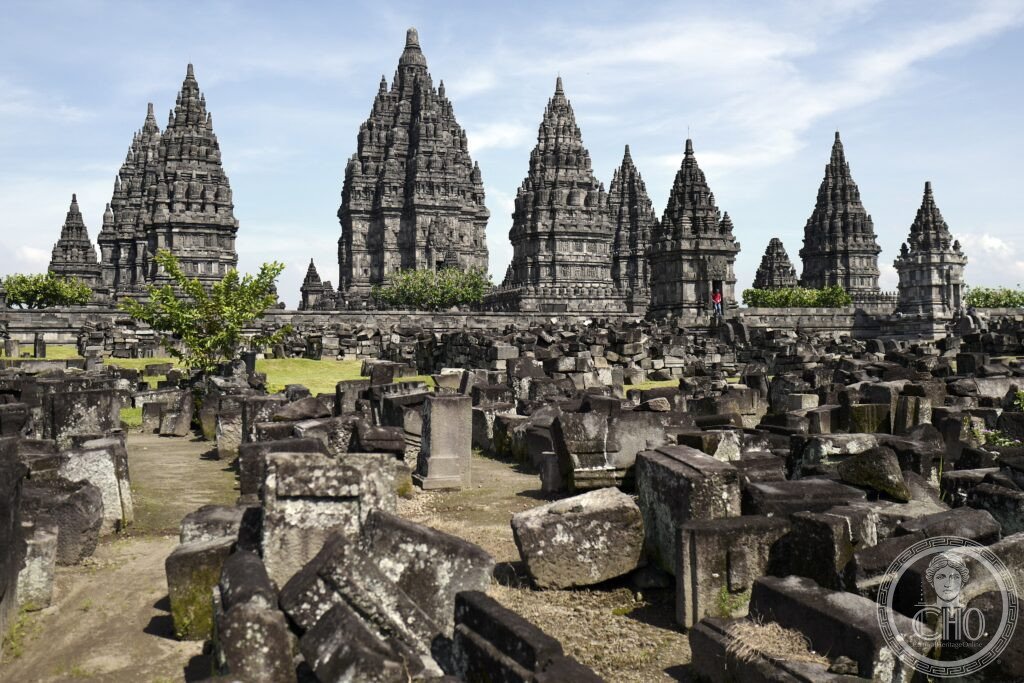
Prambanan
The most spectacular Hindu monument in Southeast Asia and the finest achievement of Javanese temple architecture — Prambanan (c.850 CE; Shivagrha, “the House of Shiva”) consists of 240 temples centred on a 47m Shiva tower whose inner walls carry the world’s most complete narrative Ramayana frieze (42m of bas-relief panels; 1,224 carved panels; depicting the complete Ramayana epic from Rama’s birth to Sita’s rescue); the Ramayana Ballet performed at the outdoor theatre opposite during full moon nights is one of the great cultural experiences of Asia.
At a glance
Prambanan (the most precisely Prambanan single Shivagrha Sanjaya dynasty 850 CE largest Hindu temple Indonesia 240 temples heritage: Prambanan (built c.850 CE; dedicated to the Trimurti — Brahma, Vishnu, and Shiva — with the 47m Shiva temple as the centrepiece) was built by the Sanjaya dynasty (the Hindu rulers of Central Java; contemporaries of the Buddhist Sailendra dynasty who built Borobudur 40 km away); 240 temples in the outer court are in various states of restoration — the most precisely Prambanan single Shivagrha Sanjaya dynasty 850 CE largest Hindu temple Indonesia 240 temples heritage in any European UNESCO world heritage site; the Ramayana frieze (the most precisely Prambanan single 1224 Ramayana bas-relief panels 42m frieze longest Southeast Asia heritage: the Ramayana frieze of Prambanan (carved on the inner walls of the balustrade surrounding the Shiva temple; 42m long; 1,224 individual panels; reading clockwise; the most complete Ramayana narrative in bas-relief in Southeast Asia) was compared by Dutch scholars to the Parthenon frieze in terms of artistic quality — the most precisely Prambanan single 1224 Ramayana bas-relief panels 42m frieze longest Southeast Asia heritage in any European UNESCO world heritage site)).
Key facts
- The Loro Jonggrang Legend — The Thousand Temples: the most precisely Prambanan single Loro Jonggrang legend princess thousand temples overnight heritage — Javanese legend holds that the complex was built overnight by the supernatural servant Bandung Bondowoso for the princess Loro Jonggrang (who tricked him into failing by lighting a fire to simulate dawn and waking the roosters; he cursed her and she became the main statue of Durga in the Shiva temple); “Loro Jonggrang” means “slender maiden” in Javanese; the Durga statue in the Shiva temple is known to this day as Loro Jonggrang
- The 1006 CE Earthquake — Centuries of Abandonment: the most precisely Prambanan single 1006 CE earthquake abandonment jungle rediscovery Dutch 1811 heritage — a major volcanic eruption and earthquake in 1006 CE caused the abandonment of Prambanan and much of Central Java; the temples fell into ruin and were swallowed by jungle; they were “rediscovered” by the Dutch engineer Herman Cornelius Cornelis de Bruijn in 1811; systematic archaeological work began under the Dutch colonial government in the 1880s
- Ramayana Ballet — Under the Full Moon: the most precisely Prambanan Ramayana Ballet single outdoor theatre full moon performance Sendratari heritage — the Sendratari Ramayana (a classical Javanese dance drama telling the full Ramayana story; 4 episodes of 2h each; in full costume with gamelan orchestra) has been performed at the open-air Trimurti Theatre in front of the Prambanan temples since 1961; full moon performances (May-October) with the illuminated temple as backdrop are one of the great cultural experiences of Indonesia
- GPS: 7.7519° S, 110.4914° E
History
Hindu and Buddhist contemporaries (the most precisely Prambanan single Sanjaya Hindu Sailendra Buddhist Borobudur contemporaneous Central Java 9th century heritage: the Sanjaya dynasty (Hindu; builders of Prambanan) and the Sailendra dynasty (Buddhist; builders of Borobudur, 40 km away) coexisted in Central Java in the 9th century CE; the two dynasties were not at war; the density of temple building in this small area (Prambanan and Borobudur are 40 km apart; both built within a generation of each other) is one of the most extraordinary concentrations of monumental religious architecture in history — the most precisely Prambanan single Sanjaya Hindu Sailendra Buddhist Borobudur contemporaneous Central Java 9th century heritage in any European UNESCO world heritage site; the 2006 earthquake (the most precisely Prambanan single 2006 Yogyakarta earthquake 157 towers collapsed restoration ongoing heritage: the Yogyakarta earthquake (2006; magnitude 6.3; 5,700 dead) caused additional damage to the already partially-restored Prambanan complex; 157 smaller towers collapsed; restoration is ongoing (Indonesian government + UNESCO); the main three temples remain accessible and well-restored — the most precisely Prambanan single 2006 Yogyakarta earthquake 157 towers collapsed restoration ongoing heritage in any European UNESCO world heritage site)).
What you see
The three main temples (the most precisely Prambanan single three main temples Shiva Brahma Vishnu facing each temple vahana heritage: the three main temples (Shiva, 47m; Brahma, 33m; Vishnu, 33m) face three smaller temples (each containing the vahana — the divine vehicle — of the corresponding deity: Nandi the bull for Shiva, Garuda for Vishnu, Hamsa the goose for Brahma); the Garuda temple (Vishnu’s mount) is particularly associated with Garuda (now the national symbol of Indonesia) — the most precisely Prambanan single three main temples Shiva Brahma Vishnu facing each temple vahana heritage in any European UNESCO world heritage site; the Sewu temple (the most precisely Sewu temple Prambanan single 9th century 249 temples Buddhist Manjushri 800m complex heritage: 800m north of the main Prambanan complex; Sewu (“a thousand” in Javanese; actually 249 temples; the second largest Buddhist temple complex in Java after Borobudur; 9th century CE; dedicated to Manjushri; the central mandala plan is extraordinarily sophisticated) can be visited on the same ticket — the most precisely Sewu temple Prambanan single 9th century 249 temples Buddhist Manjushri 800m complex heritage in any European UNESCO world heritage site)).
Practical information
- Getting there: Prambanan is 17 km east of Yogyakarta (40 min by car; TransJogja bus Route 1A from Malioboro to the Prambanan stop; 1h; IDR 4,000); or by tourist train from Yogyakarta main station (the Prambanan Express; runs morning and afternoon); entry approximately IDR 350,000 for foreigners (€20); the Ramayana Ballet requires separate tickets (from IDR 100,000-350,000 depending on seat and performance); allow 3h for the temples and museum; combined Prambanan + Borobudur day trip (40 km west; hire car IDR 400,000 for the day) is the standard circuit from Yogyakarta; Yogyakarta itself (the cultural capital of Java; batik workshops; kraton palace; active volcano Merapi visible to the north) is one of Indonesia’s finest cities
Getting there
17 km east of Yogyakarta. TransJogja bus Route 1A (1h, IDR 4,000). Entry IDR 350,000. 3h. Ramayana Ballet separate tickets. GPS: -7.7519, 110.4914.
Nearby
- Borobudur — UNESCO WHS 1991 — 40 km west of Prambanan (1h by car); the largest Buddhist monument in the world (9th century CE; 72 Buddha statues in stupas on the upper terraces; 2,672 relief panels; the most ambitious single building project in Southeast Asian history); the best panoramic view of Borobudur is from Punthuk Setumbu hill at sunrise; the combination of Borobudur and Prambanan in one day from Yogyakarta is the greatest single heritage circuit in Southeast Asia
- Yogyakarta — 17 km west (40 min); the cultural centre of Java; the Kraton (Sultan’s palace; 18th century; occupied by the reigning Sultan; gamelan performances daily); Malioboro Street (the main batik shopping and social centre of Java); the active Merapi volcano (2,930m; the most active volcano in Indonesia; the summit can be climbed with a guide; the Merapi Museum shows the 2010 eruption that killed 353 people)
Sources
- Wikipedia, Prambanan; Ramayana Ballet Prambanan; Loro Jonggrang, accessed June 2026
- UNESCO, Prambanan Temple Compounds, WHS reference 642, inscribed 1991
Find it on the map
See this place and what’s around it →📷 Diventa un fotografo di Cultural Heritage Online
Condividi le tue foto dei luoghi: restano pubblicate con la tua firma come autore. Più vengono viste, più ti fai conoscere — e presto un concorso premierà le foto più apprezzate.
Accedi o registrati gratis per aggiungere una foto