
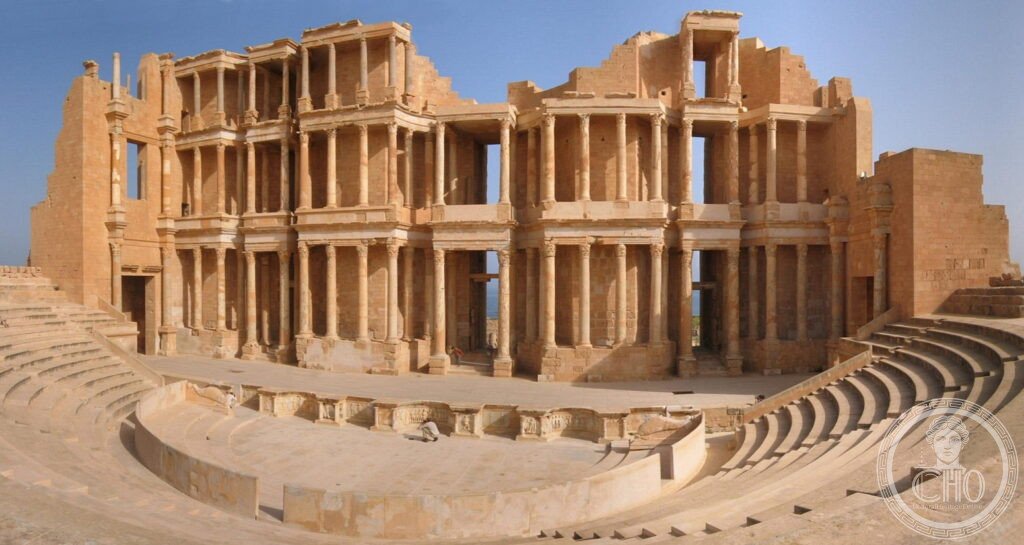
On the Libyan coast west of Tripoli, Sabratha grew from a Phoenician trading post into a Roman provincial capital whose theatre still carries the most completely reconstructed stage wall to survive anywhere from the Roman world, a three-storey screen of Corinthian columns rebuilt from its own scattered stones in the last century.
At a glance
Sabratha stands on the Tripolitanian coast, one of three ancient port cities in the region alongside Tripoli and Leptis Magna. Founded by Phoenician traders in the 7th century BCE, it passed under Roman control from the 1st century BCE and grew into a wealthy provincial city with a forum, temples and a theatre that is now the most fully restored of its kind in Africa.
The site is best known for the theatre’s scaenae frons, the ornate stage backdrop, whose three tiers of Corinthian columns were pieced back together from surviving fragments during the twentieth century. The city was also a Phoenician sanctuary site, a Roman civic centre and, later, an early Christian diocese, and its ruins and museum reflect all three phases.
Key facts
- Trial of Apuleius: in 158 CE the Roman novelist and philosopher Apuleius, author of The Golden Ass, was tried at Sabratha after being accused by his wife’s relatives of using magic to win her affections. He defended himself in a speech known as the Apologia, one of the most complete surviving records of a Roman criminal trial, and was acquitted. The trial is linked to the city’s Basilica, still identifiable in the forum area.
- Mosaic of Neptune with Gorgon: held in the on-site Sabratha Museum, this is regarded as the finest Roman mosaic surviving in Libya.
- The Tophet: a Phoenician sacred precinct at Sabratha containing urned cremation deposits and votive steles. The meaning of these burials is debated; they may relate to child sacrifice, though many scholars now think they more likely record the burial of children who died naturally before circumcision or baptism. Sabratha’s Tophet collection is considered the most important in North Africa outside Carthage.
- Coordinates: 32.8067° N, 12.4875° E.
History
Sabratha began as a Phoenician trading colony in the 7th century BCE, one of three such settlements on the Tripolitanian coast. Roman rule from the 1st century BCE brought sustained prosperity, and it was during this period, in the late 2nd century CE, that the city’s celebrated theatre took shape. The bishop Augustine of Hippo records in his Confessions that he visited Sabratha in 390 CE to support a young man seeking to become a Christian bishop against family opposition, a brief episode that offers one of the few literary glimpses of the city in late antiquity. Sabratha’s civic life declined after the Vandal kingdom, established at Carthage under Geiseric, conquered the city around 455 CE. A severe earthquake in the 4th century had already damaged much of the urban fabric, and the Arab conquest of 643 CE brought about the city’s final abandonment.What you see
The theatre’s stage building is the site’s centrepiece: a three-storey wall of Corinthian columns, some ninety-five metres wide, reconstructed from the 1920s to the 1930s by the Italian archaeologist Giacomo Guidi using surviving foundations and column drums. It remains the most photographed Roman theatre structure in Africa.
The forum is framed by three Capitoline temples, dedicated to Jupiter, to Liber Pater (a Phoenician deity absorbed into the Roman pantheon) and to Serapis, an Egyptian god widely worshipped across the Roman Empire; their proximity illustrates the religious plurality of the provincial city. Nearby stands the Basilica of Justinian, a sixth-century Byzantine church built over an earlier Roman temple, with three aisles and an apse floor mosaic depicting the New Jerusalem, a rare survival of early Byzantine floor mosaic in North Africa. The on-site museum houses the Mosaic of Neptune with Gorgon and a collection of Punic funerary steles from the Tophet.
Practical information
- Security: conditions in Libya change frequently; check current travel advisories from your government’s foreign ministry before planning a visit.
- Local arrangements: when travel is possible, visitors typically arrange a car and driver through a hotel or guide in Tripoli.
- Combining sites: Sabratha is often visited together with Leptis Magna to cover both ends of Roman Tripolitania in one trip.
Getting there
Sabratha lies west of Tripoli along the coastal road. Given the security situation in Libya, travel should only be undertaken after checking official government advisories, and arranging transport through a trusted local guide or hotel in Tripoli is the recommended approach when conditions allow.
Nearby
- Leptis Magna — east of Tripoli, a UNESCO World Heritage Site inscribed in 1982 and considered the greatest Roman city in Africa, birthplace of Emperor Septimius Severus, with the four-faced Severan Arch, a theatre, the Baths of Hadrian and one of the best-preserved ancient harbours in the Mediterranean.
- Tripoli — east along the coast, the Libyan capital, home to the Red Castle with Phoenician, Roman, Spanish and Turkish layers, and an Archaeological Museum holding Roman, Byzantine and Islamic collections including major finds from Leptis Magna.
Sources
- Wikipedia
- UNESCO
Find it on the map
See this place and what’s around it →📷 Become a Cultural Heritage Online photographer
Share your photos of places: they stay published under your name as the author. The more they're seen, the more you get noticed — and soon a contest will reward the most appreciated photos.
Log in or sign up free to add a photo