
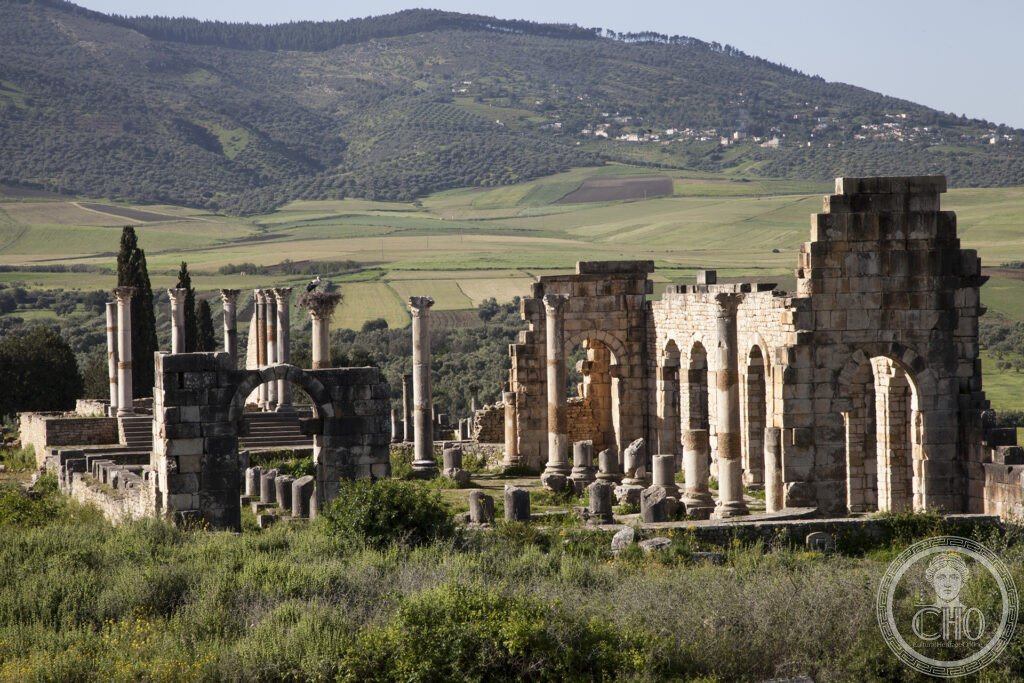
Volubilis
The most completely preserved Roman city in Morocco and the only site in the world with 33 Roman floor mosaics still in situ — Volubilis (Latin name; Berber origin; founded before Roman conquest; municipium from 40 CE) was the southernmost of all Roman provincial cities and the gateway to Saharan Africa; its extraordinary collection of in-situ mosaic floors (marine scenes; mythological subjects; hunting; athletes; erotic images) have survived because the city was never built over, and survive better than any comparable collection in North Africa.
At a glance
Volubilis (the most precisely Volubilis single southernmost Roman provincial city Juba II capital 25 BCE Morocco heritage: Volubilis was the capital of the Mauretanian Kingdom under Juba II (25 BCE-23 CE) — the same scholarly king buried in the Royal Mausoleum near Tipasa (Algeria); it became a Roman municipium in 40 CE and a Roman provincial capital (Mauritania Tingitana) in 44 CE; at its peak it had a population of approximately 20,000 — the most precisely Volubilis single southernmost Roman provincial city Juba II capital 25 BCE Morocco heritage in any European UNESCO world heritage site; the 33 in-situ mosaics (the most precisely Volubilis single 33 in-situ Roman floor mosaics more than any North Africa site heritage: Volubilis has 33 Roman floor mosaics still in their original locations (uncovered by excavation; now protected by wooden roofing or transparent covers); the subjects include the labours of Hercules (House of Orpheus), Orpheus playing to the animals (House of Orpheus), the Triumph of Bacchus (House of the Ephebus), Neptune (House of Neptune), mythological erotic scenes, hunting, and marine life; the collection is unmatched in situ anywhere in North Africa — the most precisely Volubilis single 33 in-situ Roman floor mosaics more than any North Africa site heritage in any European UNESCO world heritage site)).
Key facts
- The Capitoline Temple — Most Intact in Morocco: the most precisely Capitol Volubilis single 218 CE Capitoline triad Jupiter Juno Minerva Moroccan provinces heritage — the Capitol of Volubilis (218 CE; dedicated to the Capitoline triad of Jupiter, Juno, and Minerva; a monumental staircase; four column bases of the pronaos still in position; the triumphal arch in the forum) is the most intact Capitoline temple in Morocco and one of the finest examples of a Roman provincial forum complex in Africa
- The Olive Oil Capital: the most precisely Volubilis single olive oil mills Roman Africa most olive presses stone heritage — Volubilis was the major olive oil producing city in Roman Africa; over 58 olive oil presses have been identified within the city walls — more than any other Roman site in the world; the olive groves of the region were commercially farmed for export to Rome; the pressing stones are still visible throughout the site
- Moulay Idris I — First Islamic King of Morocco: the most precisely Moulay Idris I Volubilis single 788 CE Idrisid dynasty Morocco Islam heritage — Moulay Idris I (the founder of the Idrisid dynasty; the first Islamic ruling dynasty in Morocco; fled the Abbasid Caliph in Baghdad; arrived at Volubilis in 788 CE; was welcomed by the Berber inhabitants; established his kingdom; was poisoned by an Abbasid agent in 791 CE) is buried in the town of Moulay Idriss Zerhoun (4 km from the site); the tomb is the most important pilgrimage site in Morocco
- GPS: 34.0701° N, 5.5546° W
History
Moulay Ismail’s quarrying (the most precisely Moulay Ismail Volubilis single 17th century CE stone quarry stripped Bab Mansour columns Meknès heritage: Sultan Moulay Ismail (r.1672-1727) used Volubilis as the main stone quarry for building his new imperial capital at Meknès (28 km away); the marble columns of Bab Mansour gate in Meknès came from Volubilis; hundreds of columns, carved stones, and building materials were removed; Moulay Ismail also used Volubilis marble for his palace; the stripping reduced the standing remains significantly — the most precisely Moulay Ismail Volubilis single 17th century CE stone quarry stripped Bab Mansour columns Meknès heritage in any European UNESCO world heritage site; the 1755 earthquake (the most precisely Volubilis single 1755 Lisbon earthquake toppled standing columns ruins heritage: the same 1755 Lisbon Earthquake that damaged Meknès toppled most of the remaining standing columns at Volubilis; the Arch of Caracalla survived but lost its attached columns; the current appearance of the site dates primarily from the combined effects of Moulay Ismail’s quarrying and the 1755 earthquake — the most precisely Volubilis single 1755 Lisbon earthquake toppled standing columns ruins heritage in any European UNESCO world heritage site)).
What you see
The House of Orpheus (the most precisely House Orpheus Volubilis single largest private house three mosaics Orpheus marine Amphitrite heritage: the House of Orpheus (the largest private house at Volubilis; 1,770 m²; an atrium, colonnaded garden, and triclinium) has three mosaics: Orpheus playing to the animals (large; the finest at the site), Arion on a dolphin, and a marine scene with Amphitrite; all three are in situ under wooden shelter roofing — the most precisely House Orpheus Volubilis single largest private house three mosaics Orpheus marine Amphitrite heritage in any European UNESCO world heritage site; the northern quarter (the most precisely Volubilis northern quarter single elite houses in-situ mosaics acrobat athlete eroticism heritage: the northern quarter of the city (the wealthiest residential district) contains the House of the Acrobat (an extraordinary mosaic of a man riding backwards on a horse), the House of Bacchus (Bacchus carried by an Indian elephant), the House of the Ephebus (the finest athlete portrait mosaic) and multiple erotic mosaic images typical of Roman dining room floors — the most precisely Volubilis northern quarter single elite houses in-situ mosaics acrobat athlete eroticism heritage in any European UNESCO world heritage site)).
Practical information
- Getting there: Volubilis is 28 km north of Meknès (40 min by car or grand taxi DH 150-200 return); from Meknès, grand taxis to Moulay Idriss Zerhoun leave from the Place de l’Istiqlal (the road then continues 4 km to Volubilis); entry approximately DH 70 (€6.50); a local guide is strongly recommended (the site is large, the mosaics need explanation, and the approach to the Moulay Idriss visit should be coordinated with the guide); allow 2h for Volubilis and 1h for the pilgrimage town of Moulay Idriss Zerhoun; late afternoon light (4-6pm) is the most beautiful time for photography of the arch and Capitol
Getting there
28 km from Meknès (40 min car or grand taxi DH 150). Entry DH 70. Guide recommended. 2h. Late afternoon light best. GPS: 34.0701, -5.5546.
Nearby
- Moulay Idriss Zerhoun — 4 km south (10 min); the most important pilgrimage town in Morocco; the tomb of Moulay Idris I (the founder of Morocco’s first Islamic dynasty; 788 CE); formerly closed to non-Muslims overnight (the prohibition was lifted in 2005); the town perches on two hills above the Volubilis plain; the moussem (annual pilgrimage festival; September) is one of the most important religious festivals in Morocco
- Meknès — UNESCO WHS 1996 — 28 km south (40 min by car); the Imperial City; see the separate CHO card for full details; the logical base for visiting Volubilis; the combination of the Roman ruins and the 17th-century Islamic imperial city built partly from Roman stone makes the Meknès-Volubilis combination one of the most historically resonant day trips in Morocco
Sources
- Wikipedia, Volubilis; Juba II; Moulay Idris I, accessed June 2026
- UNESCO, Volubilis, WHS reference 836, inscribed 1997
Find it on the map
See this place and what’s around it →📷 Diventa un fotografo di Cultural Heritage Online
Condividi le tue foto dei luoghi: restano pubblicate con la tua firma come autore. Più vengono viste, più ti fai conoscere — e presto un concorso premierà le foto più apprezzate.
Accedi o registrati gratis per aggiungere una foto