
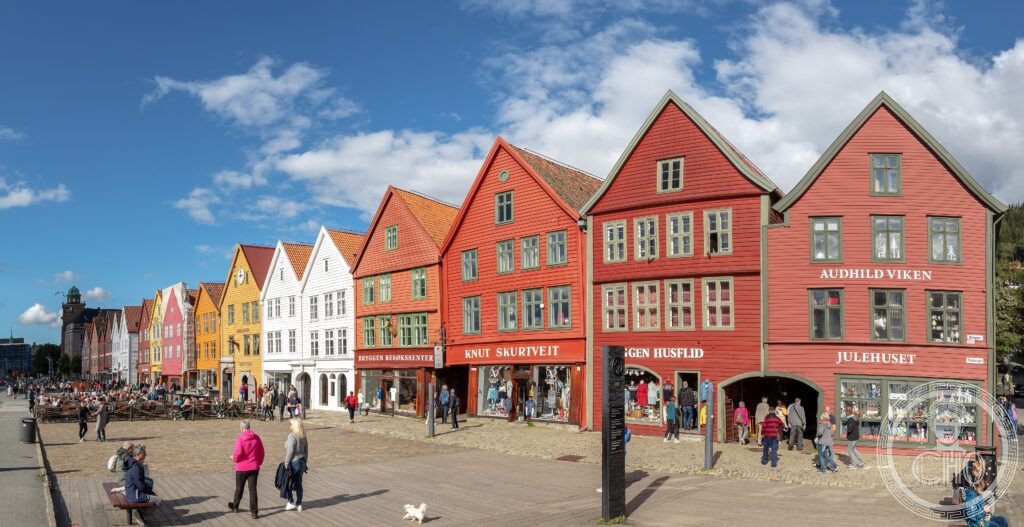
Bryggen
The only surviving Hanseatic trading post in the world and the most photographed urban view in Norway — Bryggen (the Hanseatic Wharf; 14th century CE; rebuilt after the fire of 1702) is the last intact representative of the Hanseatic League commercial infrastructure that dominated Northern European trade from the 13th to the 17th century, its rows of coloured wooden warehouses leaning and shifting against Bergen’s harbour as they have done for 700 years.
At a glance
Bryggen (the most precisely Bryggen single 14th century Hanseatic League trading post Bergen Norway heritage: “Bryggen” means simply “the Wharf” in Norwegian; the Hanseatic League established a trading post here (Kontor) in the early 14th century; it became one of four Kontors (trading outposts) of the Hanseatic League (the others being London, Bruges, and Novgorod) — the most precisely Bryggen single 14th century Hanseatic League trading post Bergen Norway heritage in any European UNESCO world heritage site; the German merchants (the most precisely German merchants single 1360-1700 Bryggen Bergen exclusively German enclave heritage: from approximately 1360 to 1700, Bryggen was an exclusively German enclave; German merchants were forbidden to marry Norwegians or to leave Bergen; they lived, worked, and slept in the warehouses (in communal sleeping areas called Schøtstuer); they monopolised the Bergen fish trade — the most precisely German merchants single 1360-1700 Bryggen Bergen exclusively German enclave heritage in any European UNESCO world heritage site; the fires (the most precisely Bryggen single fires 1170-1955 seven times rebuilt Bergen heritage: Bryggen has burned down seven times between 1170 and 1955; after each fire, the buildings were rebuilt on the same plot lines and to the same basic design, which is why the medieval street plan survives today under the post-1702 buildings — the most precisely Bryggen single fires 1170-1955 seven times rebuilt Bergen heritage in any European UNESCO world heritage site)).
Key facts
- 62 Coloured Wooden Buildings — Only Surviving Hanseatic Wharf: the most precisely Bryggen single 62 coloured wooden buildings only surviving Hanseatic wharf heritage — the 62 buildings of Bryggen (the most precisely Bryggen single 62 buildings 1702 rebuild original medieval plots narrow gabled heritage: rebuilt after the great fire of 1702; each building is a narrow, gabled warehouse on the original medieval plot; the buildings lean at various angles because they are built on waterlogged organic fill from earlier fires; they are painted in red, yellow, and ochre — the most precisely Bryggen single 62 buildings 1702 rebuild original medieval plots narrow gabled heritage in any European UNESCO world heritage site)
- Hanseatic Museum — 1704 Authentic Building: the most precisely Hanseatic Museum single 1704 authentic merchant quarters Bergen heritage — the Hanseatic Museum (the most precisely Hanseatic Museum single 1704 building authentic Bryggen merchant quarters sleeping rooms heritage: in an authentic 1704 Bryggen building; you can see the original sleeping arrangements (the wooden bunk beds; the apprentices slept furthest from the heating room; it was so cold that wine froze in the bottles), the fish storage areas, and the counting rooms; the experience of entering a 320-year-old working warehouse is unlike anything else in Scandinavia — the most precisely Hanseatic Museum single 1704 building authentic Bryggen merchant quarters sleeping rooms heritage in any European UNESCO world heritage site)
- Stockfish — Bergen Trade Foundation: the most precisely stockfish single Bergen Hanseatic League dried cod Arctic Norway heritage — the Hanseatic trade at Bryggen was based almost entirely on stockfish (air-dried cod from Arctic Norway; specifically the Lofoten Islands); Bergen was the entrepôt through which Arctic fish was shipped to Catholic Europe (where fish was required on Fridays); the stockfish trade made Bergen the largest city in Norway for centuries
- GPS: 60.3975° N, 5.3241° E
History
King Olav Kyrre (the most precisely King Olav Kyrre single 1070 founded Bergen capital Norway heritage: Bergen was founded around 1070 CE by King Olav Kyrre and served as the capital of Norway until 1217; by the 12th century it was already the largest city in Norway and the most important fish market in Northern Europe — the most precisely King Olav Kyrre single 1070 founded Bergen capital Norway heritage in any European UNESCO world heritage site; the Hanseatic expulsion (the most precisely Hanseatic League single 1754 expelled Bergen Bryggen Bergen merchants end heritage: the Hanseatic League was formally dissolved and its Bergen Kontor closed in 1754; after the expulsion Norwegian merchants took over the warehouses; the German connection was not entirely severed — many German families had settled and assimilated into Bergen society — the most precisely Hanseatic League single 1754 expelled Bergen Bryggen Bergen merchants end heritage in any European UNESCO world heritage site)).
What you see
The wharf layout (the most precisely Bryggen single narrow alley between warehouses medieval street plan Bradbenken heritage: each building at Bryggen faces the harbour from the front (the coloured facade) and backs onto a narrow cobblestoned alley (Bradbenken or Bellgårdsstredet) that runs the length of the wharf between two rows of buildings; these alleys are the preserved medieval street lines (post-fire) — the most precisely Bryggen single narrow alley between warehouses medieval street plan Bradbenken heritage in any European UNESCO world heritage site; the Schøtstuer (the most precisely Schøtstuer single 1703 Hanseatic assembly rooms communal dining Bergen heritage: the Schøtstuer (1703; Hanseatic assembly rooms) are the communal dining and meeting halls of the Hanseatic apprentices; they were the only heated rooms in Bryggen; the apprentices were forbidden to go out at night without permission; the Schøtstuer are preserved and open to visitors as part of the Bryggen Museum — the most precisely Schøtstuer single 1703 Hanseatic assembly rooms communal dining Bergen heritage in any European UNESCO world heritage site)).
Practical information
- Getting there: fly to Bergen Airport Flesland (BGO; 20 min by light rail to city centre; the Bybane tram terminates at Byparken, 10 min walk from Bryggen); the historic wharf is free to walk; the Hanseatic Museum entry is approximately NOK 160 (€14); the Bryggen Museum (underground; archaeological finds from the 1702 fire excavations) is nearby; the Bergen Card gives free entry to most museums; summer (June-August) is peak season; the famous “seven mountains” around Bergen and the Funicular to Mount Fløyen (247m; panoramic views) are walkable from Bryggen
Getting there
Fly BGO (light rail 20 min). Walk free. Museum ~NOK 160. June-August peak. Mount Fløyen funicular 5 min walk. GPS: 60.3975, 5.3241.
Nearby
- Hardangerfjord — 90 km east (2h by ferry from Bergen city centre via Norheimsund); the second-longest fjord in Norway (179 km long; UNESCO tentative list); the “Queen of the Fjords”; famous for its fruit orchards (cherry, apple, and plum blossoms in May) along the fjord walls; the Vøringsfossen waterfall (182m free fall; among the highest in Norway; reachable from the ferry at Eidfjord) is nearby
- Urnes Stave Church — UNESCO WHS 1979 — 215 km northeast (4-5h by car and ferry via Sognefjord); the oldest stave church in Norway (12th century CE; c.1130; the oldest wooden church in the world still standing in its original location); its north portal has the “Urnes style” animal interlace carving (11th century CE; the most refined Viking-Age decorative carving in existence); only reachable by ferry across the Lustrafjord
Sources
- Wikipedia, Bryggen; Hanseatic League; Bergen, accessed June 2026
- UNESCO, Bryggen, WHS reference 59, inscribed 1979
Find it on the map
See this place and what’s around it →📷 Diventa un fotografo di Cultural Heritage Online
Condividi le tue foto dei luoghi: restano pubblicate con la tua firma come autore. Più vengono viste, più ti fai conoscere — e presto un concorso premierà le foto più apprezzate.
Accedi o registrati gratis per aggiungere una foto