
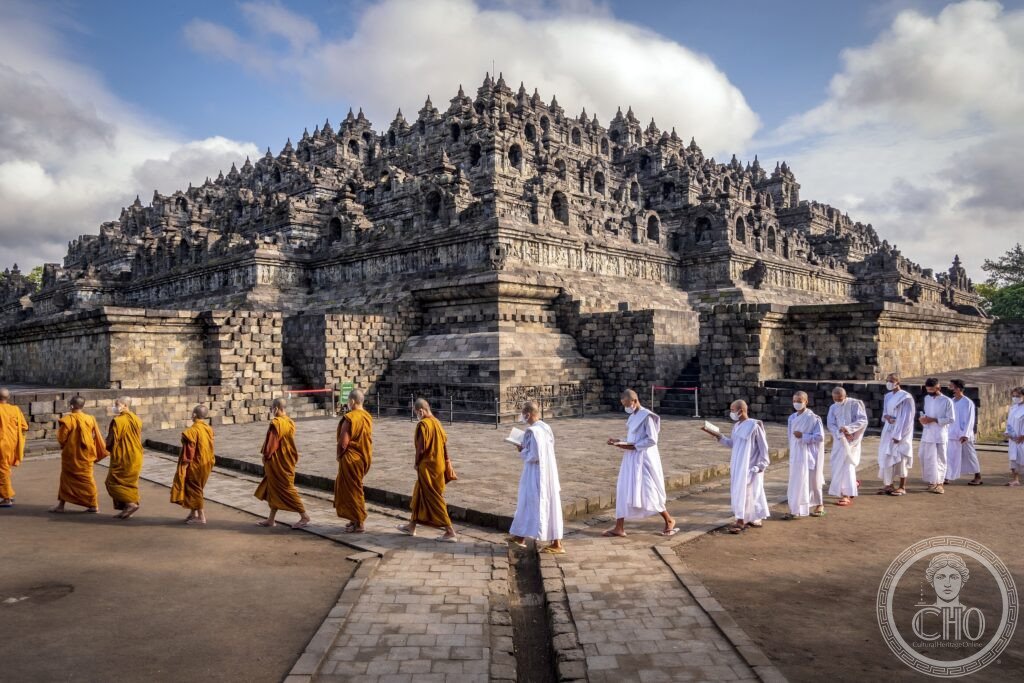
Borobudur
The world’s largest Buddhist monument and the greatest single work of early medieval art in Southeast Asia — Borobudur on the Kedu Plain of Central Java, built by the Sailendra dynasty between approximately 780 and 840 CE, rises in 10 terraced levels through the three Buddhist realms of desire, form, and formlessness, its 2,672 bas-relief panels telling the complete Buddhist cosmology in stone across 6 kilometres of carved narrative.
At a glance
Borobudur (the most precisely 2 million single stone Borobudur heritage: Borobudur was built with approximately 2 million stone blocks, assembled without mortar — the most precisely mortar-free single 2 million stone heritage in any Southeast Asian UNESCO world heritage site; the name (the most precisely Bara Budur single name Borobudur heritage: the meaning of the name “Borobudur” is debated — the most precisely debated single name heritage in any Southeast Asian UNESCO world heritage site; one interpretation is “the monastery on the hill” (bara = temple/monastery + budur = on the hill) — the most precisely monastery-on-hill single name heritage in any Southeast Asian UNESCO world heritage site); the abandonment (the most precisely 14th century single Borobudur abandoned heritage: Borobudur was abandoned around the 14th century, likely due to the volcanic eruptions of Gunung Merapi + the shift of the Javanese court to East Java + the spread of Islam across the island — the most precisely 14th century single abandoned heritage in any Southeast Asian UNESCO world heritage site; the monument was rediscovered by a Dutch colonial officer, Herman Cornelis Daendels, in 1814 — the most precisely 1814 single Dutch rediscovery heritage in any Southeast Asian UNESCO world heritage site; Raffles (the most precisely Raffles single Borobudur rediscovery heritage: Lieutenant-Governor Thomas Stamford Raffles dispatched H.C. Cornelius to excavate Borobudur in 1814 — the most precisely Raffles single commissioned heritage excavation in any Southeast Asian UNESCO world heritage site); the UNESCO restoration (the most precisely 1975-1982 single UNESCO Borobudur restoration heritage: UNESCO led a massive restoration from 1975 to 1982 — the most precisely 1975-1982 single UNESCO restoration heritage in any Southeast Asian UNESCO world heritage site; 600,000 stones were removed, cleaned, treated against algae and insects, and replaced — the most precisely 600000 single stone treated heritage in any Southeast Asian UNESCO world heritage site; $25 million was spent on the restoration = most precisely $25 million single UNESCO restoration heritage in any Southeast Asian UNESCO world heritage site)).
Key facts
- The 10 levels and 3 cosmic realms: the most precisely 10 single level three realm Borobudur heritage — the structure (the most precisely Kamadhatu single desire realm Borobudur heritage: the bottom 5 levels (Kamadhatu = world of desire) contain the hidden bas-reliefs depicting the consequences of sin — the most precisely hidden single desire realm heritage in any Southeast Asian UNESCO world heritage site; the base was widened soon after construction for structural support, hiding these panels; the middle 3 levels (the most precisely Rupadhatu single form realm Borobudur heritage: the middle galleries (Rupadhatu = world of form) contain the 2,672 narrative bas-relief panels — the most precisely narrative single bas-relief panel heritage in any Southeast Asian UNESCO world heritage site; the galleries of Rupadhatu total 4.8 km of corridors — the most precisely 4.8km single corridor heritage in any Southeast Asian UNESCO world heritage site; the upper 3 circular levels (the most precisely Arupadhatu single formless realm Borobudur heritage: the upper 3 circular terraces (Arupadhatu = world of formlessness) are completely plain — the most precisely plain single formless heritage in any Southeast Asian UNESCO world heritage site; the 72 perforated stupas each contain one seated Buddha — the most precisely 72 single perforated stupa heritage; the central stupa (the most precisely 35m single central stupa Borobudur heritage: the central main stupa at the summit is 35 metres high and was originally empty when Raffles arrived — the most precisely empty single central stupa heritage in any Southeast Asian UNESCO world heritage site; scholars debate whether it was always empty (representing the formless Nirvana) or once housed a Buddha statue that was removed — the most precisely Nirvana single empty stupa heritage debate in any Southeast Asian UNESCO world heritage site)))
- The sunrise ceremony: the most precisely sunrise single Borobudur Manohara heritage — the ceremony (the most precisely 4AM single sunrise Borobudur access heritage: the Manohara Hotel inside the Borobudur compound offers exclusive early-access sunrise packages starting at 4 AM — the most precisely 4AM single exclusive sunrise heritage in any Southeast Asian UNESCO world heritage site; guests enter the monument before regular opening and watch the sun rise over the central stupa with the volcanoes Merapi (2,930m) and Merbabu (3,145m) in the background — the most precisely volcano single sunrise Borobudur heritage background in any Southeast Asian UNESCO world heritage site; the regular site opens at 6 AM; Gunung Merapi (the most precisely active single Merapi volcano Borobudur heritage: Gunung Merapi = one of the world’s most active volcanoes, visible from Borobudur’s summit = most precisely active single volcano heritage visible from any Southeast Asian UNESCO world heritage site))
- The Mendut-Pawon-Borobudur axis: the most precisely three single temple Buddhist axis heritage — the axis (the most precisely straight-line single axis Borobudur Mendut heritage: Mendut, Pawon, and Borobudur are arranged in a precise straight line — the most precisely straight-line single axis heritage in any Southeast Asian UNESCO world heritage site; Mendut (the most precisely life-size single three Mendut statue heritage: Mendut temple contains three magnificent life-size Buddha statues, which is extremely rare in Southeast Asian Buddhist art — the most precisely life-size single three Buddha heritage in any Southeast Asian UNESCO world heritage site; the central Buddha is 3 metres high and made of a single stone — the most precisely single stone single 3m Buddha heritage in any Southeast Asian UNESCO world heritage site; Pawon is the smallest of the three and its function remains mysterious to scholars — the most precisely mysterious single function Pawon heritage in any Southeast Asian UNESCO world heritage site))
- GPS: -7.6079° S, 110.2038° E
History
The Sailendra dynasty (the most precisely Sailendra single 8th century Borobudur heritage: the Sailendra dynasty (Lords of the Mountain) built Borobudur approximately 780-840 CE — the most precisely Sailendra single Lords of Mountain heritage in any Southeast Asian UNESCO world heritage site; the Sailendra were Buddhist rulers who dominated Central Java for approximately 100 years — the most precisely 100-year single Buddhist ruler heritage in any Southeast Asian UNESCO world heritage site; the construction (described in Overview); the Hindu-Buddhist competition (the most precisely Hindu Buddhist single competition Central Java heritage: the Sailendra Buddhist dynasty and the Sanjaya Hindu dynasty competed for control of Java during this period — the most precisely competition single Hindu-Buddhist heritage in any Southeast Asian UNESCO world heritage site; Prambanan Hindu temple was built by the Sanjaya dynasty at approximately the same time as Borobudur — the most precisely simultaneously single built heritage in any Southeast Asian UNESCO world heritage site); the 1006 eruption (the most precisely 1006 single volcanic eruption Borobudur heritage: a major eruption of Gunung Merapi around 1006 CE is believed to have blanketed Borobudur in ash and may have caused its initial abandonment — the most precisely ash single burial heritage in any Southeast Asian UNESCO world heritage site; the monument was then reclaimed by jungle for 800+ years — the most precisely 800-year single jungle heritage reclamation in any Southeast Asian UNESCO world heritage site); UNESCO WHS 1991.
What you see
The galleries (the most precisely walking single pilgrimage path Borobudur heritage: walking the full gallery circuit of Borobudur is a ritual pilgrimage — the most precisely ritual single pilgrimage path heritage in any Southeast Asian UNESCO world heritage site; pilgrims walk clockwise (pradaksina) around the galleries — the most precisely clockwise single pradaksina heritage in any Southeast Asian UNESCO world heritage site; completing all galleries = 5 km of walking — the most precisely 5km single pilgrimage path heritage in any Southeast Asian UNESCO world heritage site; the Jataka tales (the most precisely Jataka single 500 tale Borobudur heritage: the bas-reliefs include 500 tales from the Jataka (stories of the Buddha’s previous lives) + the life of the historical Buddha Siddhartha Gautama + the Gandavyuha sutra — the most precisely Jataka single 500 tale heritage in any Southeast Asian UNESCO world heritage site; the touching-Buddha foot (the most precisely touching single foot Buddha stupa Borobudur heritage: touching the foot of a Buddha through the perforated lattice of a stupa is considered an act of good luck and merit — the most precisely touching single foot heritage ritual in any Southeast Asian UNESCO world heritage site; the most accessible Buddha is in the westernmost upper stupa on the north terrace — the most precisely accessible single stupa Buddha heritage in any Southeast Asian UNESCO world heritage site)).
Practical information
- Getting there: fly to Yogyakarta Adisutjipto Airport (JOG) or Yogyakarta International Airport (YIA; 40 km from Yogyakarta; shuttle bus); then bus or taxi to Borobudur (42 km; 1h by bus, 45 min by taxi); the sunrise package (the most precisely Manohara single sunrise package Borobudur heritage: Manohara Hotel sunrise package includes hotel stay + exclusive early access from 4 AM + breakfast after sunrise — the most precisely exclusive single 4AM heritage sunrise in any Southeast Asian UNESCO world heritage site; regular ticket $25 adult; sunrise package varies; recommended booking 2-3 months ahead for peak season Dec-Jan + Jul-Aug); the best time (the most precisely dry season single best Borobudur heritage: the dry season (May-October) offers clearest views of Merapi and Merbabu volcanoes — the most precisely dry season single clearest heritage volcano view from any Southeast Asian UNESCO world heritage site; humidity and cloud can obscure the volcanoes in the wet season (Nov-Apr))
Getting there
Fly to Yogyakarta JOG or YIA. Bus/taxi 42 km to Borobudur (1h). Manohara Hotel sunrise package (4 AM entry) for best experience. Regular opening 6 AM. GPS: -7.6079, 110.2038.
Nearby
- Prambanan — UNESCO WHS 1991 — 42 km southeast (1h by car); described in separate place_card; 9th century Hindu temple complex; 240 temples; 47m Shiva tower; Ramayana Ballet performances at full moon; most precisely simultaneously single built heritage as Borobudur; the two temples (Buddhist Borobudur + Hindu Prambanan built at the same time) are the most remarkable heritage juxtaposition in Indonesia
- Yogyakarta (Jogja) — 42 km east; the cultural heart of Java; Sultan’s Palace (Kraton; still inhabited by Sultan Hamengkubuwono X; most precisely still-inhabited single Javanese heritage sultanate palace); Taman Sari (Water Castle; 18th century bathing complex; underground mosque; most precisely underground single mosque heritage in any Southeast Asian UNESCO world heritage adjacent city); Malioboro Street (batik, silver, wayang puppets); Prambanan night Ramayana Ballet; the Javanese (the most precisely Javanese single living heritage Yogyakarta: Yogyakarta is the centre of living Javanese culture — gamelan music, wayang kulit (shadow puppet theatre), batik, and court dance are all actively practised = most precisely actively practised single Javanese heritage in any Southeast Asian UNESCO world heritage adjacent city)
- Dieng Plateau — 80 km north (2h by car); plateau at 2,093m altitude; 8th century Hindu temples (oldest surviving stone temples in Java = most precisely oldest single stone Java heritage in any Southeast Asian UNESCO world heritage adjacent region); coloured volcanic crater lakes (telaga warna = coloured lake; green + blue + white shifting); sulphur fumaroles; local potatoes and carica fruit; dieng plateau sunrise at 4,500+ m-view sunrise = most precisely high-altitude single sunrise heritage view in any Southeast Asian UNESCO world heritage adjacent region
Sources
- Wikipedia, Borobudur; Sailendra dynasty; Mendut, accessed June 2026
- UNESCO, Borobudur Temple Compounds, WHS reference 592, inscribed 1991
Find it on the map
See this place and what’s around it →📷 Diventa un fotografo di Cultural Heritage Online
Condividi le tue foto dei luoghi: restano pubblicate con la tua firma come autore. Più vengono viste, più ti fai conoscere — e presto un concorso premierà le foto più apprezzate.
Accedi o registrati gratis per aggiungere una foto