

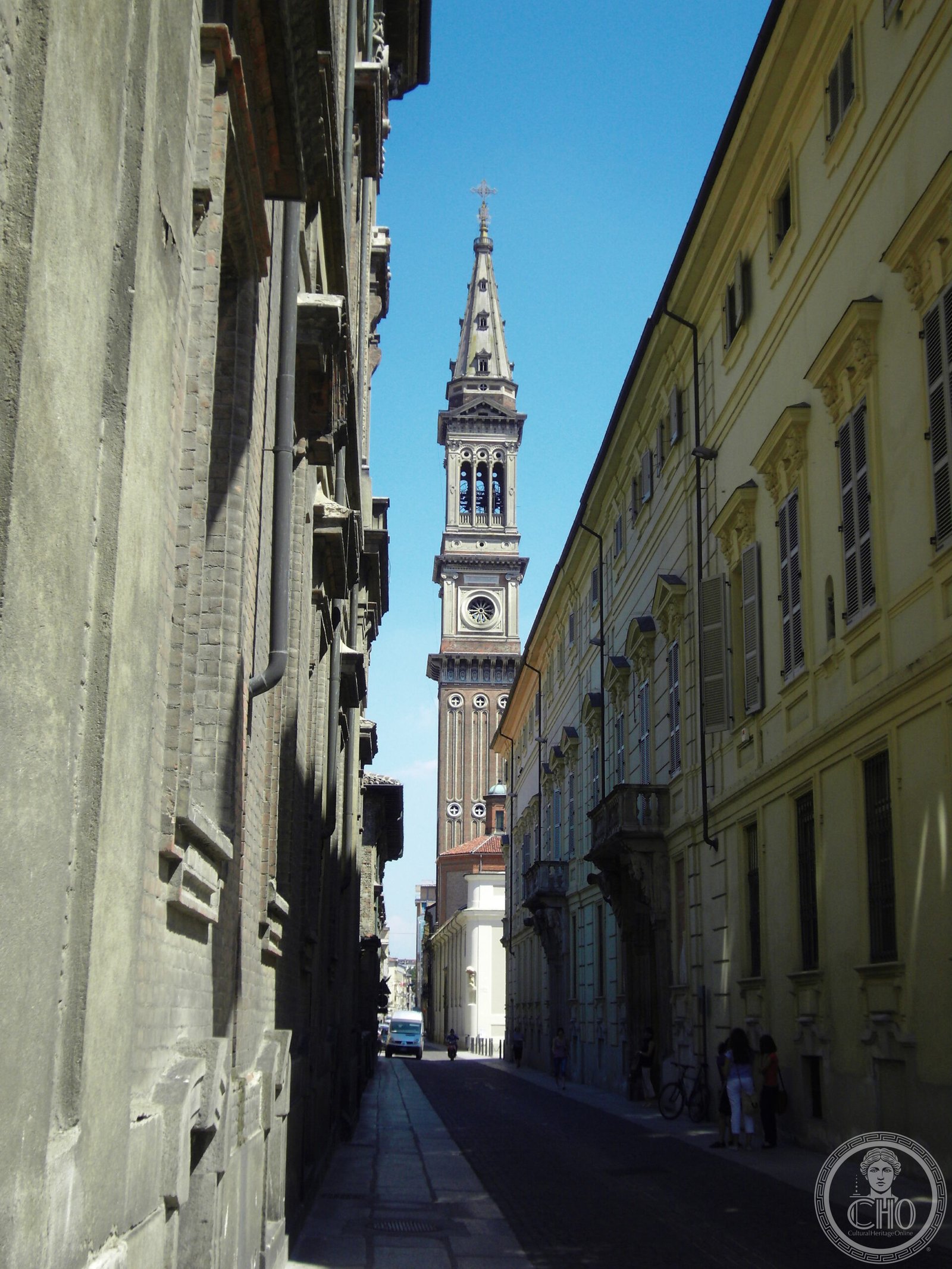
_(30290323536).jpg)
In 1857 Giuseppe Borsalino opened a hat workshop on the edge of Alessandria with a single apprentice and a rented machine. By 1900 his factory employed 2,500 workers and was producing 2.2 million hats a year. The Borsalino name became a synonym for the felt hat in seven languages — proof that a single small town in Piedmont could define a category of global dress.
At a glance
Borsalino was founded in Alessandria in 1857 by Giuseppe Borsalino, a young hatter from Pecetto di Valenza who had trained in Paris and returned to Piedmont to establish his own manufacture. The company grew to become the world's largest hat manufacturer by the early twentieth century, with production of fine felt hats at its peak factory complex on Via Cavour. The Borsalino hat — available in fedora, trilby, homburg, and panama variants — became the preferred headwear of Humphrey Bogart, Cary Grant, and Marcello Mastroianni; the 1970 French film Borsalino with Belmondo and Delon immortalised the brand in European popular culture. The company passed through successive ownership changes in the late twentieth and early twenty-first centuries, narrowly avoiding closure; the manufacturing tradition, however, remains anchored to Alessandria, where the felt is still made by hand in the complex Borsalino process.
Key facts
- Founded: 1857 by Giuseppe Borsalino in Alessandria
- City: Alessandria, Piemonte
- GPS: 44.9181, 8.6159
- Peak production: 2.2 million hats per year (early 20th century), 2,500 workers
- Famous wearers: Humphrey Bogart, Cary Grant, Marcello Mastroianni, Frank Sinatra
- Current website: borsalino.com
History
Giuseppe Borsalino had spent time working in a Parisian chapellerie before returning to Alessandria in the early 1850s. He opened his workshop on 4 April 1857 in a building near the Tanaro river with a single apprentice and ambitions shaped by what he had seen in France: that a well-made felt hat could be both a luxury object and a mass-market product if the process were sufficiently systematised. The felt hat manufacturing technique that Borsalino refined — beginning with raw rabbit and hare fur, beaten and matted into felt, then shaped over wooden blocks through successive stages of steaming, blocking, and ironing — required up to 52 hand operations before the hat was finished. This labour intensity, which seemed to limit industrial scalability, turned out to be compatible with factory organisation because each operation required relatively little skill while the sum of them produced an object of consistent quality.
The company expanded rapidly: by 1870 it had moved to a large factory on Via Cavour, the long commercial street that bisects the historic centre of Alessandria. By 1900, the Borsalino factory was the largest single employer in the city. The hat was exported to Europe, the Americas, and the British colonies; Italian emigrants wore Borsalinos as symbols of dignity in Argentina, the United States, and Brazil, and the hat's association with successful Italian identity in the diaspora was one of the sources of its international prestige.
The twentieth century was a steady, then accelerating, decline: the abandonment of hat-wearing by men in the 1960s and 1970s collapsed the mass market, leaving only the luxury segment. Borsalino survived through repeated restructurings, ownership changes (including the Austrian Hatico group and the Luxembourg-based investor Philippe Camperio), and a bankruptcy in 2018 that nearly ended the brand. It was acquired by the Singapore-based businessman Haresh Aswani in 2019 and continues to produce in Alessandria.
The city and the factory
Alessandria is a Piedmontese city on the Po plain east of Turin, at the junction of the Tanaro and Bormida rivers. Founded as a Lombard League fortification in 1168, it has a regular baroque grid of streets and a citadel (one of the best-preserved examples of eighteenth-century military architecture in Europe, now a UNESCO candidate) rather than a medieval centre — the result of its early modern role as a Savoy frontier fortress. The city's character is determinedly provincial: quiet piazzas, arcaded streets, the Duomo of San Pietro, the former Capuchin convent.
The Borsalino factory on Via Cavour is the dominant architectural presence in the industrial quarter: a long nineteenth-century building with a regular pattern of windows and a modest façade that gives no indication of the scale of its internal organisation. The Museo del Cappello, housed in the former production building, has been open intermittently due to the company's ownership changes. Visitors interested in the industrial heritage of hat-making should check the current status of museum access directly through borsalino.com or the Alessandria tourist office.
Practical information
- Museum: Check current status at borsalino.com or Alessandria tourist office (museum access has varied with ownership changes)
- Factory visits: Contact Borsalino directly for arranged group visits
- Hat shop: The Borsalino boutique network; the Alessandria flagship is on Via Cavour
- Time needed: Half a day in Alessandria, combining the Borsalino quarter with the citadel and historic centre
Getting there
Alessandria is on the Turin–Genoa railway (Turin Porta Nuova: 55 minutes; Genoa Piazza Principe: 60 minutes) and on the Milan–Genoa line (Milan Centrale: 80 minutes via Tortona). By car: A21 autostrada Torino–Piacenza, exit Alessandria Est or Alessandria Ovest. The Borsalino factory complex on Via Cavour is 15 minutes on foot from the railway station.
Nearby
- Alessandria Citadel — 18th-century fortification, one of the best-preserved in Europe; site of the Napoleonic battle of Marengo (1800)
- Monferrato wine hills — 20 km east, UNESCO-listed wine landscape (Asti, Canelli, Acqui Terme); Barbera, Moscato, and Dolcetto production
- Acqui Terme — 35 km south, Roman spa town, hot springs, Roman theatre ruins
- Asti — 40 km east, medieval towers, Palio horse race, Moscato d'Asti production
Sources
- Wikipedia (Italian): Borsalino (cappelli)
- Wikipedia (English): Borsalino
- Borsalino official: borsalino.com
- Wikimedia Commons: File:Alessandria (Piemonte, Italy), CC BY-SA 2.0. Courtesy image — the CHO community is invited to contribute a photo of the Borsalino factory or museum.
- Nominatim / OpenStreetMap: GPS 44.9181, 8.6159
Find it on the map
See this place and what’s around it →📷 Become a Cultural Heritage Online photographer
Share your photos of places: they stay published under your name as the author. The more they're seen, the more you get noticed — and soon a contest will reward the most appreciated photos.
Log in or sign up free to add a photoIs this page about you?
This page is read by travellers and heritage enthusiasts who find it on Google. Tell us how you are connected to this place and we will take it from there.