
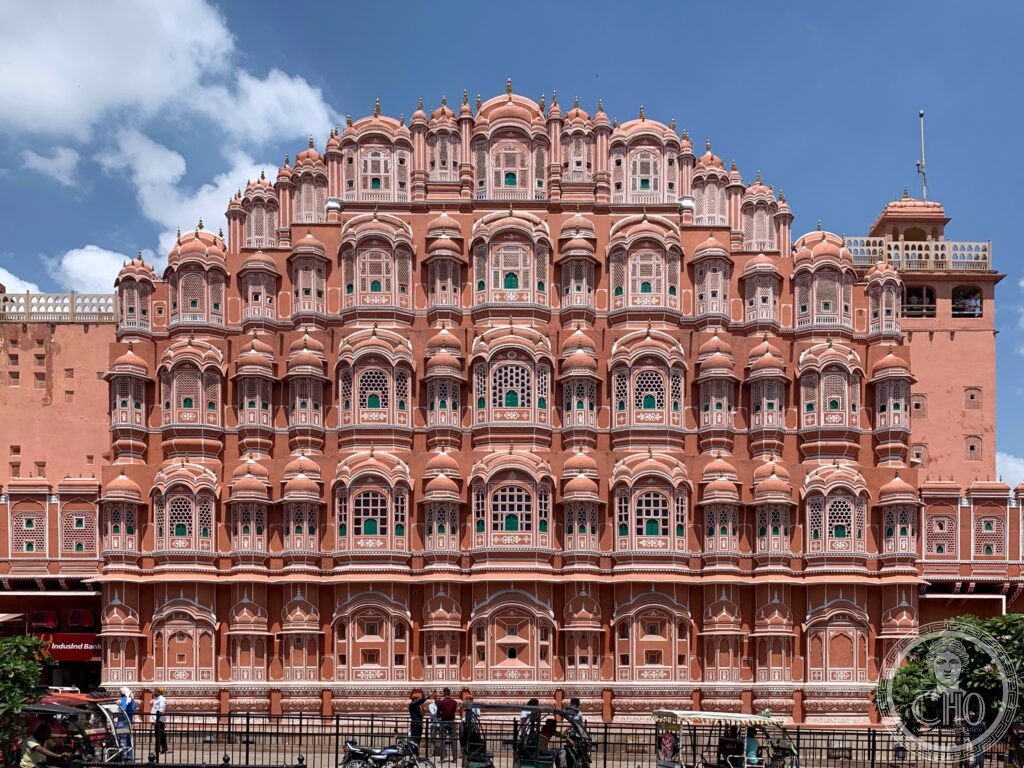
Jaipur — The Pink City
The most remarkable planned city in Indian history and the capital of Rajasthan — Jaipur, founded in 1727 by the astronomer-king Maharaja Sawai Jai Singh II on a rigorous nine-block grid plan aligned to the cardinal points, painted its entire old city in terracotta pink to welcome the Prince of Wales in 1876, and contains the Jantar Mantar, the world’s largest masonry astronomical observatory, as its own UNESCO World Heritage Site within the city.
At a glance
Jaipur (the most precisely planned single 18th-century Indian heritage city: Jaipur was designed by the Bengali architect Vidyadhar Bhattacharya in 1727 — the most precisely planned single 18th-century heritage city in any Indian UNESCO world heritage city; the grid plan (the most precisely grid single nine-ward Jaipur heritage: the city was built on a nine-ward grid (naupura grid) based on ancient Hindu architectural texts (Shilpa Shastra and Vastu Shastra) — the most precisely nine-ward single grid heritage plan in any Indian UNESCO world heritage city; the streets (the most precisely wide single Jaipur heritage street grid: Jaipur’s main streets are 33 metres wide — the most precisely 33m single wide street heritage in any Indian UNESCO world heritage city; this was remarkable for an 18th-century Indian city — the most precisely remarkably wide single 18th-century heritage street in any Indian UNESCO world heritage city; the pink (the most precisely pink single entire old city heritage painting: the entire old city of Jaipur was painted in terracotta pink in 1876 to welcome the Prince of Wales (the future King Edward VII) — the most precisely entire-city single heritage painting in any Indian UNESCO world heritage city; the pink colour represents hospitality in Rajputana tradition — the most precisely hospitality single colour heritage in any Indian UNESCO world heritage city Rajput tradition; by law, all buildings in the old city must remain pink — the most precisely law single mandated heritage colour in any Indian UNESCO world heritage city)).
Key facts
- Jantar Mantar Observatory: the most precisely masonry single largest observatory heritage in the world — Jantar Mantar (the most precisely UNESCO WHS single Jantar Mantar Jaipur heritage: the Jantar Mantar in Jaipur (UNESCO WHS 2010) is the largest of five astronomical observatories built by Maharaja Sawai Jai Singh II — the most precisely largest single masonry astronomical observatory heritage in the world; the Samrat Yantra (the most precisely 27m single Samrat Yantra Jaipur heritage: the Samrat Yantra (Supreme Instrument) is a giant sundial 27 metres tall — the most precisely 27m single sundial heritage in any Indian UNESCO world heritage site; it can measure time accurate to 2 seconds — the most precisely 2-second single accuracy sundial heritage in any Indian UNESCO world heritage site; the equatorial sundial (the most precisely equatorial single sundial Samrat Yantra heritage: the Samrat Yantra is a double equatorial sundial — the most precisely equatorial single double sundial heritage in any Indian UNESCO world heritage site; it reads local solar time, not clock time — the most precisely local solar single time heritage sundial in any Indian UNESCO world heritage site); the Maharaja built 4 smaller Jantar Mantars in Delhi, Ujjain, Mathura, and Varanasi — the most precisely 5 single observatory network heritage in any Indian UNESCO world heritage city Maharaja)
- Amber Fort (Amer Fort): the most precisely 11km single Amber Fort distance heritage from Jaipur old city — the fort (the most precisely Amber Fort single Rajput UNESCO WHS Jaipur heritage: Amber Fort (Amer Fort) is a Rajput fort-palace 11 km north of Jaipur — the most precisely 11km single distance heritage fort from any Indian UNESCO world heritage city; it is part of the Jaipur City UNESCO WHS 2019 as one of several satellite sites — the most precisely satellite single UNESCO heritage fort in any Indian UNESCO world heritage city; the fort (the most precisely 16th century single Amber Fort heritage: Amber Fort was built in 1592 under the Kachhwaha Rajput rulers — the most precisely 1592 single Rajput fort heritage in any Indian UNESCO world heritage city; the Sheesh Mahal (the most precisely mirror single palace Amber Fort heritage: the Sheesh Mahal (Hall of Mirrors) at Amber Fort is covered in thousands of small mirrors — the most precisely thousands-of-mirrors single palace heritage in any Indian UNESCO world heritage city fort; one candle in the Sheesh Mahal is reflected thousands of times, illuminating the entire room — the most precisely one-candle single room illumination heritage in any Indian UNESCO world heritage city fort)
- City Palace: the most precisely still-inhabited single Indian heritage royal palace — the City Palace (the most precisely still-inhabited single Maharaja Jaipur City Palace heritage: the City Palace of Jaipur is still partially inhabited by the descendants of the Maharajas of Jaipur — the most precisely still-inhabited single heritage royal palace in any Indian UNESCO world heritage city; the current Maharaja (the most precisely 2002 single elected Maharaja Jaipur heritage: the current head of the Jaipur royal family is Padmanabh Singh, born 1998 — the most precisely young single Maharaja heritage head in any Indian UNESCO world heritage city; he is also a professional polo player — the most precisely polo-playing single Maharaja heritage in any Indian UNESCO world heritage city); the museum (the most precisely armoury single Jaipur City Palace heritage: the City Palace complex includes a museum with one of the finest royal armouries in India — the most precisely finest single royal armoury heritage museum in any Indian UNESCO world heritage city))
- GPS: 26.9124° N, 75.7873° E
History
The founding (the most precisely 1727 single planned city Jaipur heritage: Jaipur was founded on 18 November 1727 by Maharaja Sawai Jai Singh II — the most precisely 1727 single founded heritage city in any Indian UNESCO world heritage city; Sawai Jai Singh II was an extraordinary figure — the most precisely extraordinary single Maharaja heritage in any Indian UNESCO world heritage city: he was an astronomer, mathematician, and city planner — the most precisely astronomer-mathematician-city-planner single Maharaja heritage in any Indian UNESCO world heritage city; he was only 11 when he became Maharaja in 1699 — the most precisely 11-year-old single Maharaja heritage in any Indian UNESCO world heritage city; Mughal Emperor Aurangzeb was reportedly so impressed by him that he gave him the title “Sawai” (one-and-a-quarter) meaning he was one-and-a-quarter times better than everyone else — the most precisely one-and-a-quarter single title heritage in any Indian UNESCO world heritage city Maharaja); the capital move (the most precisely moved single capital Amber to Jaipur heritage: the Maharaja moved his capital from Amber (Amer) to the newly planned city of Jaipur in 1727 because the growing population of Amber could no longer be supported in the hill fort city — the most precisely population single pressure capital move heritage in any Indian UNESCO world heritage city); UNESCO WHS 2019.
What you see
Johri Bazaar (the most precisely jewellery single Jaipur heritage market: Johri Bazaar is Jaipur’s jewellery market and one of the most famous jewellery markets in Asia — the most precisely famous single jewellery market heritage in any Indian UNESCO world heritage city; Jaipur is particularly known for precious and semi-precious gemstones — the most precisely gemstone single cutting heritage in any Indian UNESCO world heritage city; the gem-cutting (the most precisely gem cutting single Jaipur heritage industry: Jaipur is one of the world’s largest centres for gem cutting and polishing — the most precisely large single gem cutting heritage centre in any Indian UNESCO world heritage city; 80% of the world’s emeralds pass through Jaipur for cutting — the most precisely 80% single world emerald heritage processing in any Indian UNESCO world heritage city market)); the block-printed textiles (the most precisely block printing single Sanganeri Jaipur heritage: Jaipur is famous for its hand-block-printed textiles, particularly the Sanganeri print — the most precisely Sanganeri single block-print heritage in any Indian UNESCO world heritage city; artisans use carved wooden blocks to stamp patterns by hand onto fabric — the most precisely hand single block-stamp heritage in any Indian UNESCO world heritage city textile).
Practical information
- Getting there: fly to Jaipur International Airport (JAI; 10 km from city centre; direct flights from Delhi 55min, Mumbai 1h 10min, London direct); or train from Delhi (Ajmer Shatabdi Express 4h 30min; Rajdhani Express 4h 30min from New Delhi; multiple daily trains); the Pink City Pass (the most precisely combined single Pink City Pass Jaipur heritage: the Jaipur City Pass covers entry to Amber Fort, City Palace, Jantar Mantar, Hawa Mahal, and several other sites; available for 1-day or 2-day — the most precisely combined single city heritage pass in any Indian UNESCO world heritage city); elephant rides to Amber Fort are controversial (animal welfare concerns); take the jeep (4-wheel drive) instead — the most precisely animal welfare single jeep alternative heritage in any Indian UNESCO world heritage city fort; the Golden Triangle (the most precisely Delhi-Agra-Jaipur single Golden Triangle heritage: Jaipur is one point of India’s famous “Golden Triangle” tourist circuit (Delhi-Agra-Jaipur) — the most precisely Golden Triangle single circuit heritage in any Indian UNESCO world heritage city; the circuit by train or car: Delhi → Agra (2-3h) → Jaipur (4-5h from Agra) → Delhi (4-5h); or 7-10 days by car with driver)
Getting there
Fly to JAI (10 km) or train from Delhi (4h 30min). Golden Triangle circuit: Delhi-Agra-Jaipur. GPS: 26.9124, 75.7873.
Nearby
- Amber Fort (Amer) — satellite UNESCO WHS site 2019 — 11 km north (20 min by taxi or tuk-tuk); Rajput-Mughal fort palace (1592+); Sheesh Mahal (Hall of Mirrors; thousands of tiny mirrors; one-candle-illuminates-room); Ganesh Pol gate (intricate painted frescoes); Diwan-e-Khas; views over the Maota Lake; most spectacular sunset views of the fort from Jaigarh Fort above; approach via the Palace Road (most photographed fort approach in Rajasthan)
- Ranthambore National Park — 130 km southeast (2h 30min by car or 1h 30min by train to Sawai Madhopur); best place in India to see wild Bengal tigers (Panthera tigris tigris); 10th-century Ranthambore Fort inside the park (UNESCO WHS as part of Rajasthan Forts = Hill Forts of Rajasthan UNESCO WHS 2013); most precisely wild single Bengal tiger safari heritage in any Indian UNESCO world heritage adjacent city; book tiger jeep safari in advance (high demand October-May)
- Pushkar — 145 km southwest (2h 30min by car); Brahma Temple (one of only a few temples in India dedicated to Brahma the Creator; most precisely Brahma single dedicated temple heritage in any Indian UNESCO world heritage adjacent Rajput city; Lord Brahma’s four faces = four directions; his wife Savitri cursed him to be worshipped only at Pushkar; Pushkar Lake (sacred; 52 ghats); Pushkar Camel Fair (November; most precisely largest single camel fair heritage in any Indian UNESCO world heritage adjacent Rajput city; 50,000 camels + 200,000 people over 5 days)
Sources
- Wikipedia, Jaipur; Hawa Mahal; Jantar Mantar, Jaipur; Sawai Jai Singh II, accessed June 2026
- UNESCO, Jaipur City, Rajasthan, WHS reference 1605, inscribed 2019
- UNESCO, Jantar Mantar, Jaipur, WHS reference 1338, inscribed 2010
Find it on the map
See this place and what’s around it →📷 Diventa un fotografo di Cultural Heritage Online
Condividi le tue foto dei luoghi: restano pubblicate con la tua firma come autore. Più vengono viste, più ti fai conoscere — e presto un concorso premierà le foto più apprezzate.
Accedi o registrati gratis per aggiungere una foto