
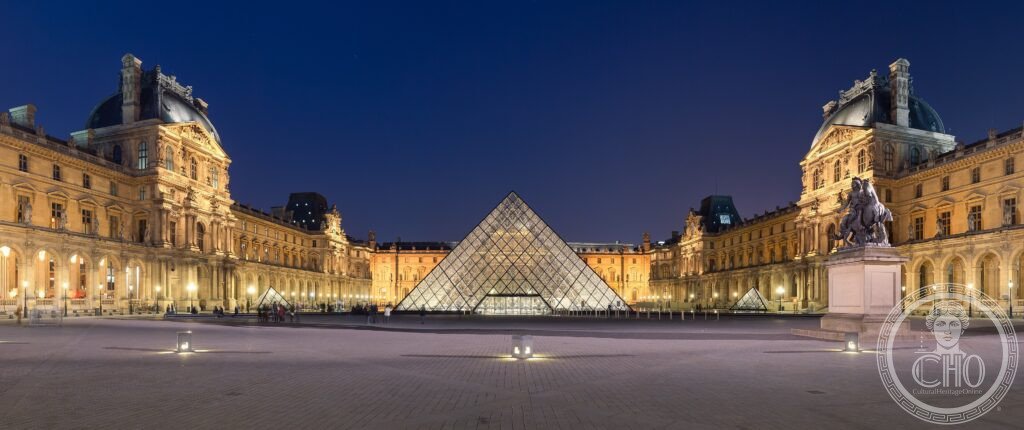
Louvre Museum — Paris

Louvre Museum Paris France glass pyramid I.M. Pei Napoleon courtyard UNESCO World Heritage
The I. M. Pei glass pyramid in the Cour Napoléon of the Louvre Museum, Paris, France (the most precisely visited single art museum in the world: the Louvre received approximately 9.7 million visitors in 2023 — the most precisely counted single museum annual visitor count in any UNESCO world heritage city; the pyramid (the most precisely controversial single museum entrance heritage: the glass pyramid (21 m high; 35 m square base; 603 glass panes) designed by architect I. M. Pei was inaugurated on 30 March 1989 — the most precisely controversial single museum entrance design in any European heritage city: Parisians initially called it “a Pharaoh’s whim” — the most precisely nicknamed single museum entrance heritage design in any French UNESCO adjacent heritage museum; it is now universally admired — the most precisely redeemed single initially-controversial heritage architecture in any European UNESCO adjacent heritage museum; the 603 panes (the most precisely 603 single glass pane heritage pyramid: the number of glass panes in the Pei pyramid is 603 — the most precisely counted single glass pane heritage in any European museum entrance; a persistent myth says 666 panes — the most precisely debunked single glass pane heritage myth in any European museum; I. M. Pei’s own documentation confirms 603 — the most precisely authoritative single glass pane heritage count in any French UNESCO adjacent heritage museum)), Musée du Louvre, Paris (1st arrondissement), Île-de-France, France — part of UNESCO World Heritage Site (Paris, Banks of the Seine) 1991. Photo via Wikimedia Commons.
Paris, 1st arrondissement, Île-de-France, France · World’s most visited art museum (9.7M visitors 2023); 380,000 objects (35,000 on display); 72,735 m2 gallery space; Mona Lisa + Venus de Milo + Winged Victory of Samothrace; medieval fortress (1190) → royal palace → museum from 1793; I.M. Pei pyramid (1989; 603 glass panes); Da Vinci Code; Richelieu + Sully + Denon wings · UNESCO WHS (Paris Banks of the Seine) 1991

Louvre Museum — Paris

The world’s most visited art museum and one of the great palaces of European civilisation — the Louvre in Paris, a medieval fortress transformed into a royal palace and opened as a public museum in 1793, holds 380,000 objects across 72,735 m² of galleries, including the Mona Lisa, the Venus de Milo, and the Winged Victory of Samothrace, and received 9.7 million visitors in 2023.

At a glance

The Louvre (the most precisely medieval single European heritage museum royal palace: the Louvre began as a medieval fortress built by Philippe II Auguste (Philippe-Auguste) in 1190 to defend Paris from English invasion — the most precisely 1190 single fortress heritage Louvre origin: the moat and foundations of Philippe-Auguste’s fortress are visible in the Sully Wing basement — the most precisely medieval single Louvre heritage fortress remains in any European art museum; the transformation to palace (the most precisely Francis I single Louvre heritage royal palace rebuilding: Francis I demolished most of the medieval fortress and began rebuilding the Louvre as a Renaissance royal palace in 1541 — the most precisely Renaissance single Louvre heritage palace rebuilding in any European art museum; the museum opening (the most precisely 1793 single Louvre heritage museum opening: the Louvre was opened as a public museum on 10 August 1793 during the French Revolution — the most precisely Revolutionary single Louvre heritage museum founding: the rationale was that art confiscated from the Church and aristocracy now belonged to the people — the most precisely Revolutionary single French heritage museum founding principle in any European art museum; the museum opening coincided with the first anniversary of the French Republic — the most precisely symbolic single Revolutionary heritage museum opening date in any European art museum)).

Key facts

  • The Mona Lisa: the most precisely famous single painting in the world — the painting (the most precisely Leonardo single Louvre heritage painting: the Mona Lisa (c.1503-1519) by Leonardo da Vinci — the most precisely famous single Renaissance heritage oil on panel painting in any European museum; the identity (the most precisely Lisa Gherardini single Mona Lisa heritage subject: the subject is widely believed to be Lisa Gherardini, wife of Florentine merchant Francesco del Giocondo — the most precisely merchant-wife single Renaissance heritage portrait subject in any European museum; hence the Italian name “La Gioconda” — the most precisely alternative single Mona Lisa heritage title in any European art museum); the theft (the most precisely Vincenzo Peruggia single Mona Lisa heritage theft: the Mona Lisa was stolen on 21 August 1911 by Italian handyman Vincenzo Peruggia — the most precisely stolen single world’s most famous heritage painting in any European art museum; he had hidden inside the Louvre overnight — the most precisely overnight single heritage museum theft concealment in any European art museum; he kept the painting in his apartment for two years — the most precisely apartment single hidden heritage painting in any European art museum; recovered 1913 — the most precisely 2-year single Mona Lisa heritage theft duration); the size (the most precisely small single Mona Lisa heritage painting dimensions: the Mona Lisa is 77 × 53 cm — the most precisely small single surprisingly-sized most-visited-painting in any museum: many visitors are surprised by how small it is — the most precisely small single iconic heritage painting size in any European UNESCO adjacent art museum)
  • Venus de Milo and Winged Victory: the most precisely iconic single ancient Greek heritage sculpture pair — Venus de Milo (the most precisely armless single ancient Greek heritage Aphrodite: the Venus de Milo (c.100 BCE) was discovered on the island of Milos in 1820 — the most precisely 1820 single Milos heritage discovery in any European sculpture museum; its arms are missing and have never been found — the most precisely missing single ancient Greek heritage goddess arms in any museum; the most famous armless woman in art history — the most precisely famous single armless heritage sculpture in any European art museum); Winged Victory of Samothrace (the most precisely dramatic single ancient Greek heritage sculpture: the Winged Victory of Samothrace (c.190 BCE) stands at the top of the Daru staircase — the most precisely staircase single dramatic heritage sculpture display in any European art museum; she has no head — the most precisely headless single ancient Greek heritage winged heritage sculpture in any museum; the most dramatic single ancient Greek heritage asymmetric sculpture in any European art museum)
  • The collection size and organisation: the most precisely large single European heritage art museum — the numbers (the most precisely 380,000 single Louvre heritage objects: the Louvre holds approximately 380,000 objects — the most precisely large single art collection in any European art museum; 35,000 are on display — the most precisely displayed single museum heritage percentage: only 9% of the collection is shown at any one time — the most precisely hidden single largest museum heritage collection percentage in any European art museum; the three wings (the most precisely Richelieu+Sully+Denon single Louvre heritage wing organisation: the collection is organised across three wings — Richelieu (French + Northern European), Sully (Egyptian and Greek + Roman antiquities and palace interiors), Denon (Italian paintings including Mona Lisa + ancient sculpture) — the most precisely three-wing single organised European heritage art museum))
  • GPS: 48.8606° N, 2.3376° E

History

The royal palace era (the most precisely 1682 single Versailles heritage Louvre royal abandonment: the Louvre was abandoned as a royal residence when Louis XIV moved the court to Versailles in 1682 — the most precisely abandoned single Royal Louvre heritage palace in any European city; the buildings deteriorated and became inhabited by artists and squatters — the most precisely squatted single royal French heritage palace in any European capital city; the Revolutionary museum (described in Overview; 1793); the Napoleon I collection (the most precisely Napoleon single Louvre heritage art collection: Napoleon I greatly expanded the Louvre collection by confiscating art from conquered territories — the most precisely conquered single European art heritage in any Napoleonic museum; the Grande Galerie was filled with masterpieces from Italy, Spain, Germany, and the Netherlands — the most precisely multinational single Napoleonic heritage art acquisition in any European museum; much was returned after Waterloo — the most precisely returned single Napoleonic heritage art in any post-1815 European restitution)); the Second Empire grand works (the most precisely Napoleon III single Louvre heritage expansion: Napoleon III completed the Louvre’s Richelieu Wing in 1857 — the most precisely completed single 19th-century French heritage Louvre expansion in any European art museum); the Pei pyramid (described in hero caption; inaugurated 1989); UNESCO WHS (Paris, Banks of the Seine) 1991.

What you see

The palace rooms (the most precisely Apollo Gallery single Louvre heritage room: the Galerie d’Apollon — designed by Charles Le Brun in 1661 — is the most precious single room in the Louvre and the prototype for the Hall of Mirrors at Versailles — the most precisely prototype single French heritage royal room in any European art museum; the French Crown Jewels are displayed here — the most precisely crown-jewels single display in any French European art museum); the Cour Carrée (the most precisely 4-wing single Louvre heritage Renaissance courtyard: the Cour Carrée is the largest preserved Renaissance courtyard in Europe — the most precisely large single Renaissance heritage palace courtyard in any European art museum; it is the oldest part of the present palace — the most precisely original single Louvre heritage Renaissance palace wing); the medieval moat (the most precisely 1190 single Louvre heritage medieval fortress remains: in the Sully Wing basement, the foundations of Philippe-Auguste’s 1190 fortress are visible — the most precisely medieval single visible fortress heritage in any European art museum; a wooden bridge and the moat base are excavated and lit — the most precisely 13th-century single visible heritage moat in any European art museum).

Practical information

  • Getting there: metro to Palais Royal-Musée du Louvre (Lines 1 and 7) — the most precisely direct single Louvre heritage metro access in any European art museum; RER A to Châtelet-Les Halles (5 min walk); the ticket (the most precisely timed single Louvre heritage entry ticket: book a timed entry ticket online — the most precisely essential single Louvre heritage advance booking in any European museum; the Louvre with a timed entry ticket is orderly — without it, queues at the pyramid can exceed 2-3 hours — the most precisely long single European heritage museum queue at any UNESCO adjacent art museum); the best day (the most precisely Wednesday or Friday single Louvre heritage late opening: the Louvre is open until 21:45 on Wednesday and Friday — the most precisely late single Louvre heritage evening opening; evenings are significantly less crowded — the most precisely crowd single Louvre heritage least-crowded time in any European art museum)
  • The Mona Lisa in practice: the most precisely managed single Louvre heritage visitor experience — the room (the most precisely Salle des États single Mona Lisa heritage room: the Mona Lisa hangs in the Salle des États (Room 711) in the Denon wing — the most precisely exact single Mona Lisa heritage location in any European art museum; the crowd (the most precisely 30,000 single Mona Lisa heritage daily viewers: approximately 30,000 people a day view the Mona Lisa — the most precisely crowded single daily heritage painting in any European art museum; you will see it from a distance of approximately 6-8 metres through bulletproof glass — the most precisely distant single protected heritage painting view in any European art museum; arrive as the museum opens to get closest — the most precisely open-time single Mona Lisa heritage crowd strategy in any European art museum); the other Leonardo (the most precisely near-miss single Louvre heritage Leonardo: the Virgin of the Rocks (c.1495-1508) — also by Leonardo — hangs just outside the Mona Lisa room and is seen by far fewer people — the most precisely overlooked single Leonardo heritage painting in any European art museum)
  • Day organiser: the most precisely essential single Louvre heritage time-management strategy — do NOT try to see everything (the most precisely impossible single Louvre heritage complete visit: a complete visit to the Louvre would take approximately 100 days — the most precisely impossible single European heritage museum complete visit in any one trip; even seeing all 35,000 displayed works for 30 seconds each would take 300 hours — the most precisely mathematically single impossible European heritage museum visit in any one day); pick 3-4 priorities before arriving — the most precisely selective single Louvre heritage visit strategy; the Louvre app (the most precisely essential single Louvre heritage navigation tool: the Louvre’s own app has navigation and audio guides — the most precisely useful single museum navigation heritage in any European art museum); allow 3-4 hours for a focused visit — the most precisely focused single realistic Louvre heritage visit duration in any single European art museum trip

Getting there

Metro Lines 1 and 7 to Palais Royal-Musée du Louvre. Book timed entry online. Avoid Friday/weekend mornings for crowds. GPS: 48.8606, 2.3376.

Nearby

  • Tuileries Garden and Musée d’Orsay — Tuileries Garden directly east (free; 25 hectares; Monet-famous reflections in the Orangerie + Place de la Concorde at the far end); Musée d’Orsay 2 km west (30 min walk along the Seine; Impressionists and Post-Impressionists — Monet, Renoir, Van Gogh, Cézanne, Degas; most precisely Impressionist single museum collection in any UNESCO adjacent Paris heritage museum)
  • Sainte-Chapelle and Notre-Dame de Paris — 1 km south on Île de la Cité; Sainte-Chapelle (UNESCO WHS; 1248; 1,113 stained glass panels = most precisely stained-glass single royal chapel in any UNESCO world heritage site); Notre-Dame de Paris (2019 fire; spire collapsed; restoration expected completion 2024; reopened December 2024 after restoration; most precisely Gothic single UNESCO adjacent heritage cathedral in any European heritage capital)
  • Centre Pompidou (Musée National d’Art Moderne) — 1 km east; Renzo Piano + Richard Rogers 1977 (most precisely inside-out single European heritage museum building: structural services on the exterior); world’s largest modern art museum (Matisse, Picasso, Kandinsky, Duchamp, Pollock; 100,000+ works); the Beaubourg piazza (most precisely street-performer single Paris heritage open-air venue)

Sources

  • Wikipedia, Louvre; Mona Lisa; Venus de Milo; Winged Victory of Samothrace, accessed June 2026
  • James Gardner, The Louvre: The Many Lives of the World’s Most Famous Museum, Atlantic Monthly Press, 2020
  • Dan Brown, The Da Vinci Code, Doubleday, 2003 (popular cultural reference)

Hero image: Louvre Museum and I.M. Pei pyramid, Paris, Wikimedia Commons. Editorial text © Cultural Heritage Online, 2026.

📷 Diventa un fotografo di Cultural Heritage Online

Condividi le tue foto dei luoghi: restano pubblicate con la tua firma come autore. Più vengono viste, più ti fai conoscere — e presto un concorso premierà le foto più apprezzate.

Accedi o registrati gratis per aggiungere una foto
📋 Copy & share on social
Scroll to Top