
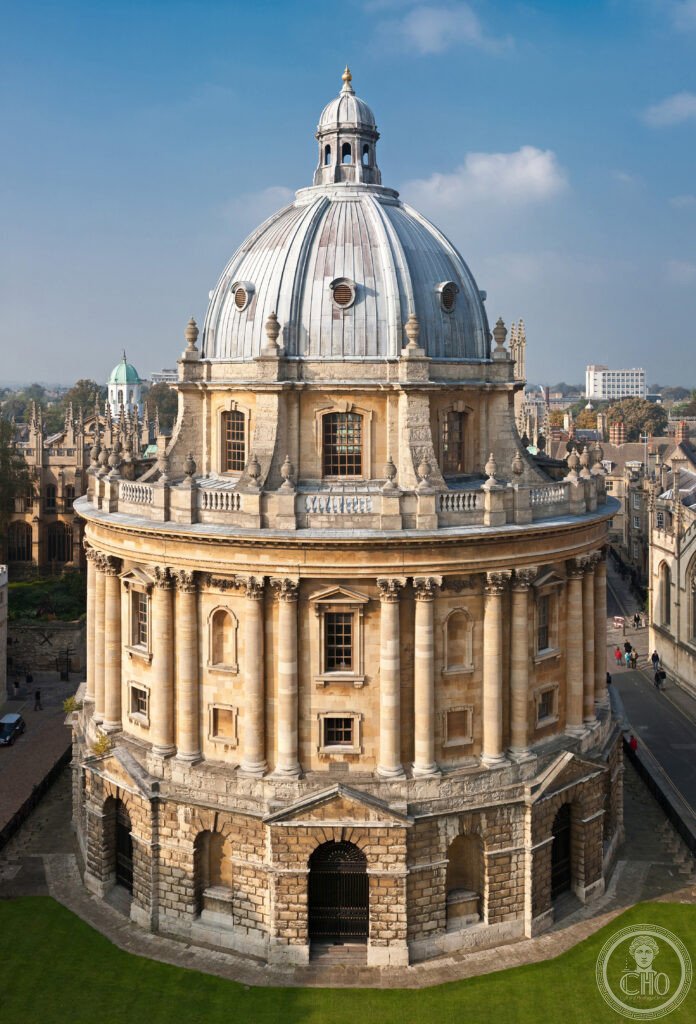
Oxford is the oldest university in the English-speaking world, its teaching traceable to 1096 and its character built from thirty-eight semi-independent colleges bound into one federal institution. Visitors find a working research library with roots in royal legal deposit, a domed Baroque reading room, and streets that have shaped English history, politics and fiction in equal measure.
At a glance
The University of Oxford is the oldest university in the English-speaking world, with teaching recorded from 1096. A formal academic community took shape by 1167-1168, after Henry II barred English students from studying in Paris and sent a wave of scholars back to Oxford. The university today is organised as a collegiate federation: thirty-eight semi-independent colleges, each with its own dining hall, chapel, library and quadrangles, bound together under the wider university.
Key facts
- Founded: teaching recorded from 1096; a formal university community established by 1167-1168.
- Structure: 38 semi-independent colleges within a single federal university.
- Bodleian Library: founded on Duke Humphrey of Gloucester’s 1488 donation and refounded by Thomas Bodley in 1602; holder of legal deposit rights from 1610, extended to all formats from 2003; the collection runs to millions of books, manuscripts and digital objects, including one of the surviving Shakespeare First Folios.
- Christ Church: founded by Cardinal Wolsey in 1525 and refounded by Henry VIII in 1546; linked to Lewis Carroll’s Alice’s Adventures in Wonderland and to the Great Hall that inspired the Hogwarts hall in the Harry Potter films.
- Alumni: British prime ministers including Gladstone, Asquith, Harold Macmillan, Margaret Thatcher, Tony Blair, David Cameron and Boris Johnson; a long list of Nobel laureates; writers C.S. Lewis and J.R.R. Tolkien, who founded the Inklings discussion group.
- Coordinates: 51.7548° N, 1.2544° W.
History
Oxford’s teaching tradition is recorded from 1096, and the university took organised shape after 1167-1168, when Henry II’s expulsion of English students from the University of Paris sent scholars back to Oxford in numbers. Relations between university and town were not always easy: on 10 February 1355 a dispute in a tavern escalated into two days of fighting between scholars and townspeople, remembered as the St Scholastica Day Riot. In punishment, the Mayor of Oxford was required each year to attend a church service on St Scholastica’s Day wearing a black cloak, carrying a candle and paying a fine, a penance that continued until 1825.
The Reformation left its own mark on the city: Archbishop Thomas Cranmer, principal author of the Book of Common Prayer, was burned at the stake on Broad Street on 21 March 1556, said to have thrust his right hand into the flames first in atonement for an earlier recantation. During the English Civil War, Oxford served as the Royalist capital between 1642 and 1646. Later writers found gentler images for the city: Matthew Arnold called it ‘that sweet city with her dreaming spires.’
What you see
Oxford’s centre is compact and best explored on foot. The High Street, known simply as ‘The High’, curves from Carfax Tower to Magdalen Bridge and is counted among the great streets of Europe. Christopher Wren’s Sheldonian Theatre, completed in 1669 as his first major commission, took its design from the Theatre of Marcellus in Rome. The Ashmolean Museum, opened in 1683 around Elias Ashmole’s donated collection, is regarded as the first university museum in the world. Hertford Bridge, popularly known as Oxford’s Bridge of Sighs, spans New College Lane, though it has no functional connection to its Venetian namesake.
Practical information
- Bodleian Library tours: guided tours run regularly and take in Duke Humphrey’s Library; photography is restricted in some reading rooms, and current tour arrangements should be checked with the Bodleian directly.
- Divinity School: the medieval Divinity School, completed in 1488, appears in the Harry Potter films as the Hogwarts hospital; a separate paid Bodleian Experience gives access to the vaulted cellars and Convocation House.
- Christ Church Meadow: reached from the college, it is the only meadow attached to an English city-centre university college, with grazing cattle close to the city centre.
- Punting: punts can be hired on the Cherwell from Magdalen Bridge in the warmer months; falling in is treated locally as more or less inevitable.
Getting there
Oxford is reached by direct train from London Paddington, with frequent services through the day, or by coach from Victoria, a cheaper if slower option. By car the city lies off the M40, but drivers are advised to leave vehicles at the Park and Ride sites on the outskirts, since parking in the centre is heavily restricted. Once there, the city is best covered on foot.
Nearby
- Blenheim Palace — north of Oxford; birthplace of Winston Churchill and the largest non-royal residence in England, built by Vanbrugh and Hawksmoor between 1705 and 1722 with gardens laid out by Capability Brown; inscribed as a UNESCO World Heritage Site in 1987.
- Stonehenge — southwest of Oxford; the prehistoric stone circle dating from around 3000 to 1500 BCE, with sarsen stones up to 13 metres tall and a known solstice alignment; inscribed as a UNESCO World Heritage Site in 1986.
- The Cotswolds — west of Oxford; an Area of Outstanding Natural Beauty taking in villages such as Bourton-on-the-Water, Burford and Chipping Campden, built in honey-coloured stone, and the starting point of the Cotswold Way to Bath.
Sources
- Wikipedia (University of Oxford, Bodleian Library, Christ Church Oxford, Radcliffe Camera)
- Jan Morris, Oxford, Oxford University Press, 1965
- Peter Swinyard, Oxford: A Short History, Dovecote Press, 2016
Find it on the map
See this place and what’s around it →📷 Become a Cultural Heritage Online photographer
Share your photos of places: they stay published under your name as the author. The more they're seen, the more you get noticed — and soon a contest will reward the most appreciated photos.
Log in or sign up free to add a photoIs this page about you?
This page is read by travellers and heritage enthusiasts who find it on Google. Tell us how you are connected to this place and we will take it from there.