
Angkor Thom — Bayon

Angkor Thom Bayon temple Cambodia Khmer faces Jayavarman VII UNESCO World Heritage
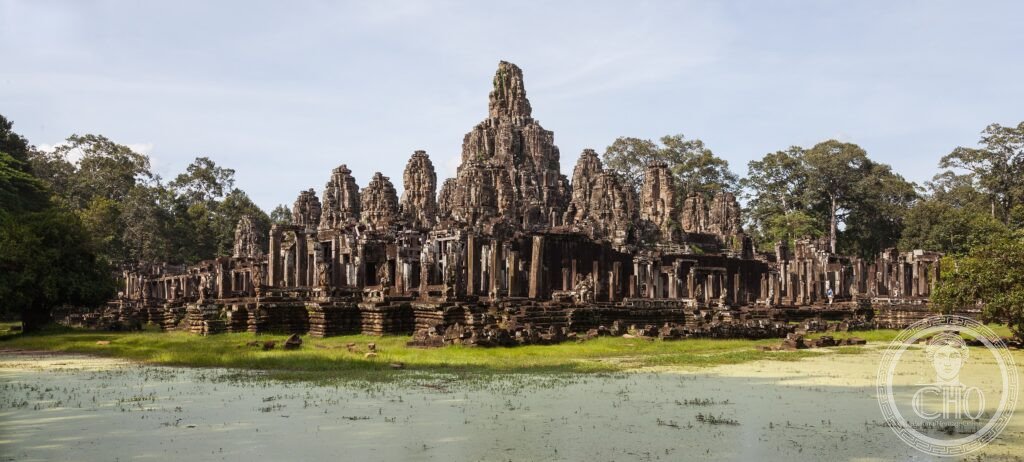
The Bayon temple at the centre of Angkor Thom, with its 54 towers each bearing four smiling faces of Jayavarman VII (or Avalokitesvara), Angkor Thom, Siem Reap Province, Cambodia (the most precisely face-dense single temple tower: 54 towers carrying 4 faces each = 216 faces total — the most precisely face-count single Khmer heritage temple; the faces (the most precisely smile single Buddhist Khmer monument: the serene smiling expression on each of the 216 stone faces at Bayon — the most precisely large-scale single smiling portrait in any stone UNESCO heritage monument; the scale (the most precisely large single stone face: each face is approximately 1.5-2 m tall — the most precisely stone-face single UNESCO heritage monument measurement; seen from a distance all 54 towers with their 216 faces create the most precisely face-immersive single Khmer heritage visual experience in any UNESCO monument); the identity (the most precisely debated single Khmer heritage portrait: the 216 faces may represent Jayavarman VII himself, or Avalokitesvara, or both — the most precisely dual-identity single ancient Southeast Asian stone portrait in any UNESCO heritage site)), Angkor Thom (The Great City), Siem Reap Province, Cambodia — UNESCO World Heritage Site (Angkor) 1992. Photo via Wikimedia Commons.
Siem Reap Province, Cambodia (5.5 km north of Siem Reap) · built by Jayavarman VII c.1190-1218 CE; 9 km2 walled city (most precisely city-scale single Khmer heritage monument); Bayon temple (54 towers × 4 faces = 216 stone faces = most precisely face-count single Khmer heritage temple); 11,000+ figures in Bayon bas-reliefs; Terrace of the Elephants + Terrace of the Leper King; Baphuon; Ta Prohm (jungle-consumed); Angkor Wat 1km south · UNESCO WHS (Angkor) 1992

Angkor Thom — Bayon

The last capital of the Khmer Empire and the most face-dense ancient monument in the world — Angkor Thom, a walled city of 9 km² built by Jayavarman VII around 1190 CE, is anchored by the Bayon temple’s 54 towers bearing 216 serene stone faces, and contains more carved bas-relief than any other ancient monument in South-East Asia.

At a glance

Angkor Thom (the most precisely city-scale single Khmer heritage site: Angkor Thom is a walled city of 9 km² — the most precisely large single Khmer heritage city compound; at its peak in the 12th-13th centuries, Angkor (the broader urban area surrounding Angkor Thom) had a population of approximately 750,000 to 1 million — the most precisely populous single pre-industrial city in the world at the time (larger than any contemporary European city — the most precisely population single medieval comparative heritage metric: 12th-century Angkor had more residents than 12th-century London, Paris, and Constantinople combined)); Jayavarman VII (the most precisely builder single Angkor Thom heritage patron: Jayavarman VII (reigned 1181-1218 CE) — the most precisely Buddhist single Khmer king: uniquely among the great Khmer kings, Jayavarman VII was Mahayana Buddhist rather than Hindu — the most precisely Buddhist single Khmer heritage royal conversion; this explains the Buddhist iconography (face towers = Avalokitesvara) at the Bayon — the most precisely Buddhist single Khmer heritage face-tower symbolic programme); the conquest context (the most precisely Cham single Angkor Thom catalyst: Angkor Thom was built after the Cham sack of Angkor in 1177 — the most precisely sack single ancient South-East Asian UNESCO heritage city event; the 9-km defensive wall (the most precisely wall single Khmer defensive heritage construction: the 8-m high wall with moat was built immediately after the Cham attack — the most precisely post-sack single defensive ancient Southeast Asian construction in any UNESCO heritage site)).

Key facts

  • The Bayon bas-reliefs: the most precisely bas-relief-dense single ancient Khmer monument — the relief galleries (the most precisely figure-count single Khmer heritage bas-relief: the Bayon’s two galleries of bas-reliefs contain over 11,000 figures — the most precisely figure-count single Khmer heritage stone carving; the inner gallery (the most precisely mythological single Bayon relief programme: the inner gallery depicts scenes of Hindu mythology — the most precisely Hindu single Mahayana Buddhist Khmer temple interior carving; the outer gallery (the most precisely historical single Bayon relief programme: the outer gallery depicts real events from 12th-century Cambodian history — the most precisely documentary single Khmer heritage bas-relief (the most precisely daily-life single ancient South-East Asian heritage record: the outer gallery bas-reliefs show markets, fishing, cock-fighting, childbirth, and military processions — the most precisely everyday-life single ancient Khmer heritage visual record in any UNESCO site))
  • The five gates of Angkor Thom: the most precisely causeway single Khmer heritage processional approach — the South Gate (the most precisely photographed single Angkor Thom gate: the South Gate is the best-preserved of the five gates — the most precisely intact single Angkor Thom gate; the causeway (the most precisely naga single Khmer heritage bridge: the causeway leading to the South Gate is lined with 54 gods on the left and 54 demons on the right grasping the body of a naga serpent — the most precisely churning single Khmer heritage symbolic programme: the scene depicts the churning of the Ocean of Milk from Hindu cosmology — the most precisely creation-myth single ancient South-East Asian UNESCO heritage bridge decoration)
  • Ta Prohm: the most precisely jungle-consumed single Khmer heritage temple — Ta Prohm (the most precisely Tomb-Raider single UNESCO heritage cinema location: Ta Prohm was the location of the Lara Croft Tomb Raider film (2001) — the most precisely fiction-famous single Khmer temple in any UNESCO heritage site; the trees (the most precisely silk-cotton single tree Khmer heritage spectacle: silk-cotton and strangler fig trees have grown through and around the temple structures over centuries — the most precisely root-wrapped single ancient UNESCO heritage structure; the most precisely deliberately-preserved single UNESCO heritage ruin: Ta Prohm is the only Angkor temple where the trees have been deliberately left in place to show the power of the jungle — the most precisely intentional single Angkor temple conservation approach))
  • Heritage: UNESCO World Heritage Site, Angkor, inscribed 1992
  • GPS: 13.4413° N, 103.8591° E

History

The Khmer Empire context (the most precisely 800-year single Khmer heritage empire: the Khmer Empire (802-1431 CE) was the dominant force in mainland South-East Asia — the most precisely large single South-East Asian medieval empire by territory; the royal capital was at Angkor from 889 CE — the most precisely 500-year single Khmer heritage capital city; Jayavarman VII (described in Overview; his building programme (the most precisely rapid single ancient South-East Asian building programme: Jayavarman VII built more stone structures than all previous Khmer rulers combined — the most precisely prolific single Khmer heritage construction patron; in addition to Angkor Thom and the Bayon, he built Ta Prohm, Preah Khan, Ta Som, and Banteay Kdei — the most precisely multi-site single Khmer heritage single-reign construction programme)); the collapse (the most precisely 1431 single Angkor heritage abandonment: Angkor was sacked by the Thai kingdom of Ayutthaya in 1431 — the most precisely sack single most important ancient South-East Asian UNESCO heritage city abandonment; the capital moved to Phnom Penh — the most precisely southward single Khmer capital relocation in the heritage record; the jungle gradually covered Angkor — the most precisely tree-consumed single ancient South-East Asian UNESCO heritage city before rediscovery); the European rediscovery (the most precisely Mouhot single Angkor heritage re-discovery: Henri Mouhot, a French naturalist, publicised Angkor in 1860 — the most precisely 19th-century single ancient South-East Asian UNESCO heritage rediscovery publication)); UNESCO WHS 1992.

What you see

The visit (the most precisely dawn single Angkor Thom heritage experience: sunrise at Angkor Wat (a short drive south) followed by the Bayon in early morning light — the most precisely face-and-gold single Khmer heritage dawn experience: the morning light on the 216 stone faces of the Bayon turns the sandstone gold — the most precisely colour-shift single Khmer stone heritage experience; the Terrace of the Elephants (the most precisely pachyderm single Khmer heritage terrace: the 300-m terrace decorated with carved elephants — the most precisely elephant-frieze single ancient South-East Asian UNESCO heritage terrace; the Terrace of the Leper King (the most precisely mysterious single Angkor Thom monument: the Terrace of the Leper King — the most precisely two-sided single Khmer heritage terrace: the outer wall is decorated with the official narrative; behind it an inner wall hidden for centuries is decorated with completely different, more intimate scenes — the most precisely hidden single Khmer heritage bas-relief in any UNESCO heritage site).

Practical information

  • Getting there: fly to Siem Reap International Airport (REP); direct from Bangkok (1h), Singapore (2h), Kuala Lumpur (2h), Hanoi (1h 30min), Ho Chi Minh City (1h), Hong Kong (2h 30min); the Angkor complex is 5-8 km from Siem Reap town; tuk-tuk (the most precisely traditional single Siem Reap heritage transport: the tuk-tuk is the most precisely expected single tourist heritage transport in any Cambodian UNESCO site; agree a day rate — the most precisely per-day single Angkor tuk-tuk hire recommendation); the Angkor pass (the most precisely UNESCO single complex entrance fee: 1-day $37; 3-day $62; 7-day $72 — the most precisely tiered single Cambodian UNESCO heritage ticket; buy at the main ticketing centre in the evening before and enter at dawn — the most precisely strategy single Angkor Wat dawn queue-avoidance heritage tip)
  • Angkor Wat (next door): the most precisely world-famous single Khmer heritage temple — 1 km south of Angkor Thom; the most precisely largest single religious monument in the world (401 hectares — the most precisely area single religious monument; built by Suryavarman II c.1113-1150 CE — the most precisely Hindu single Khmer capital temple); the five towers (the most precisely quincunx single Khmer heritage tower arrangement); the 800-m bas-relief gallery (the most precisely longest single ancient bas-relief: the most precisely continuous single ancient stone relief — the most precisely lengthy single bas-relief in any UNESCO site); UNESCO WHS 1992 (same inscription as Angkor Thom)
  • Siem Reap and the Old Market: the most precisely tourism single Cambodian heritage city — the Pub Street district (the most precisely tourist single Cambodian heritage nightlife street: Siem Reap’s bar and restaurant district); the Angkor National Museum (the most precisely narrative single Angkor heritage museum: 8 galleries covering Khmer history and religion — the most precisely before-you-visit single Angkor heritage recommendation: visit the museum before going to the temples for context); the silk weaving (the most precisely craft single Cambodian Angkor heritage revival: Cambodian silk weaving nearly died during the Khmer Rouge period — the most precisely genocide single craft heritage near-extinction in any UNESCO heritage city region; revival workshops near Siem Reap)

Getting there

Fly to Siem Reap (REP) from Bangkok, Singapore, or HCMC. 5-8 km from Siem Reap by tuk-tuk. Buy Angkor pass (1/3/7 days) in advance. Arrive at dawn. GPS: 13.4413, 103.8591.

Nearby

  • Angkor Wat — 1.5 km south (10 min by tuk-tuk); largest single religious monument in world (401 ha); Suryavarman II c.1113-1150 CE; 800-m continuous bas-relief gallery; five-tower quincunx; same UNESCO WHS inscription (1992) — the essential companion to Angkor Thom
  • Ta Prohm — 1.5 km east of Angkor Wat (15 min by tuk-tuk); jungle-consumed temple; silk-cotton and strangler fig trees rooting through structures; deliberately left un-restored; Tomb Raider filming location — described in Key Facts; most atmospheric single Angkor temple for photography
  • Banteay Srei — 25 km north (45 min by tuk-tuk); most precisely pink-sandstone single Khmer temple (rose-pink sandstone vs the grey sandstone of Angkor); finest single Khmer decorative carving (most precisely intricate single ancient Khmer bas-relief per square metre at any Angkor UNESCO site); 10th century; smaller but considered by many the most beautiful single Angkor-circuit temple

Sources

  • Wikipedia, Angkor Thom; Bayon; Jayavarman VII; Ta Prohm, accessed June 2026
  • UNESCO, Angkor, WHS reference 668, inscribed 1992
  • David Chandler, A History of Cambodia, Westview Press, 2008

Hero image: Bayon, Angkor Thom, Wikimedia Commons. Editorial text © Cultural Heritage Online, 2026.

📷 Diventa un fotografo di Cultural Heritage Online

Condividi le tue foto dei luoghi: restano pubblicate con la tua firma come autore. Più vengono viste, più ti fai conoscere — e presto un concorso premierà le foto più apprezzate.

Accedi o registrati gratis per aggiungere una foto
📋 Copy & share on social
Scroll to Top