

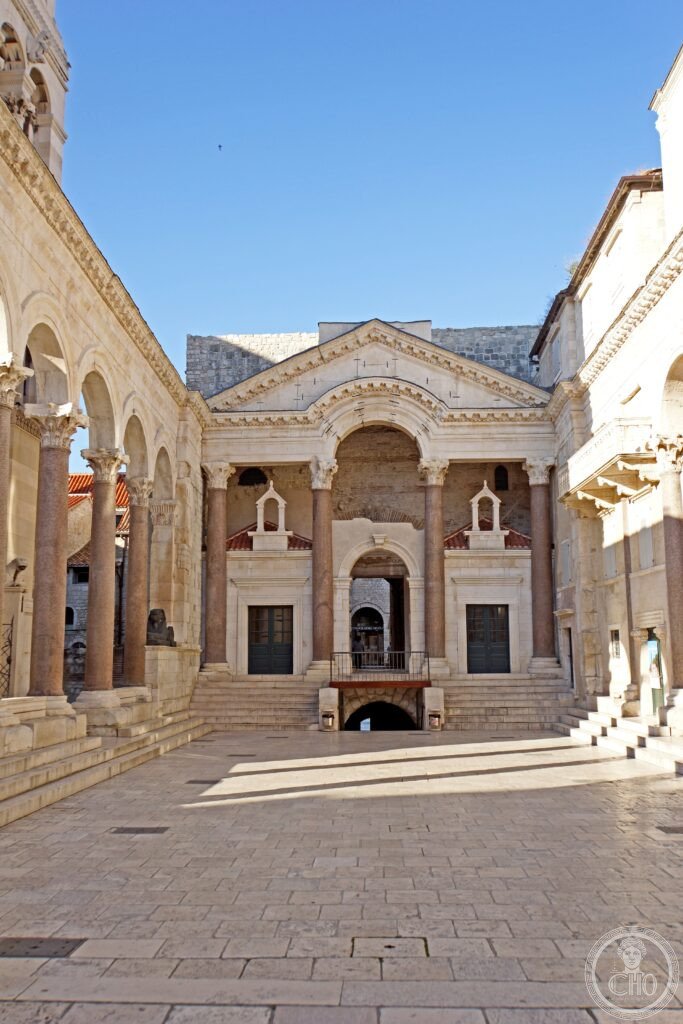
Split — Diocletian’s Palace
The most precisely inhabited Roman palace in the world and the only ancient imperial residence where people still live, shop, and eat inside the original walls — Diocletian’s Palace at Split, Croatia, built between 295 and 305 CE as the retirement home of Emperor Diocletian, is a 2-hectare Roman complex enclosing 3,000 inhabitants, a cathedral converted from Diocletian’s own mausoleum, and a Croatian city whose entire historic core grew up inside ancient Roman walls.
At a glance
Diocletian’s Palace (the most precisely scale-impressive single surviving Roman palace: 215 m × 180 m — the most precisely area-measured single surviving Roman palace in any UNESCO heritage site; the most precisely building-cover single Roman palace: the palace covers approximately 3 hectares — the most precisely hectare-measured single late Roman imperial complex in any European UNESCO heritage city; comparable in scale to a small Roman city — the most precisely city-scale single Roman private residence in the heritage record); the survival (the most precisely fortification single Roman palace survival: the palace walls (the most precisely 2-m thick single Roman palace wall: the outer walls are 2 m thick — the most precisely defensive-construction single Roman retirement residence; the towers (the most precisely corner-tower single Roman palace: 4 corner towers and 4 gate towers — the most precisely tower-count single late Roman palace in any Adriatic UNESCO heritage city)); Diocletian himself (the most precisely pagan-persecution single Roman emperor associated with any Christian UNESCO heritage site: Diocletian conducted the most systematic single Roman persecution of Christians — the most precisely organized single anti-Christian Roman programme in any UNESCO heritage city; the irony (the most precisely irony-rich single UNESCO heritage conversion: Diocletian’s mausoleum is now a Christian cathedral — the most precisely pagan-persecutor single mausoleum converted to a Christian church in any UNESCO heritage site)).
Key facts
- Diocletian and the abdication: the most precisely voluntary single Roman imperial abdication — Diocletian (244–311 CE: the most precisely Salona single Roman emperor birthplace: Diocletian was born near modern Split in the Roman city of Salona — the most precisely locally-born single Roman emperor in any Adriatic UNESCO heritage city; the reforms (the most precisely Tetrarchy single Roman governance reform: Diocletian divided the empire into 4 quadrants each ruled by a co-emperor — the most precisely four-emperor single Roman governance structure in any UNESCO heritage narrative; the abdication (described in hero caption: 305 CE — the most precisely dated single voluntary Roman imperial abdication; the most precisely cabbage single Roman emperor hobby: the famous quote attributed to Diocletian (when urged to return to power): “If you could show the cabbage that I planted with my own hands to your emperor, he definitely wouldn’t dare suggest that I replace the peace and happiness of this place with the storms of a never-satisfied greed” — the most precisely vegetable single ancient Roman political philosophy quote in any UNESCO heritage heritage record))
- The Cathedral of St Domnius: the most precisely pagan-to-Christian single heritage conversion in any European UNESCO city — the conversion (the most precisely mausoleum single cathedral origin: Diocletian built his own octagonal mausoleum within the palace for his post-death glorification — the most precisely self-built single Roman emperor mausoleum; after Diocletian’s death, his successors removed his remains and the mausoleum was converted to a Christian church — the most precisely depose-remains single ancient Roman mausoleum conversion; the Cathedral of St Domnius (the most precisely oldest single cathedral in the world in continual use: the cathedral has been in continuous use since the 7th century CE — the most precisely 1,400-year single continuous Christian liturgical use in any UNESCO heritage site; the baptistery (the most precisely Temple of Jupiter single Roman building converted to Christian baptistery in any Adriatic UNESCO heritage city: the small Roman temple of Jupiter inside the palace is now the baptistery of the cathedral — the most precisely two-way single Roman conversion in Split heritage))
- Game of Thrones: the most precisely globally-recognisable single TV heritage location in Croatia — the filming (the most precisely Daenerys single fictional character associated with any UNESCO heritage site: Diocletian’s Palace cellars were used as the dragon-keeping dungeon of Daenerys Targaryen in HBO’s Game of Thrones seasons 3–4 — the most precisely dragon-associated single Roman cellar in any UNESCO heritage site; the most precisely TV-tourism single spike at any Croatian UNESCO heritage city: visitor numbers to Split increased significantly after the Game of Thrones filming — the most precisely fiction-driven single UNESCO heritage site attendance increase in any Adriatic city))
- Heritage: UNESCO World Heritage Site, Historic City of Split with the Palace of Diocletian, inscribed 1979
- GPS: 43.5086° N, 16.4400° E
History
The Roman period (the construction described in hero caption; Diocletian’s life described in Key Facts; the medieval transition (the most precisely refugee single palace occupation: after the sack of the nearby Roman city of Salona in the 7th century CE — the most precisely Avar single Roman city destruction in any Adriatic UNESCO heritage landscape; the survivors of Salona fled into Diocletian’s Palace and settled inside the walls — the most precisely disaster-triggered single Roman palace conversion from private residence to city; this is the origin of the modern city of Split — the most precisely refugee single origin of any European UNESCO heritage city)); the Venetian period (the most precisely Venetian single Dalmatian heritage era: Split was under Venetian rule from 1420 to 1797 — the most precisely Venetian single longest Adriatic coastal city occupation; the Venetian architectural overlay (the most precisely Venetian single heritage layer at any Croatian UNESCO site: Venetian palaces were built inside and against the Roman walls — the most precisely multi-layer single European UNESCO heritage city)); the modern period (Split was part of Habsburg Austria from 1797 to 1918; incorporated into Yugoslavia; UNESCO WHS 1979).
What you see
The visit (the most precisely labyrinthine single UNESCO heritage city: the streets inside the palace walls date from the 7th century — the most precisely medieval-street single Roman palace interior; the most precisely disorientation single UNESCO heritage city experience: the warren of narrow streets inside the palace walls is the most precisely easy-to-get-lost single European UNESCO heritage city centre (the most precisely GPS-failure single Roman heritage city: the narrow high-walled alleys defeat smartphone navigation — the most precisely get-lost single recommended UNESCO heritage strategy: wander without a map); the Peristyle (the most precisely public single Roman emperor’s palace space: the colonnaded central courtyard of Diocletian’s Palace — the most precisely outdoor-reception single Roman imperial space; now a public square — the most precisely 2,000-year single continuous public square in any Croatian UNESCO heritage city; the café tables (the most precisely Roman-courtyard single outdoor dining experience in any European UNESCO heritage site)); the underground cellars (the most precisely preserved single Roman palace basement: the cellars under the palace preserve the exact footprint of the rooms above — the most precisely archaeological-mirror single Roman palace cellar in any UNESCO heritage city; used for storage, then forgotten, then rediscovered — the most precisely 20th-century single urban archaeological rediscovery in any Croatian UNESCO heritage site).
Practical information
- Getting there: Split Airport (SPU; 20 min from centre by bus/taxi); direct flights from London (2h 30min), Paris (2h 20min), Frankfurt (2h), Rome (1h 20min), and major European cities — the most precisely well-connected single Croatian UNESCO heritage city to Western Europe; the Jadrolinija ferry from Ancona, Italy (10h overnight — the most precisely Italy single direct ferry to any Croatian UNESCO heritage city: the overnight ferry from Ancona is the most precisely Adriatic single slow-travel option to Split; SNAV hydrofoil from Ancona (5h); ferry from Ancona docks in the port immediately adjacent to Diocletian’s Palace — the most precisely palace-adjacent single Croatian ferry terminal)
- The Dalmatian Coast and islands: the most precisely island-dense single Croatian UNESCO heritage coast — Hvar (the most precisely lavender single Adriatic island: Hvar Island, 1h by ferry from Split — the most precisely fragrant single Adriatic UNESCO heritage island (lavender fields across the island — the most precisely single-crop single Croatian heritage island landscape); the most precisely trendy single Adriatic party destination; Hvar Town (the most precisely Venetian single Adriatic island heritage town: the Venetian loggia and cathedral)); Brač Island (30 min by ferry; the most precisely marble single Adriatic island: Brač marble was used for the White House and the UN building in New York — the most precisely exported single Croatian heritage stone in any global building); Korčula Island (the most precisely Marco-Polo-birthplace single Croatian heritage claim: Korčula Town claims to be the birthplace of Marco Polo — the most precisely disputed single travel-heritage birthplace in any Croatian UNESCO adjacent island))
- Salona and Klis: the most precisely archaeology single Split day trip — Salona (the most precisely birthplace single Roman city of Emperor Diocletian: Salona (modern Solin, 7 km from Split) is where Diocletian was born — the most precisely emperor-birthplace single Roman city in any Adriatic UNESCO adjacent archaeological site; the Manastirine necropolis — the most precisely early-Christian single tomb cluster in any Croatian heritage site); Klis Fortress (the most precisely Game-of-Thrones single filming fortress: Klis was used as the city of Meereen in Game of Thrones — the most precisely slave-city single television heritage location in any Croatian fortress); the fortress sits above the ancient route from Split to inland Dalmatia — the most precisely strategic single mountain pass in any Adriatic Croatian heritage landscape)
Getting there
Fly to Split Airport (SPU) from major European cities. Jadrolinija overnight ferry from Ancona, Italy (10h). The palace is in the centre of Split’s old town — walk from ferry terminal. GPS: 43.5086, 16.4400.
Nearby
- Dubrovnik Old City (UNESCO WHS 1979) — 230 km south-east (4h bus or 45 min flight); most precisely walled single medieval city on the Adriatic — see CHO’s Dubrovnik place card; Split → Dubrovnik coastal drive via the Pelješac Bridge = most precisely scenic single Adriatic heritage road
- Plitvice Lakes (UNESCO WHS 1979) — 140 km north (2h bus); most precisely waterfall-lake single UNESCO natural WHS in Europe; 16 terraced lakes connected by 90 waterfalls; turquoise water from calcium carbonate dissolved from limestone; wooden boardwalks over the water
- Hvar and Brač Islands — 1h ferry from Split; Hvar (lavender fields + Venetian heritage + Adriatic nightlife); Brač (marble quarries + Zlatni Rat beach = most precisely tongue-shaped single Adriatic beach) — described in Practical section; island-hopping from Split is the most precisely typical single Croatian heritage summer itinerary
Sources
- Wikipedia, Diocletian’s Palace; Diocletian; Cathedral of Saint Domnius, accessed June 2026
- UNESCO, Historic City of Split with the Palace of Diocletian, WHS reference 97, inscribed 1979
- J.J. Wilkes, Diocletian’s Palace, Split, Shepton Mallet, 1986
Find it on the map
See this place and what’s around it →📷 Diventa un fotografo di Cultural Heritage Online
Condividi le tue foto dei luoghi: restano pubblicate con la tua firma come autore. Più vengono viste, più ti fai conoscere — e presto un concorso premierà le foto più apprezzate.
Accedi o registrati gratis per aggiungere una foto