
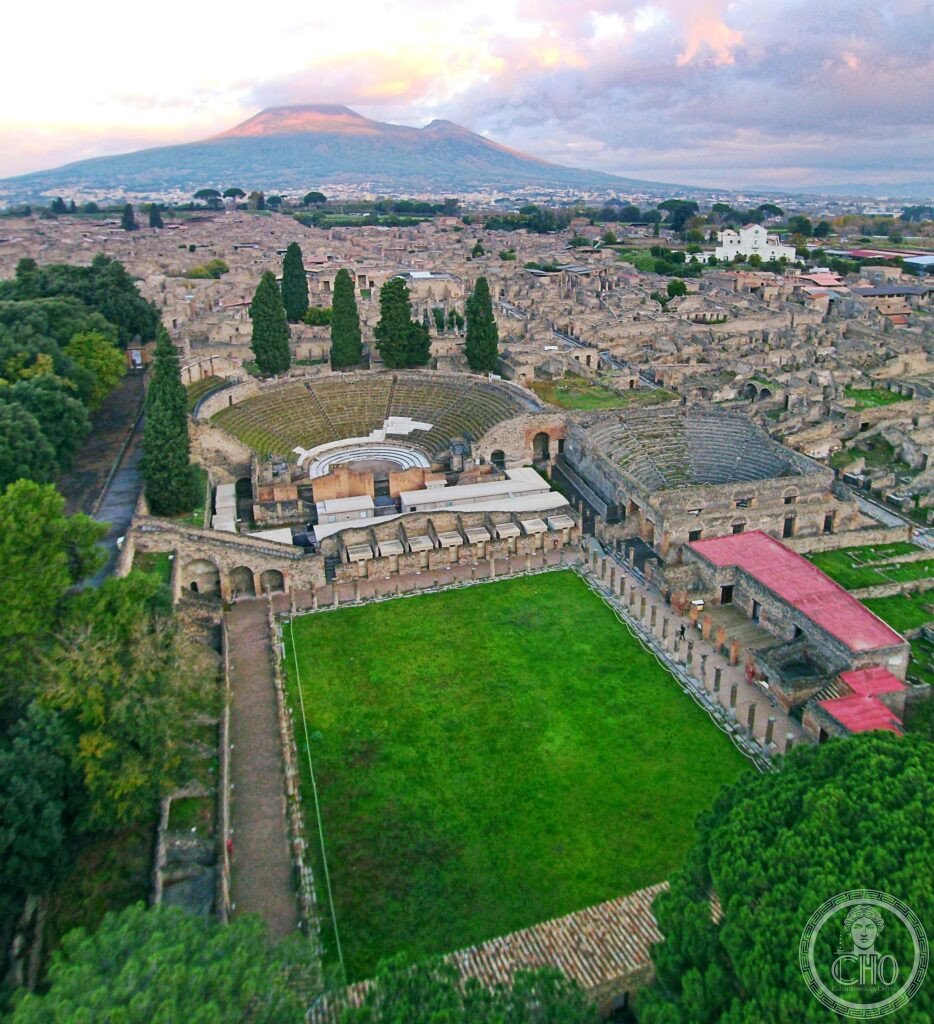
Pompeii
The most completely preserved ancient Roman city in the world and the most visited single archaeological site in Italy — Pompeii, buried under 4–6 metres of volcanic ash when Vesuvius erupted on 24 August 79 CE, offers an incomparable window into the daily life of a Roman provincial city in the 1st century CE, with streets, houses, frescoes, bakeries, and brothels preserved with a completeness no other Roman city can equal.
At a glance
Pompeii (UNESCO WHS 1997 as part of the inscription covering the Archaeological Areas of Pompei, Herculaneum and Torre Annunziata; the most visited ancient Roman site in Italy: 4.5 million visitors per year (the most attended single classical site in Europe; the most sustained year-over-year growth in visitors of any single Italian heritage site since the Great Pompeii Project (2012)); the excavated area (44 ha — approximately two-thirds of the ancient city; the most extensively excavated ancient city in Italy; the remaining one-third has been deliberately left unexcavated (the most conservatively managed single decision in Italian classical archaeology: the remaining area is reserved for future generations with better preservation technology — the most forward-looking single conservation decision in Italian heritage management)); the site preservation (the volcanic ash produced the most complete single time-capsule preservation of daily Roman life: the most precisely dated single snap-shot of Roman material culture (everything visible at Pompeii is from before 24 August 79 CE — the most precisely dated terminus ante quem in classical archaeology).
Key facts
- The eruption of 79 CE: the most extensively documented ancient natural disaster — the eruption (the most important single volcanic event in the history of archaeology: Vesuvius erupted on 24 August 79 CE (the date has been revised twice: the 19th-century date of 24 August was based on Pliny the Younger’s letter; a 2018 charcoal inscription discovery at the Regio V excavation site confirms the eruption was in October or November 79 CE — the most recently revised single date in classical archaeological literature); the most documented ancient disaster: two letters of Pliny the Younger to Tacitus describing the eruption from Misenum (30 km west) are the most important eyewitness accounts in Latin literature (the most frequently cited single classical text in volcanological science — the first systematic description of a Plinian eruption in any ancient source; the term “Plinian eruption” is named after Pliny the Younger — the most eponymous single young ancient observer in volcanological terminology)); the burial (4–6 m of ash and pumice (Phase 1) followed by pyroclastic surges (Phase 2) — the most geologically complex single volcanic burial in any documented ancient city; the pyroclastic surges (the most immediately lethal single phase: temperatures up to 300°C; arriving at 100 km/h — the most precisely modelled single ancient natural disaster in modern volcanological literature))
- The plaster casts and the victims: the most affecting single archaeological discovery in classical Italy — the plaster casts (the most innovative single excavation technique in the history of classical archaeology: Giuseppe Fiorelli (Director of Excavations at Pompeii 1860–1875) discovered that the ash had hardened around the bodies, leaving hollow moulds; by injecting liquid plaster into the cavities, he produced the first three-dimensional casts of the victims — the most photographically compelling single archaeological discovery of the 19th century; the most discussed single ethical question in Italian heritage management: should the casts be displayed as they are (the most viscerally confronting experience in any Roman archaeological site) or should they be treated with greater dignity?); the number of victims (the most frequently cited archaeological estimate in Italian school curricula: approximately 2,000 people are believed to have been in Pompeii at the time of the eruption (the most conservative single estimate; the city had a population of 11,000–20,000 — the most frequently discussed depopulation event in pre-modern Italian history); 1,150 individuals have been identified from skeletal remains — the most precisely counted individual victims of any ancient volcanic disaster))
- The frescoes and the brothels: the most complete surviving ancient Roman domestic decoration — the frescoes (the Pompeii fresco cycles are the most important surviving evidence for ancient Roman domestic wall painting: the four Pompeian Styles of wall painting (the most precisely classified single ancient decorative sequence in classical art history (Mau 1882 — the most influential single classification of Roman painting in the history of classical studies); the House of the Vettii (the finest surviving Pompeian fresco programme: the complete redecoration of the Vettii brothers’ wealthy house — the most extensive single surviving ancient painted domestic interior in the world)); the Lupanare (the official brothel of Pompeii: the most visited single building in Pompeii after the Forum; the numbered cells (10 stone beds in 5 rooms — the most precisely measured ancient Roman commercial sex establishment); the erotic frescos above each cell door (the most frequently reproduced single ancient Roman erotic painting cycle in any heritage museum worldwide — the most visited single room for erotic art in the ancient world)); the thermopolia (ancient fast-food counters: 80 thermopolia in Pompeii — the most thermopolia in any Roman city in Italy; the 2019 Regio V thermopolium discovery (the most recently excavated complete thermopolium: painted ducks, wine jars still embedded in the counter, duck bone food residue still in the pots — the most complete ancient “restaurant” discovery in the history of classical excavation))
- Heritage: UNESCO World Heritage Site, Archaeological Areas of Pompei, Herculaneum and Torre Annunziata, inscribed 1997
- GPS: 40.7491° N, 14.4989° E
History
Pre-Roman history (Pompeii was founded in the 7th–6th century BCE by the Oscan-speaking people of Campania — the most culturally mixed pre-Roman urban foundation in Italy (Oscan, Etruscan, and Greek influences are all documented in the earliest Pompeian archaeology); the Roman period (the Social War: Pompeii became a Roman colony (Colonia Veneria Cornelia Pompeianorum) in 80 BCE — the most consequential single act of Roman colonisation in Campania: 4,000–5,000 Roman veterans settled in the city, transforming its architecture and social structure); the earthquake of 62 CE (the most destructive single pre-eruption event: a major earthquake (magnitude estimated 5–6) severely damaged the city 17 years before the eruption — the most frequently cited coincidence in Pompeian archaeology: many of the major public buildings were still under repair at the time of the eruption); the modern excavation history (the most extensively continued single archaeological excavation in the world: 1748 (first official excavations under King Charles III of Naples — the most royally commissioned single classical excavation in history); 1863 (Fiorelli; the plaster cast technique — described in Key Facts); 2012–ongoing (the Grande Progetto Pompei — the most extensively funded single Italian archaeological conservation project: EUR 105 million from the EU and Italian state — the most expensive single ancient site restoration in European history); UNESCO WHS 1997.
What you see
The Pompeii visit (the most complex single heritage site visit in Italy by area: 44 ha of excavated streets, houses, temples, and public buildings; the recommended sequence: the Forum (the central civic space; the Temple of Jupiter; the Basilica); the Via dell’Abbondanza (the main commercial street — the most intact ancient Roman commercial street in any excavated city: the wheel ruts in the basalt paving; the stepping stones crossing the flooded street (the most precisely preserved single ancient urban infrastructure detail); the electoral campaign graffiti on the walls — the most extensive collection of ancient Roman political graffiti in any city (the most directly democratic single wall surface in the Roman world: candidates for city office (duumviri) had their campaigns painted by professional sign-writers on the exterior walls of houses along the main street)); the House of the Vettii (described in Key Facts); the Lupanare brothel (described in Key Facts); the Garden of the Fugitives (the most moving single space in Pompeii: a vineyard in which 13 plaster casts of victims were found huddled together — the most spatially concentrated single human tragedy in any Roman archaeological site)).
Practical information
- Getting there: Naples Central Station (NAP; the main gateway for Pompeii; the Circumvesuviana railway (the most historically significant single suburban rail line in southern Italy: running since 1839 — the oldest still-operating railway in Southern Italy) from Naples Piazza Garibaldi to Pompei Scavi-Villa dei Misteri station (35 min; departures approximately every 30 min; the most frequently cited single train connection in Italian heritage tourism after the Rome–Florence Frecciarossa); the station exit (the Pompeii Scavi (Pompeii excavations) station is immediately outside the main archaeological site entrance — the most conveniently positioned single archaeological site railway station in Italy); the ticket (single site: adults €18; combined Pompeii + Herculaneum + Oplontis: €26); by car from Naples (23 km by the A3 motorway (Napoli-Salerno) exit Pompeii — Ovest; the most accessible major UNESCO site in southern Italy by motorway)
- Herculaneum (Ercolano, UNESCO WHS 1997): the smaller and better-preserved companion city to Pompeii — Herculaneum (12 km north-west of Pompeii; the Circumvesuviana to Ercolano Scavi station (12 min from Naples — the most frequently missed single companion site to Pompeii in Italian heritage tourism); the most important fact about Herculaneum vs. Pompeii (the most consequential comparative statement in Campanian archaeology: Herculaneum was buried by 20–25 m of volcanic mud (rather than dry ash) which preserved organic materials that Pompeii lost — the most completely preserved ancient wooden furniture, food, books (the Villa of the Papyri (the only ancient Roman library in the world with books (carbonised papyrus scrolls; 1,800 recovered) — the most significant single ancient library find in the history of classical scholarship))); the city (approximately 20% excavated — the most archaeologically conservative single Campanian heritage site (the rest is under the modern city of Ercolano); the most intact ancient Roman two-storey houses in Europe))
- Vesuvius and the national park: the most densely populated active volcanic zone in the world — Vesuvius (14 km north-east of Pompeii; the summit hike (the most easily accessible active volcano summit in Europe: 1h 30min hike from the parking area at 1,000 m; the summit caldera (300 m wide; 200 m deep) with steam vents; the panorama (the finest view over the Bay of Naples and the Sorrentine Peninsula in any single non-powered climb in Campania); the national park (the Parco Nazionale del Vesuvio; Europe’s most densely populated national park by surrounding population: 3 million people live within 30 km of the summit — the most riskily populated single volcanic zone in the world; the evacuation plan (the most extensively planned single volcanic emergency procedure in Europe: the evacuation of 600,000 people in the red zone is rehearsed annually — the most regularly drilled single mass evacuation in any European metropolitan area))
Getting there
Circumvesuviana train Naples → Pompei Scavi-Villa dei Misteri (35 min; every 30 min). Station directly at site entrance. Open daily 9am–5pm (winter) / 9am–7pm (summer). Book tickets online to skip queues. GPS: 40.7491, 14.4989.
Nearby
- Herculaneum (UNESCO WHS 1997) — 12 km north-west (Circumvesuviana 12 min from Naples); better organic preservation than Pompeii + the only ancient library with books — described in Practical section; ideal sequence: arrive Naples, take train to Herculaneum (morning; 2h), continue to Pompeii (afternoon; 3h)
- Vesuvius National Park and summit hike — 14 km north-east (bus from Pompeii or Ercolano); most accessible active volcano in Europe — described in Practical section; the Pompeii + Vesuvius summit same-day combination is the most historically ironic single day itinerary in southern Italy: you see the city the volcano destroyed, then climb the volcano that destroyed it
- Naples Historic Centre (UNESCO WHS 1995) and the Amalfi Coast — Naples 23 km north-west (30 min by motorway); UNESCO WHS 1995 (Historic Centre of Naples): the Museo Archeologico Nazionale di Napoli (the most important single repository of Pompeian frescoes and objects: the Pompeian and Herculanean collections transferred here since 1777 — the most consequentially relocated single ancient Italian heritage collection; the most important ancient Roman fresco cycle accessible in an air-conditioned museum: the Farnese collection and the Pompeian rooms are the most undervisited world-class ancient Roman collection in any Italian museum); the Amalfi Coast (UNESCO WHS 1997): 50 km south of Pompeii (1h drive via the SS145 corniche — the most dramatically vertical single coastal road in Italy: the Amalfi Drive; the most photographed single coastal road in Europe)
Sources
- Wikipedia, Pompeii; Pliny the Younger; Giuseppe Fiorelli; Eruption of Vesuvius in AD 79, accessed June 2026
- UNESCO, Archaeological Areas of Pompei, Herculaneum and Torre Annunziata, WHS reference 829, inscribed 1997
- Mary Beard, The Fires of Vesuvius: Pompeii Lost and Found, Belknap Press, 2008
Find it on the map
See this place and what’s around it →📷 Diventa un fotografo di Cultural Heritage Online
Condividi le tue foto dei luoghi: restano pubblicate con la tua firma come autore. Più vengono viste, più ti fai conoscere — e presto un concorso premierà le foto più apprezzate.
Accedi o registrati gratis per aggiungere una foto