
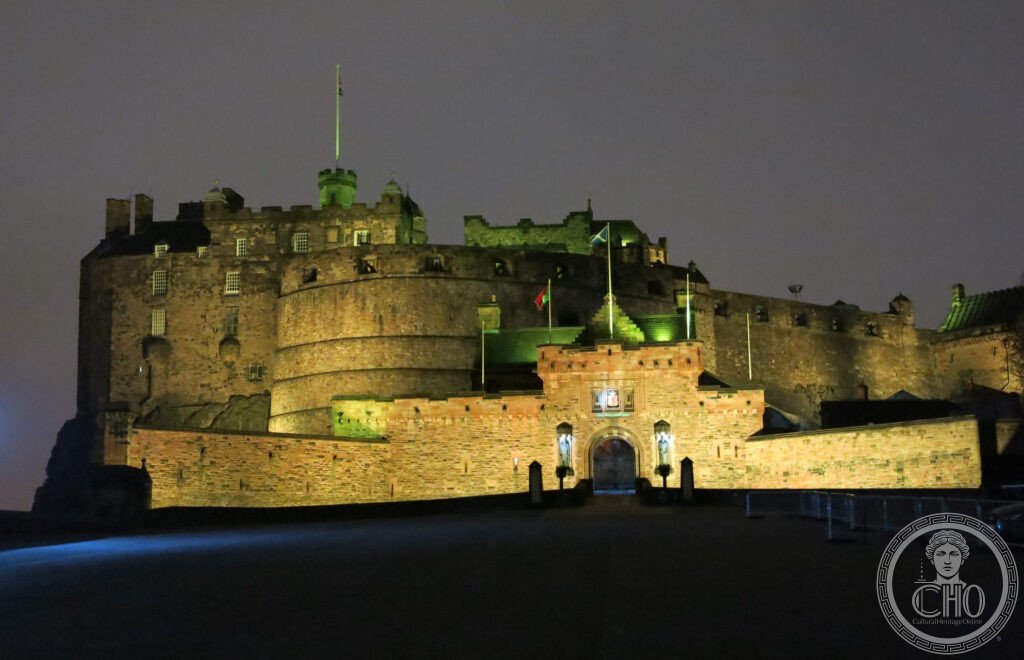
The most architecturally dramatic capital city in the British Isles and the finest surviving ensemble of medieval Old Town and Georgian New Town in the world — Edinburgh, built on the basalt crag of an extinct volcano, contrasts its medieval Royal Mile (running from the Castle at the top to the Palace of Holyroodhouse at the bottom) with the neoclassical terraces, crescents, and squares of the New Town (the most ambitious urban planning project of 18th-century Britain).
At a glance
The Old and New Towns of Edinburgh (UNESCO WHS 1995; population of Edinburgh approximately 550,000 (the capital of Scotland; the second most visited city in the United Kingdom after London)); the topography (the city is built on a series of volcanic crags and ridges created by the solidified magma plugs (sills) of volcanoes that were active approximately 350 million years ago (the Carboniferous period); the most important topographic feature: the Royal Mile ridge (the crag-and-tail formation created when the glacier of the last Ice Age (approximately 10,000 years ago) hit the hard basalt of Castle Rock and flowed around it, leaving a tail of softer volcanic material extending eastward for approximately 1.6 km — that tail is the Royal Mile; the most geologically consequential natural feature in urban Scottish history); the two contrasting urban forms: the Old Town (the medieval town that grew along the spine of the Royal Mile; the tenements (the “lands”; the earliest high-rise residential buildings in Europe; by the 17th century some Edinburgh tenements were 15 storeys high — the tallest residential buildings in the pre-industrial world; the most innovative urban solution to a city constrained by city walls and a narrow ridge); the closes (the narrow alleys (or closes) that run off the Royal Mile; approximately 100 closes survive; each close was its own mini-neighbourhood with its own informal street life, water supply (the communal well), and waste disposal (the “Gardy-loo” system — the practice of throwing waste from upper-floor windows into the close below; the origin of the phrase “Gardy-loo” from the French “Gardez l’eau!” — “Watch the water!”))); the New Town (the Georgian city built on the flat plain north of the Old Town; designed by James Craig (1744–1795; an unknown 26-year-old architect who won the competition for the New Town design in 1766; his simple grid of three parallel streets (Princes Street, George Street, Queen Street) connected by cross streets was the winning plan; the most important grid plan in British urban history; the implementation (the New Town was built over 65 years (1767–1830) by multiple architects; the most important: Robert Adam (1728–1792; the greatest British neoclassical architect; Charlotte Square (1791–1807; the west end of George Street; the most beautiful single Georgian square in Scotland; the north side (Robert Adam’s finest urban elevation; the most perfect neoclassical street facade in Britain; the composition of the north side of Charlotte Square (the three-part composition: two identical flanking houses with a central colonnade of Corinthian columns; the most sophisticated play of advance and recession in Georgian facade design; the perfect balance of public grandeur and domestic scale).
Key facts
- The Royal Mile: the most historically layered street in Britain — the Royal Mile (the 1.6-km spine of the Old Town from the Castle Esplanade (the open plaza at the top of the Castle) to the forecourt of the Palace of Holyroodhouse (the official Scottish residence of the British monarch); technically four streets (Castlehill, Lawnmarket, High Street, Canongate — named for the Canons of Holyrood Abbey who had right of passage along it); the key buildings: the High Kirk of Edinburgh (St. Giles’ Cathedral; the most important church in Scotland; the church that gave the Scottish Reformation its most famous moment (the prayer book riot of 1637: when King Charles I attempted to impose the Anglican Book of Common Prayer on Scotland, a woman in the congregation (traditionally named Jenny Geddes) threw her stool at the minister — the most famous act of religious protest in Scottish history; the most consequential single act in the chain of events that led to the English Civil War)); John Knox’s House (c.1490; the most intact medieval dwelling in Edinburgh; the home (probably) of John Knox (c.1514–1572; the founder of Presbyterianism; the most important figure in the Scottish Reformation; the man who confronted Mary Queen of Scots (1542–1587) in a series of interviews that are the most dramatic confrontations in Scottish political history)); the Palace of Holyroodhouse (the official Scottish residence of the British monarch; built from the 16th century as a royal palace beside Holyrood Abbey (the 12th-century abbey of which only the ruined nave survives); the historic chambers (the apartments of Mary Queen of Scots (the most visited historical rooms in Scotland; the room where Rizzio was murdered (described below)))
- Mary Queen of Scots and the Rizzio Murder: the most dramatic scene in Scottish royal history — the murder of David Rizzio (22 February 1566; the most important single event in the history of Holyroodhouse; David Rizzio (1533–1566; Italian musician and secretary; the most important confidant and probably the closest companion of Mary Queen of Scots in Edinburgh); the murder (on the evening of 9 March 1566, while Mary was at supper in her private chambers with Rizzio and a small party, a group of Protestant lords led by Lord Darnley (Mary’s husband) and Lord Ruthven burst into the room; Rizzio was dragged from the room or from beneath Mary’s skirts (accounts differ) and stabbed 56 times (the most brutal single assassination in Scottish royal history; the number of wounds was apparently deliberate — each conspirator wanted to share in the killing to ensure mutual complicity); the room (the small outer chamber of Mary’s apartments at Holyroodhouse; a brass plaque marks the spot where Rizzio died; the most visited single spot in the palace); Mary was 8 months pregnant at the time of the murder (the child would become King James VI of Scotland and James I of England — the first king of a united Britain; the most consequential pregnancy in British royal history)
- The Scottish Enlightenment: the intellectual revolution that shaped the modern world — the Scottish Enlightenment (1740s–1790s; the most concentrated period of intellectual achievement in British history; Edinburgh was the centre; the key figures (David Hume (1711–1776; the greatest British philosopher; the most important empiricist philosopher; the Treatise of Human Nature (1739–1740; the most ambitious systematic philosophy in English); the Enquiry Concerning Human Understanding (1748; the most accessible); the most radical epistemologist of the 18th century; Hume’s atheism (or at least extreme scepticism about religion) made him the most controversial thinker in British society; James Boswell tried to convince him to convert on his deathbed; Hume refused with cheerful composure); Adam Smith (1723–1790; the founder of modern economics; The Wealth of Nations (1776; the most influential book in the history of economic thought; the most-quoted author in modern economic policy; the theory of the division of labour and the invisible hand of the market))
- Heritage: UNESCO World Heritage Site, Old and New Towns of Edinburgh, inscribed 1995
- GPS: 55.9533° N, -3.1883° E
History
The founding (the rock has been occupied since at least the Iron Age; the first medieval castle on Castle Rock dates to the 12th century; the city grew along the ridge below the castle during the 11th–15th centuries); the medieval expansion (the Royal Mile closes; the Scottish Parliament (in the Old Town from 1639; now returned to the new Scottish Parliament building at the foot of the Royal Mile (designed by Enric Miralles; opened 2004; the most important piece of contemporary architecture in Scotland; the building was massively over budget (£414 million vs. the original £40 million estimate) and massively late (3 years); the controversy (the cost overrun and Miralles’ death during construction (2000) made it the most controversial public building project in Scottish history; the building is now widely regarded as a masterpiece)); the Scottish Reformation (1560; John Knox; the abolition of Catholic worship; the beginning of Presbyterian church governance); the Jacobite risings (1715 and 1745; Bonnie Prince Charlie entered Edinburgh and briefly held court at Holyrood (1745–1746); the last Scottish royal court at Edinburgh; the most romantic episode in Scottish political history); the New Town planning (1766; James Craig; 1767–1830 construction); the Victorian era (the Scott Monument (1840–1846; the largest monument to a writer in the world at 61 m; the 287-step internal spiral stair gives the finest view of the city from a fixed point); the universities (the University of Edinburgh (founded 1583; the sixth oldest university in the UK; the most important medical school in the 18th–19th centuries)); UNESCO WHS 1995.
What you see
The Old Town circuit (the Castle (allow 2h; the Crown Jewels Room; the Scottish National War Memorial (the most moving single room in Edinburgh)); the Royal Mile (walk the full length; turn into at least 3 closes (Mary King’s Close (now underground and part of the Old Town below street level — the most unusual attraction in Edinburgh; a guided tour of the 17th-century street sealed below the current street level in 1753; the best-preserved example of a historic Edinburgh close); the High Kirk of St. Giles; the Scottish Parliament; the Palace of Holyroodhouse (allow 1h 30min; the apartments of Mary Queen of Scots are the most visited rooms; the gardens (the best view of Arthur’s Seat))); the New Town (Charlotte Square; the Georgian House (the National Trust for Scotland’s reconstruction of a typical 1796 New Town interior); Princes Street Gardens (the formal gardens in the valley between the Old and New Towns; the Scott Monument)).
Practical information
- Getting there: Edinburgh Airport (EDI; 13 km west of the city centre; tram (Princes Street; 35 min; GBP 8.50 one way); or bus (Airlink 100; Waverley Bridge; 25 min; GBP 4.50 one way; most economical)); Edinburgh Waverley Station (the main rail hub; centrally located under the Royal Mile ridge; the most conveniently located major railway station in Britain; high-speed train from London Kings Cross (LNER; 4h 20min; the fastest option; the Avanti service from London Euston to Glasgow is slower and requires a change; always check if a seat reservation is required; Virgin/LNER trains have mandatory seat reservations on intercity services))
- The Edinburgh Festival Fringe: the world’s largest arts festival — the Edinburgh Fringe (held annually in August (the entire month; approximately 3,500 shows in 250+ venues; 500,000+ tickets sold in August 2023 — the highest figures since the pandemic); the origin (the Festival began as the Edinburgh International Festival (EIF) in 1947 as a post-war cultural celebration; the Fringe began informally in the same year when 8 uninvited theatre companies appeared alongside the official programme; the “fringe” grew over 75 years to become larger than the official Festival that it originally surrounded)); the accommodation (the single largest logistical challenge of visiting Edinburgh; book any visit in August 12+ months in advance; prices rise 3–5× during the Fringe; the Royal Mile (the main outdoor performance venue; jugglers, comedians, musicians competing for attention every day from noon to midnight; the most intense outdoor street performance scene in the English-speaking world))
- The whisky trail: Scotland’s defining contribution to world culture — Scotch whisky (Edinburgh is not in the whisky heartland (which is Speyside and Islay in the north and west) but it is the best place to understand whisky: the Scotch Whisky Experience (the Royal Mile; the most comprehensive whisky museum and tasting centre; the 281-bottle collection includes examples from every distillery in Scotland); the Caledonian Brewery (the largest independent craft brewery in Scotland; Edinburgh’s Deuchar’s IPA is the most important Edinburgh beer; the cask ale tradition (the “real ale” served at cellar temperature from a hand pump — the most specific Edinburgh pub experience; the Bow Bar (Victoria Street; the finest traditional Edinburgh pub; 150+ whiskies; the best-maintained cask ale; the most comprehensive whisky-and-ale combination in the city))
Getting there
Edinburgh Airport EDI (tram 35min GBP 8.50). Waverley Station: LNER from London Kings Cross 4h20. The Old Town and New Town are both walkable. GPS: 55.9533, -3.1883.
Nearby
- Stirling Castle and the Wallace Monument — 55 km north-west of Edinburgh (1h by train); the most historically charged castle in Scotland and the most important symbol of Scottish independence — Stirling Castle (the finest Renaissance royal palace in Scotland; the Great Hall (the finest medieval feasting hall in Scotland; built for James IV (r. 1488–1513); the most ambitious royal construction project in Scotland before the Palace of Holyroodhouse); the Chapel Royal (built by James VI (1594) for the baptism of his son Prince Henry; the finest decorative painting programme in a Scottish building of the period); the Wallace Monument (the Victorian tower (1869) on the volcanic Abbey Craig overlooking Stirling; the monument to William Wallace (c.1270–1305; the Guardian of Scotland; the leader of the resistance to English conquest (1297–1305); the most important non-royal figure in Scottish history; his capture and execution at London in 1305 (the most gruesome public execution in English history: hanged, drawn, and quartered; the body then distributed between Berwick, Perth, Stirling, and Aberdeen as a warning) made him the defining martyr of Scottish nationalism; the monument houses Wallace’s two-handed sword (William Wallace’s broadsword; the most important object in the Wallace collection; 5 feet 4 inches (163 cm) long; the largest surviving personal sword from medieval Scotland))
- St. Andrews and the East Neuk of Fife — 80 km north of Edinburgh (1h 30min by bus); the home of golf and the finest collection of fishing villages in Scotland — St. Andrews (the most important university town in Scotland after Edinburgh (University of St. Andrews; founded 1413; the oldest university in Scotland; the most famous student of the 21st century: Prince William met Catherine Middleton here); the Golf (St. Andrews Links (the Old Course; the most famous golf course in the world; 600 years of continuous play; the home of the R&A (the oldest golf club in the world; the rules of golf were codified here); the Swilcan Bridge (the most photographed single piece of golf infrastructure in the world; the 700-year-old medieval bridge that crosses the Swilcan Burn at the 18th hole); the Cathedral ruins (St. Andrews Cathedral; the most important medieval religious complex in Scotland before the Reformation; the largest church ever built in Scotland (119 m long); destroyed in the iconoclasm of the Reformation; the most important single casualty of the Scottish Reformation in built heritage terms; the ruins include the remarkable Square Tower and Sea Tower; the most atmospheric medieval ruins on the east coast of Scotland))
- The Highlands and Loch Ness — 170 km north of Edinburgh (2h 30min by train to Inverness); the most dramatic landscape in Britain and home to the world’s most famous monster — Loch Ness (the most famous lake in the world (for one reason only); the statistics (37 km long × 2.7 km wide; maximum depth 227 m; the deepest lake in Britain; the volume (7.45 km³ — more water than all the lakes in England and Wales combined)); the monster (the first reliable written record of a strange creature in the loch dates to Adomnán’s Life of St. Columba (c.565 CE; the saint reportedly drove a “water beast” back into the loch; the most ancient written reference to Nessie); the modern myth (the 1933 newspaper photograph by John Macgregor (the first widely circulated “sighting”; the most important single media event in creating the Nessie tourism industry); the famous 1934 “surgeon’s photograph” (revealed in 1994 to be a hoax using a toy submarine with a plasticine head))
Sources
- Wikipedia, Edinburgh; Royal Mile; Edinburgh New Town; Scottish Enlightenment, accessed June 2026
- UNESCO, Old and New Towns of Edinburgh, WHS reference 728, inscribed 1995
- Charles McKean, Edinburgh: Portrait of a City, Century, 1991
Find it on the map
See this place and what’s around it →📷 Become a Cultural Heritage Online photographer
Share your photos of places: they stay published under your name as the author. The more they're seen, the more you get noticed — and soon a contest will reward the most appreciated photos.
Log in or sign up free to add a photo