
.jpg)
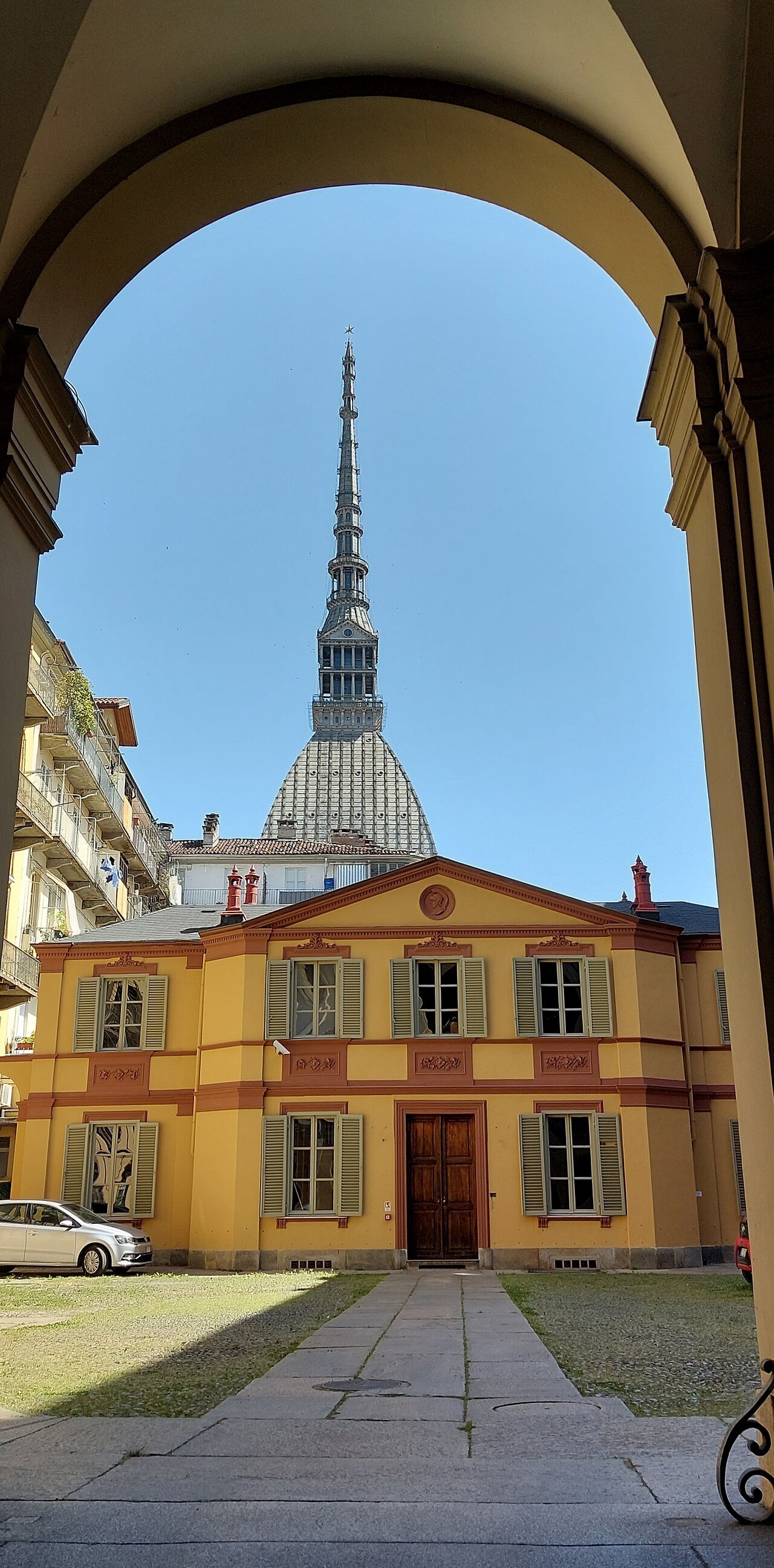
At 167.5 metres, Alessandro Antonelli’s tower over Turin was the tallest masonry structure in the world when it was completed in 1889 — the same year the Eiffel Tower opened. Today it houses the Museo Nazionale del Cinema, one of the world’s great collections on the history of film.
At a glance
The Mole Antonelliana rises from Via Montebello 20 in Turin’s Vanchiglia neighbourhood, its tapering spire visible from across the Po plain. Built for Turin’s Jewish community as a synagogue, then purchased by the municipality of Turin after the community could no longer afford to complete it, the building became by default the defining monument of an industrial capital that already had plenty of Baroque palaces. Alessandro Antonelli kept revising the design upward — the original 1862 plans showed a 47-metre dome — until the tower reached its final height of 167.5 metres in 1889. Since 2000 the interior has housed the Museo Nazionale del Cinema, accessible by a transparent elevator that rises through the central hall.
Key facts
- Architect: Alessandro Antonelli (1798–1888)
- Construction: 1863–1889
- Height: 167.5 m (tallest masonry structure in the world until 1908)
- Original commission: Synagogue for Turin’s Jewish community
- Purchased by City of Turin: 1878
- Museum opened: 2000 (Museo Nazionale del Cinema)
- Address: Via Montebello 20, 10124 Turin
- GPS: 45.0689, 7.6931
History
Turin’s Jewish community acquired the land on what was then called Contrada del Cannon d’Oro (today Via Montebello) in the early 1860s following the Albertine Statute’s grant of religious liberty. The first plans, approved in 1863, showed a synagogue 47 metres high. Alessandro Antonelli — already famous for his domed Basilica di San Gaudenzio in Novara — was appointed architect, and immediately began proposing modifications: the dome was to rise higher, then higher still. By 1869 the community had run out of funds and completed a temporary flat roof at 70 metres, abandoning the project.
The City of Turin purchased the unfinished structure in 1878, recognising it as too significant (and too structurally peculiar) to leave half-built. Antonelli resumed work under municipal patronage. The tower reached its final height of 167.5 metres in 1889 — the year the Eiffel Tower opened in Paris. Antonelli himself died in 1888, a year before the completion he had spent three decades pursuing. Friedrich Nietzsche, resident in Turin during 1888-89, described the Mole as “perhaps the most inspired architectural work ever created.”
Throughout the twentieth century the building was used for exhibitions and as a repository. A major restoration in 1961 reinforced the original masonry with steel and concrete. The Museo Nazionale del Cinema — founded in 1941 and long housed in the Palazzo Chiablese — transferred to the Mole in 2000 after a comprehensive redesign of the interior by the studio Gabetti e Isola.
What you see
Antonelli’s design is one of the more anomalous buildings in Italian architectural history: a neoclassical base with Corinthian portico and four-fronted classical massing rises into a sequence of reducing cylinders and octagons, culminating in a needle spire topped by a metal star. The structural concept is masonry pyramidal, each stage lighter than the one below, with the stone and brick relieved by iron tie-rods introduced during construction. The base area — relatively small for the height it has to support — caused structural anxieties from the beginning; Antonelli himself designed the first set of iron reinforcements.
The interior space created by the rising dome — now the main hall of the Museo Nazionale del Cinema — is 85 metres tall at the centre, an extraordinary volume for a masonry enclosure. Ramps spiral up through the drum; the transparent elevator installed in 2000 allows visitors to ascend through the full height of the interior while looking down through the century of cinema history displayed around them.
Practical information
- Opening hours: Check current times at museocinema.it
- Panoramic lift: Ascends to the 85 m observation platform; ticket sold separately or combined with museum
- Time needed: 2–3 hours for the full museum + panoramic view
- Exterior: Visible from Via Montebello and from the Piazza Vittorio area at any time
- Best views: From Piazza Vittorio Veneto and from the hilltop Parco del Valentino
Getting there
From Turin Porta Nuova station, take tram line 15 east to Gran Madre (10 minutes) or walk 20 minutes through Piazza Vittorio Veneto. The Mole is one block north of Piazza Vittorio, on Via Montebello. By metro: alight at Porta Nuova (line 1) and walk or take the tram. The adjacent Piazza Vittorio is the largest square in Italy and worth combining with any visit.
Nearby
- Piazza Vittorio Veneto — 200 m south, Turin’s grand riverfront square
- Gran Madre di Dio — 400 m east across the Po bridge, neoclassical church on a hill
- GAM — Galleria Civica d’Arte Moderna — 1.2 km west, Turin’s modern art museum
- Palazzo Madama — 1.5 km west, Museo Civico d’Arte Antica, Piazza Castello
Sources
- Wikipedia (Italian): Mole Antonelliana
- Museo Nazionale del Cinema: museocinema.it
- Wikimedia Commons: File:Mole Antonelliana (Torino, Piemonte).jpg, CC BY-SA 4.0
- Nominatim / OpenStreetMap: GPS 45.0689, 7.6931
Find it on the map
See this place and what’s around it →📷 Become a Cultural Heritage Online photographer
Share your photos of places: they stay published under your name as the author. The more they're seen, the more you get noticed — and soon a contest will reward the most appreciated photos.
Log in or sign up free to add a photoDo you manage this place?
This page is read by travellers and heritage enthusiasts who find it on Google. Keep it accurate — and make it work for you. Free for non-profit heritage institutions.