

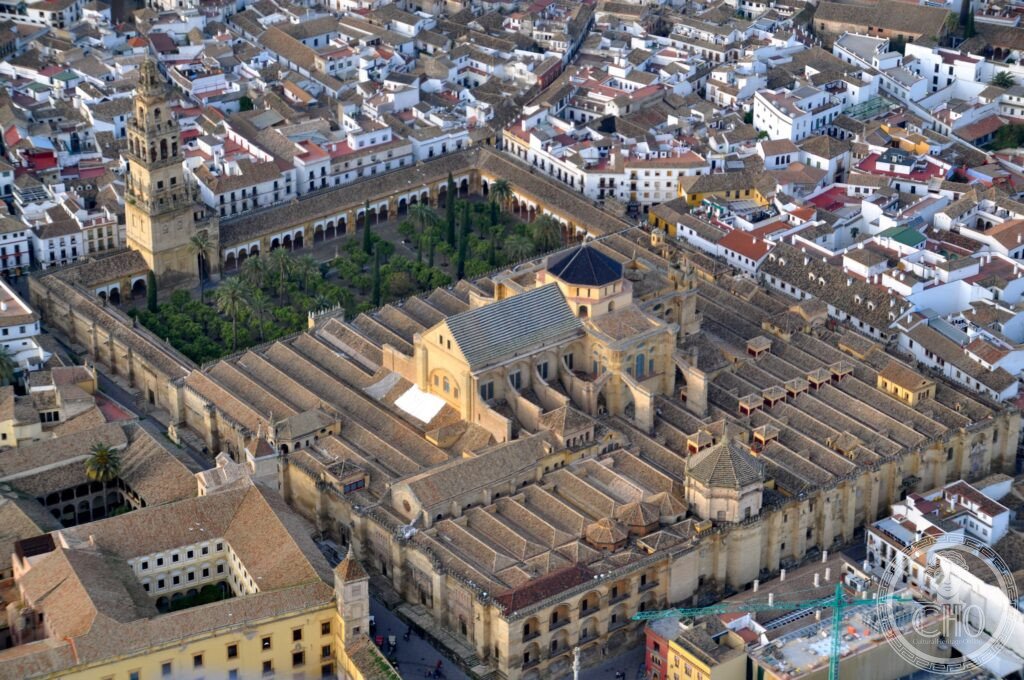
Córdoba is the most extraordinary palimpsest of civilisations in western Europe. Within a few hundred metres it contains the finest Islamic building in the western Mediterranean, the Mezquita, whose forest of 856 marble columns supporting bicolor arches remains one of the most astonishing interiors in the history of architecture. It also contains the most complete medieval Jewish quarter in Spain, the Judería, and the ruins of the 10th-century palace-city of Medina Azahara, which once housed 40,000 people in the most luxurious court in Europe.
At a glance
The Historic Centre of Córdoba (UNESCO WHS 1984, extended 1994 to include the Judería) is located on the Guadalquivir River in Andalusia, southern Spain. The population of the city of Córdoba is approximately 325,000: the largest city in the Province of Córdoba and the seventh-largest city in Spain. In the 10th century Córdoba, then the capital of the Emirate and later the Caliphate of Córdoba, was the most populous city in western Europe, with an estimated population of 500,000 to 1,000,000. The estimates vary widely and the highest ones are probably exaggerated, but a population of 300,000–500,000 is supported by the physical evidence of the city’s extent. The city was the intellectual and cultural capital of the Islamic west (al-Andalus). The philosopher and physician Ibn Rushd (Averroes, 1126–1198) was born in Córdoba: the greatest commentator on Aristotle and the most influential Islamic philosopher in western Europe. The Jewish philosopher and physician Maimonides (Rambam, 1138–1204) was also born in Córdoba, the greatest Jewish intellectual of the Middle Ages; his philosophical synthesis of Aristotle and Jewish theology influenced Christian scholasticism as profoundly as it did Jewish thought. The city was reconquered from the Moors by Ferdinand III of Castile in 1236 and began its long decline from European pre-eminence. It remains one of the most beautiful and culturally significant cities in Spain.
Key facts
- The Mezquita-Catedral: the greatest single building in western Islamic architecture. The Mosque-Cathedral of Córdoba (Spanish: Mezquita-Catedral de Córdoba) is the most visited heritage site in Spain after the Alhambra of Granada and the Sagrada Família of Barcelona. It was built by Abd al-Rahman I on the site of the Visigothic church of San Vicente Mártir; the church was shared between Christians and Muslims from 711–784 and then purchased from the Christians by the Emir to build the mosque. The first construction (784–786, Abd al-Rahman I) gave the original mosque 11 naves of 12 arches each. Its columns were reused Roman and Visigothic columns of varying heights, and the genius of the building is the response to this structural problem: a double-arch system, a lower horseshoe arch topped by a semicircular arch, allows columns of different heights to be unified under a single roof level. The bicolor voussoirs, the wedge-shaped stones of the arch, alternate red brick and white limestone and are the most distinctive visual element and the most imitated feature of Córdoba’s architecture. There were three extensions. Abd al-Rahman II in 848 extended the mosque by 8 bays to the south. Al-Hakam II (961–966) built the most refined extension, the qibla wall with the mihrab; the prayer niche is the finest single decorative surface in all of Islamic architecture. The mihrab arch is framed by Byzantine mosaics installed by craftsmen sent by the Byzantine Emperor Nikephoros II Phokas as a diplomatic gift to Al-Hakam II, with gold mosaic tesserae and carved stucco of the panel. The cupola above the mihrab is a ribbed muqarnas dome whose ribs do not intersect at the apex but form a star-polygon interlaced pattern, one of the earliest examples of this technique in Islamic architecture. Al-Mansur (987–990) built the largest extension, doubling the width of the mosque to the east; it is the least refined extension, because Al-Mansur was a regent, not a caliph, and his extension was politically controversial. The cathedral insertion came in 1523, when the chapter obtained permission from Holy Roman Emperor Charles V to build a cathedral nave in the centre of the mosque. When Charles V visited and saw the result he reportedly said: “You have destroyed something unique to build something ordinary”. The anecdote appears in Spanish chronicles within decades of the event and is considered reliable. The result, a Renaissance nave inserted into the centre of the mosque, is simultaneously one of the most controversial architectural decisions in history and one of the most extraordinary buildings in the world.
- The Judería: the most intact medieval Jewish quarter in Spain. The Judería, the Jewish quarter of Córdoba, is the most complete surviving example of a medieval Spanish Jewish neighbourhood, with streets of whitewashed houses and flower-filled patios. The Córdoba patio culture is the most important element of the city’s domestic architecture. The Patios Festival in May (the Festival de los Patios de Córdoba; UNESCO Intangible Heritage 2012) is the most important festival in Córdoba: private patios are opened to the public in May and compete for the best-decorated patio. The Synagogue of Córdoba is the most important medieval synagogue in Spain alongside the Tránsito Synagogue in Toledo. It was built approximately 1315 and is one of three surviving pre-Expulsion (1492) synagogues in Spain. Its interior has carved plasterwork, Mudéjar decoration and the Hebrew inscription from Psalms 5:8: “I will bow toward your holy temple in awe of you”. The statue of Maimonides, a bronze statue of the philosopher in the Judería square, is the most important public monument to a Jewish intellectual in Spain.
- Medina Azahara: the most ambitious palace-city in the history of al-Andalus. Medina Azahara (Madinat al-Zahra, “the city of Zahra”) was built 936–976 CE by Caliph Abd al-Rahman III for his favourite concubine Zahra. It was the caliph’s court and administrative centre, the largest and most magnificent court in 10th-century Europe, constructed by 10,000 workers using 6,000 blocks of stone daily. The city measured approximately 1.5 km × 750 m on three terraced levels on the hillside: the upper level held the royal residence, the middle level the administrative buildings and royal mosque, the lower level the city of ordinary inhabitants and artisans. The destruction came in 1010, during the civil wars of the fitna, the collapse of the Caliphate of Córdoba, when the city was sacked and burned by Berber troops and the ruins were buried. It was rediscovered 1911 and is currently approximately 10% excavated; UNESCO WHS 2018. The most important single artefact in the archaeological site museum is the carved marble panels of the Rich Hall (the Salón Rico), the throne room, the most elaborate carved stone decoration in any 10th-century building in Europe.
- Heritage: UNESCO World Heritage Site, Historic Centre of Córdoba, inscribed 1984.
- GPS: 37.8789° N, 4.7794° W.
History
Roman Colonia Patricia was the Roman provincial capital of Hispania Baetica. Major Roman ruins survive, including the temple of the Imperial Cult, whose columns stand partially reconstructed in the old town, and the Roman bridge over the Guadalquivir. In the Visigothic period (5th–8th century) the church of San Vicente Mártir stood on the site of the future Mezquita. The Umayyad conquest came in 711 CE, when the Arab and Berber forces crossed the Strait of Gibraltar and conquered the Iberian Peninsula in one of the fastest military conquests in history; Córdoba became the capital of al-Andalus. The Emirate and Caliphate of Córdoba (756–1031) was the most important period. Abd al-Rahman I (r. 756–788) was the last Umayyad prince, who escaped the Abbasid massacre of his family by fleeing to Spain; he founded the Emirate and began the Mezquita. Abd al-Rahman III (r. 912–961) proclaimed himself Caliph in 929 and built Medina Azahara; Córdoba under his rule was the most powerful state in the western Mediterranean. Al-Hakam II (r. 961–976) was the most cultured Umayyad caliph and built the mihrab extension of the Mezquita; the library at Córdoba reportedly held 400,000 volumes, the largest in Europe at the time, and the caliph himself wrote marginal annotations in many books. Under Hisham II and Al-Mansur (976–1002), with Al-Mansur as regent, came the final extensions of the Mezquita. In the Reconquista of 1236 Ferdinand III of Castile conquered Córdoba; the Mezquita was immediately converted to a Christian cathedral by adding a small chapel, and the full Renaissance nave insertion was not until 1523. In the modern period: UNESCO WHS 1984, extended 1994 for the Judería; Medina Azahara UNESCO WHS 2018.
What you see
The Mezquita-Catedral is the single most important visit; allow 2h minimum and purchase tickets online in advance. It is the most visited heritage site in Andalusia and queues without advance purchase can be 1–2h in peak season. Enter through the Puerta del Perdón, the gate of pardon, the 16th-century gate in the north wall. The Patio de los Naranjos is the orange tree courtyard, the ablution courtyard of the mosque, with the original fountain and the 98 orange trees in regular rows; it is the most photographed exterior space of the Mezquita. Inside, walk the entire extent of the hypostyle hall from north to south: the different quality of each extension is visible in the column materials and the arch decoration, and the Al-Hakam II extension is the finest. The mihrab is the most important 15 minutes of the visit; stand directly in front of it and look at the Byzantine mosaic arch. Adjacent is the capilla de Villaviciosa, the first Christian chapel, 1238. The Judería is on foot from the Mezquita, with the Synagogue, the Maimonides statue and the Jewish Museum. The Calleja de las Flores is the narrowest lane, famous for the view of the Mezquita bell tower at the end of the lane. Visit during the Patios Festival in May, or make individual patio visits, since some patios are open year-round.
Practical information
- Getting there: Córdoba Train Station is in the city centre. Córdoba is on the Madrid–Seville high-speed line, served by the AVE high-speed train: 1h 50 min from Madrid Atocha, 45 min from Seville Santa Justa, approximately EUR 20–50 depending on train type and advance booking. There are 20+ trains daily between Madrid and Córdoba, and the train is the most efficient approach from any major Spanish city. There is no major airport: the nearest airports are Seville (AGP; 1h 30 min by bus/train) and Málaga (AGP; 1h 30 min by bus). Córdoba is a walking city — its historic centre is extremely compact, and the Mezquita, the Judería, the Roman bridge and the Alcázar de los Reyes Cristianos are all within 10 min walk of each other, so a full day on foot is the ideal approach.
- The Mezquita visit strategy: the most important practical consideration for any visit. The Mezquita opens 8:30am, and the first 90 minutes (8:30–10:00am) is the quietest period, before the tour groups have arrived. Entering from the east in the morning, the early sun comes through the eastern doors and illuminates the columns from behind: the most beautiful light in the entire building. The afternoon, when the orange-tree courtyard is shaded, and the morning, when the interior is illuminated, are different experiences. Advance ticket booking is mandatory in peak season (April–October) and available at cordobamezquita.com. The cathedral also holds daily religious services, with Mass at 8:30am on weekdays and at various times on Sundays; during services the tourist areas of the building are restricted. The Mezquita also has a night show, a projection mapping on the exterior, for an additional charge and available seasonally; the exterior of the Mezquita is the most atmospheric setting for an illuminated show in Andalusia.
- The Festival de los Patios: Córdoba’s living architecture in bloom. The Festival de los Patios de Córdoba (UNESCO Intangible Heritage 2012) is held in May, approximately the first two weeks, with exact dates varying annually. It is the most distinctive cultural festival in Andalusia and one of the most unusual in Europe: the private courtyards (patios) of Córdoba’s historic centre are opened to the public and compete for the prizes for the best-decorated patio. The competition is intense, as the same families have been competing for generations and the preparation begins months in advance. The pots (macetas) of geraniums, begonias, carnations and jasmine are assembled and rearranged throughout winter and early spring, and the smell of jasmine in a Córdoba patio in May is the most distinctive sensory experience of the city. The patios are concentrated in the San Basilio quarter, south of the Mezquita, the most traditional patio neighbourhood; the competition patios are marked on maps available at the tourist office, entry is free, and the queues for the most famous patios can be long. The festival is a live example of the concept “living heritage”: the architecture of the patio is not a museum exhibit but a functioning domestic space transformed seasonally into a work of art.
Getting there
Córdoba Train Station on the Madrid–Seville AVE line (1h50min from Madrid, 45min from Seville). Walking city — Mezquita, Judería, Roman Bridge all within 10 min. GPS: 37.8789, -4.7794.
Nearby
- Medina Azahara (UNESCO WHS 2018) — 8 km west of Córdoba, 15 min by dedicated shuttle bus from the Paseo de la Victoria, approximately EUR 3 round trip, with buses running regularly. This is the 10th-century palace-city of Abd al-Rahman III, the most ambitious building project in the history of al-Andalus, described above under Key Facts. The archaeological museum at the entrance is a mandatory first stop and gives the best context for understanding the scale and sophistication of what was built here. The site is partially excavated; the Salón Rico is the reconstructed throne room, the most elaborate carved stone interior in 10th-century Europe, and its carved marble panels depict vegetal and geometric motifs in a dense interlace pattern. Allow 2–3h for the site and museum. The combination of Mezquita and Medina Azahara gives the most complete picture of Umayyad Córdoba at its peak.
- Granada and the Alhambra — 165 km east of Córdoba, 1h 30 min by bus or 1h 45 min by train via Antequera. The Alhambra (UNESCO WHS 1984) is the most visited monument in Spain and the most perfect surviving example of Nasrid Islamic architecture, and the most visited tourist site in Spain. The palace complex includes the Nasrid Palaces: the Comares Palace, with the Hall of the Ambassadors and the most refined muqarnas ceiling in the world; and the Court of the Lions, the most famous courtyard in the Islamic west, with the 12 marble lions supporting the central fountain, the surrounding colonnade and the muqarnas ceilings of the surrounding halls. The Generalife gardens are the finest surviving medieval Islamic garden in the western Mediterranean. Tickets make this the most booked-out attraction in Spain: advance booking at alhambradegranada.es is mandatory months in advance for peak season, and without it, it is often impossible to purchase tickets on arrival.
- Seville — 140 km south-west of Córdoba, 45 min by AVE, EUR 10–20. Seville is the most vibrant city in Andalusia and the capital of the region. The Cathedral of Seville (UNESCO WHS 1987) is the third-largest cathedral in the world. Its Giralda, the minaret of the Almohad mosque converted to a cathedral bell tower, is the most direct architectural relative of the Koutoubia in Marrakech and the Hassan Tower in Rabat: all three were built by the same Almohad dynasty in the same period, and the Giralda is the only one of the three to have been converted and extended. The Real Alcázar is the most important Mudéjar palace complex in Spain. It was originally built for the Almohad governors and extensively rebuilt and extended by the Christian kings of Castile from 1364, under Pedro I; it has the most complex architectural layering in any royal palace in Spain and is still a royal palace, since the Spanish royal family uses it as their official Seville residence. UNESCO WHS 1987.
Sources
- Wikipedia, Mosque–Cathedral of Córdoba; Medina Azahara; Judería of Córdoba, accessed June 2026.
- UNESCO, Historic Centre of Córdoba, WHS reference 313rev, inscribed 1984; Medina Azahara, WHS reference 1560, inscribed 2018.
- Richard Fletcher, Moorish Spain, University of California Press, 1992.
Find it on the map
See this place and what’s around it →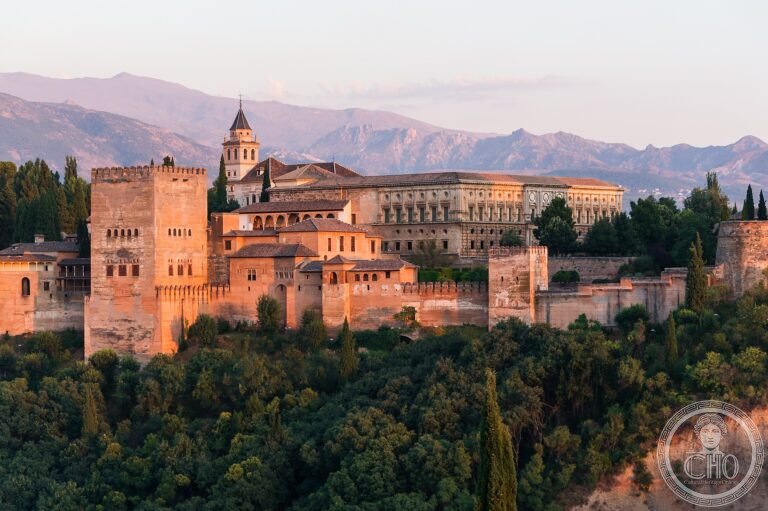
📷 Become a Cultural Heritage Online photographer
Share your photos of places: they stay published under your name as the author. The more they're seen, the more you get noticed — and soon a contest will reward the most appreciated photos.
Log in or sign up free to add a photo