

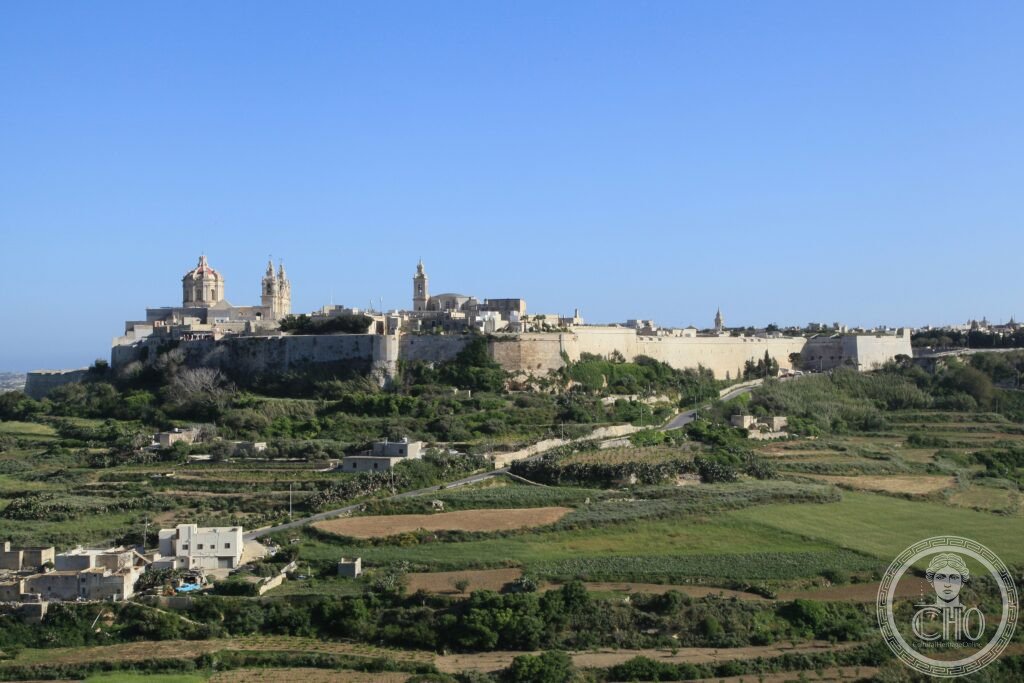
The most eerily atmospheric medieval city in the Mediterranean and one of the smallest walled cities in Europe. Mdina, perched on a 150-metre limestone ridge at the centre of Malta, is a city of 300 permanent residents, no through-traffic, near-silence except for the cathedral bells, and a density of Baroque and medieval architecture that has made it one of the most filmed cities in Europe: the setting for Eddard Stark’s walk to execution in Game of Thrones, the Roman approach in Gladiator, and dozens of lesser productions drawn by the honey-gold limestone and the absence of any modern intrusion.
At a glance
Mdina (Maltese: L-Imdina; Arabic: مدينة, Madīna, simply “city” — the Maltese name is a contraction of the Arabic; population approximately 300 permanent residents; surface area approximately 0.44 km² — one of the smallest walled cities in the world by area; cars are almost entirely banned (only residents’ vehicles and wedding/funeral carriages are permitted; the most common vehicle on the streets of Mdina is the horse-drawn karrozzin, the traditional Maltese carriage); the most photographed city in Malta after Valletta and the Blue Lagoon) is located on a limestone plateau (approximately 150 m above sea level; the highest point on the main island of Malta) at the geographical centre of Malta, approximately 12 km west of Valletta. The city served as the capital of Malta from the Bronze Age through the Arab period (9th–11th century), the Norman and Aragonese periods (1091–1530), and remained the most important fortified city on the island until the Knights of St. John moved the seat of government to Valletta (founded 1566) following the Great Siege of Malta of 1565. The silhouette of Mdina. The honey-limestone walls on the ridge. The dome of St. Paul’s Cathedral. The network of Baroque palaces. Is visible from much of Malta and is the iconic image of the Maltese interior landscape.
Key facts
- St. Paul’s Cathedral: the finest Baroque cathedral in Malta and the masterpiece of Lorenzo Gafà. St. Paul’s Cathedral (Kattidral ta’ San Pawl; the Cathedral of Mdina; the Cathedral Metropolitan; built 1702–1720; architect Lorenzo Gafà (1638–1703; the most important Maltese Baroque architect; also built the Cathedral of St. John the Baptist in Gozo and multiple important churches in Malta; trained in Rome in the Roman Baroque tradition of Bernini and Borromini; the Mdina Cathedral is his masterpiece and the finest Baroque religious building in Malta)). The earthquake (the previous cathedral on this site (a Norman-Romanesque cathedral of the 12th century) was destroyed by the earthquake of January 1693 (the 1693 Sicily earthquake; one of the most destructive earthquakes in the history of the western Mediterranean; the earthquake damaged or destroyed virtually every building in Mdina; the new cathedral was designed from scratch by Gafà in the post-earthquake period)). The interior (the finest single church interior in Malta; the marble floor (the floor is covered in the funerary slabs of Maltese nobles; the floor is a graveyard, every stone marking a burial; the slabs are carved with the heraldic arms and epitaphs of the individuals buried beneath; walking across the cathedral floor is walking across a gallery of Maltese noble history); the paintings (the cathedral museum adjacent to the cathedral has the most important collection of Mattia Preti paintings in Malta — Preti (1613–1699) was the Calabrian Baroque painter who spent the last 38 years of his life in Malta and painted the entire nave vault of the Co-Cathedral of St. John in Valletta; the Mdina cathedral has 12 paintings by Preti)).
- Palazzo Falson (the Norman House): the finest surviving medieval domestic interior in Malta. Palazzo Falson (Ir-Razzett ta’ Falson; the Norman House; built approximately 14th–15th century; the most important surviving medieval secular building in Malta; the home of Olof Frederick Gollcher (1889–1962; a shipping magnate, amateur sailor, and passionate collector; Gollcher lived in the Palazzo Falson from 1927 until his death and filled it with his collection of art, furniture, weaponry, coins, and maritime instruments; he bequeathed the palazzo and its entire contents to the Maltese state on condition that it be maintained as a museum without alteration; the result is a remarkably intimate museum — a medieval palazzo that feels lived-in rather than institutionalised; the private chapel; the library; the sea-charts; the collection of Maltese cross-shaped swords)).
- St. Paul’s Grotto, Rabat: the cave where St. Paul allegedly spent his Maltese sojourn. St. Paul’s Grotto (adjacent to Mdina in Rabat, the settlement that grew up outside Mdina’s walls; the cave (a natural underground cavern beneath the Wignacourt Collegiate Church; the tradition that St. Paul sheltered in this cave during his three-month stay in Malta in 60 CE (after his shipwreck on the island, described in Acts 28); the Maltese tradition of the shipwreck has been maintained without interruption from the 1st century to the present; the most important Pauline site in Malta; the statue of St. Paul in the cave (a 17th-century white marble statue); the underground catacombs of St. Agatha and St. Paul adjacent to the grotto (the most important early Christian catacombs in Malta; dating from the 3rd–5th century; the most extensive early Christian burial complex outside Rome)); the entire Rabat–Mdina area is the most historically concentrated part of the Maltese interior).
- Game of Thrones and screen heritage: one of the most filmed cities in Europe. Mdina and Game of Thrones (Season 1, 2011; the filming locations: the Main Gate and the square in front of it (filmed as the gate of King’s Landing where Ned Stark’s execution is proclaimed); the streets of the old town (filmed as the streets of King’s Landing in multiple scenes); Mdina Cathedral Square (filmed as the square in front of the Great Sept of Baelor); the Gladiator connection (2000; the film crew used the main gate approach for the Roman procession scenes); the Count of Monte Cristo (1975; Mdina was the island of Elba)). The walking tour of Game of Thrones locations (available from the main gate; the most popular guided experience in Mdina; approximately 2h; the film crew used multiple specific locations; the tour guide identifies each location and plays clips on a tablet).
- GPS: 35.8858° N, 14.4030° E.
History
Bronze Age settlement (the ridge was occupied from approximately 4000 BCE; the most defensible site on the island). Phoenician and Greek period (the trading port of the Phoenicians; the Phoenician name for the island of Malta (Maleth; “shelter” or “safe harbour”) gives Malta its current name). Roman period (the capital of Roman Malta; the Roman city of Melite on the Mdina site; the domus (town houses) of the Roman period (the remains of a Roman house with mosaic floors are preserved in the Domus Romana Museum in Rabat, adjacent to Mdina; the most important Roman domestic remains in Malta)). St. Paul’s visit (60 CE; the shipwreck; the sojourn of 3 months; the healing of Publius the governor’s father; the tradition of Pauline Christianity in Malta that dates from this visit). The Arab period (870–1090 CE; the Arab name Medina was contracted to Mdina; the Arab fortifications; the character of the city as a hilltop fortress defended against coastal raids). The Norman conquest (1091; Roger I of Sicily conquered Malta from the Arabs; the Norman cathedral (predecessor of the current Baroque cathedral); the 13th–14th century expansion of the fortifications). The Aragonese period (1282–1530; the most important medieval building period; Palazzo Falson dates from this era). The Knights of St. John (1530–1798; after the Great Siege of 1565, the knights moved the capital to Valletta, built new; Mdina lost its political importance and became the silent aristocratic city it remains today). French period (1798–1800; Napoleon). British period (1800–1964). Maltese independence 1964.
What you see
The Main Gate (the Baroque entrance gate (1724; architect Charles François de Mondion; the most theatrical entrance to any city in Malta; the bastions flanking the gate; the view from the bridge over the dry moat)). St. Paul’s Cathedral (30 min for the cathedral; 45 min including the cathedral museum with the Mattia Preti paintings and the Albrecht Dürer woodcuts — the Cathedral Museum holds one of the finest collections of Dürer woodprints in the Mediterranean region). Palazzo Falson (the finest single museum experience in Mdina; allow 1h). The Bastion Square (Misraħ San Publiju; the finest panoramic terrace in Malta; from the bastion wall you can see Valletta, the harbour, and on clear days the island of Gozo; the view of the Mosta Dome (approximately 7 km; the third-largest dome in Europe by interior volume)).
Practical information
- Getting there: Mdina is 12 km from Valletta and 10 km from Malta International Airport (MLA). Bus 52 or 53 from Valletta Bus Terminus (approximately 40 min; EUR 1.50; the bus stops at Rabat; walk from Rabat through the suburb to the Mdina Main Gate (approximately 10 min)). Taxi from Valletta (approximately EUR 20–25; 20 min without traffic; the taxi cannot enter Mdina — you alight at the Main Gate). The Malta hop-on/hop-off bus (the tourist circuit includes Mdina; approximately EUR 20–25/day; the most convenient option if visiting multiple sites). Mdina itself is entirely pedestrian (no cars; the streets are narrow medieval lanes of golden limestone; the karrozzin (horse-drawn carriage) rides from the main gate are available at approximately EUR 15–20 for a 30-min circuit of the main streets of the city).
- The Mdina Dungeons: the most theatrical heritage experience in Malta. The Mdina Dungeons (beneath the Palazzo Vilhena (1726; now the Natural History Museum; the baroque palazzo built for the Knights of St. John; the largest palazzo in Mdina); the Dungeons exhibition (a theatrical walk-through of the darker episodes of Maltese history: the Arab slave raids; the Inquisition (Malta had one of the more active Inquisitions in the Mediterranean; the Inquisitor’s Palace in Birgu is the only surviving Inquisitor’s Palace open to the public in Europe); the Black Death; the pirate attacks; the Norman conquest; the exhibition uses life-size wax figures, sound effects, and reconstructed dungeon environments to dramatic effect — more theatrical than academic, but effective as an introduction to the multiple catastrophes that have shaped Maltese history); approximately EUR 10; 45 min–1h).
- The Mosta Miracle and the Rotunda: the most extraordinary church in Malta and the site of the “Mosta Miracle”. The Church of the Assumption of Our Lady — Ir-Rotunda tal-Mosta, the Rotunda of Mosta — stands 6 km south-east of Mdina and is the most striking building in the Maltese interior: a neoclassical church built between 1833 and 1860 by the architect Giorgio Grognet de Vassé. Its dome measures 37 m in diameter, the third-largest unsupported dome in Europe after the Pantheon in Rome at 43.3 m and the Basilica of Our Lady of Peace in Yamoussoukro, Ivory Coast, at 38 m, and it is visible from most of Malta. The miracle dates to 9 April 1942. During World War II the Luftwaffe bombed Malta 154 consecutive days, the “Siege of Malta”, which made the island the most bombed place of the war. On 9 April a German bomb fell through the dome during a crowded Mass, with approximately 300 people inside. It did not explode, and all 300 survived unhurt. The bomb is displayed in a niche in the sacristy — a replica, since the original was dismantled for safety — and Malta celebrates the event as a miracle of divine intervention.
Getting there
Bus 52/53 from Valletta (40 min, EUR 1.50) to Rabat, then 10 min walk. No cars inside Mdina. GPS: 35.8858, 14.4030.
Nearby
- Valletta. 12 km east (30 min by bus or 20 min by taxi). The UNESCO WHS capital of Malta and the smallest EU capital city. Valletta, UNESCO WHS 1980, has approximately 6,500 inhabitants, which makes it the smallest EU national capital by population. The Knights of St. John built it after the Great Siege of 1565 on an empty peninsula between two harbours, and it takes its name from Jean de Valette, the Grand Master who led the defence of Malta in that siege. Its Co-Cathedral of St. John, 1577, is the most important Baroque church on the island: Mattia Preti painted the nave vaults between 1661 and 1666, the most important commission of Preti’s career, and the vaults alone took approximately 18 months. In the Oratory hangs the Beheading of John the Baptist by Caravaggio, 1608 — the only painting he ever signed, with his own blood according to tradition, though the actual medium is red paint. It measures 361 × 520 cm, is the largest Caravaggio in the world and is considered his greatest work, and the Oratory was built specifically to house it. Below the city lies the Grand Harbour, the most visually dramatic natural harbour in the Mediterranean, with the view of the Three Cities — Birgu or Vittoriosa, Senglea and Cospicua — from the Upper Barrakka Gardens.
- The Ħaġar Qim and Mnajdra Temples. 30 km south-west of Mdina (45 min by car or bus; Bus 201 from Valletta via the coast road). The most important megalithic temples in the world and the oldest free-standing buildings in human history. Ħaġar Qim and Mnajdra (UNESCO WHS 1980, extended 1992) form the megalithic temple complex on the southern coast of Malta, built approximately 3600–2500 BCE: older than Stonehenge, 2500–2000 BCE, and than the Egyptian pyramids, 2600 BCE. The limestone megaliths reach 7 m in length and weigh approximately 20 tonnes each. The temple plan gathers apses, a trilithon entrance and altar niches, and the stone surfaces carry a pitted decoration — small holes hammered into the limestone in patterns, whose exact purpose is unknown but whose deliberateness is clear. Mnajdra is precisely aligned with the winter solstice sunrise: on the shortest day of the year the rising sun shines straight through the entrance corridor and illuminates the back wall.
- Gozo Island. 45 min by ferry from Cirkewwa, in northern Malta, reached by Bus 41 from Valletta in 45 min for EUR 1.50; the ferry runs every 30 min–1h and is free, being publicly subsidised. Gozo — Għawdex — is the second island of Malta, with a population of approximately 37,000, the most beautiful and the most agricultural of the group, and the most unspoiled of the three inhabited islands, Malta, Gozo and Comino. Its capital is Victoria, Il-Belt, and above it stands the Citadel, Il-Ċittadella, the fortified upper town and the most dramatic medieval citadel in the Maltese islands, under consideration by UNESCO. Inside it is the Cathedral of Gozo, 1697–1711, by Lorenzo Gafà, the same architect as St. Paul’s Cathedral in Mdina. The cathedral has a remarkable trompe-l’oeil ceiling: a flat ceiling painted to look like a dome, because the dome that had been planned was never built. The painting, of 1739, by Antonio Manuel Bellanti, is so convincing that visitors regularly believe they are looking up into a real dome.
Sources
- Wikipedia, Mdina. St. Paul’s Cathedral, Mdina. Palazzo Falson, accessed June 2026.
- Heritage Malta, Mdina / The Silent City. Official heritage information, 2024.
- John Cremona, Mdina: A Short History of the Ancient City of Malta, Midsea Books, 2003.
Find it on the map
See this place and what’s around it →📷 Become a Cultural Heritage Online photographer
Share your photos of places: they stay published under your name as the author. The more they're seen, the more you get noticed — and soon a contest will reward the most appreciated photos.
Log in or sign up free to add a photo