
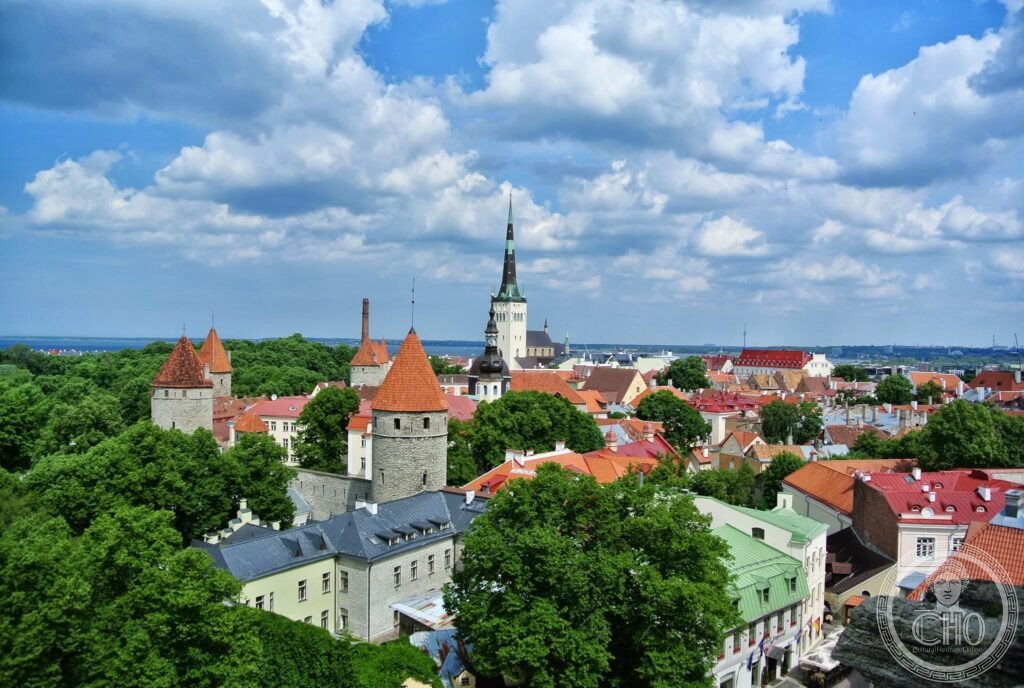
The best-preserved medieval Hanseatic city in northern Europe and the most authentically intact Gothic city centre on the Baltic Sea. Tallinn, the limestone city on a natural rocky platform above the Gulf of Finland, preserves in almost unaltered form its medieval street plan, its complete city walls with 26 towers, its Gothic town hall (home to the oldest continuously operating pharmacy in Europe), and a visual identity that makes it the most photographed city in the Baltic states.
At a glance
The Historic Centre of Tallinn (UNESCO WHS 1997; the inscribed zone covers the medieval Vanalinn (Old Town) of approximately 1.1 km²; population of the city of Tallinn approximately 450,000 (approximately 54% Estonian, 37% Russian-speaking; the Soviet-era mass immigration from Russia created the bilingual character of the contemporary city)) is the capital of Estonia, located on the southern shore of the Gulf of Finland approximately 85 km south of Helsinki. The city is built on a natural limestone plateau (the Toompea; the upper town on the Ordovician limestone escarpment that rises approximately 20 m above the lower town and approximately 48 m above sea level) overlooking the Baltic Sea. The medieval town plan (the lower town (Allinn; the Hanseatic merchant city; the streets radiating from the Town Hall Square (Raekoja plats; the market square; the commercial heart of the city); the guild houses; the merchant residences) and the upper town (Toompea; the episcopal and secular authority; the castle; the cathedral; the residences of the nobility; separated from the lower town by a series of gates (Lühike jalg (Short Leg) and Pikk jalg (Long Leg) gates; the most photographed viewpoints in Tallinn)) together form the most complete example of a medieval dual-city (upper/lower) arrangement anywhere in the Baltic region).
Key facts
- The Town Hall and the Town Hall Pharmacy: the finest Gothic secular building in northern Europe and the oldest continuously operating pharmacy in Europe. The Tallinn Town Hall (Raekoja; built 1371–1404; the most important Gothic secular building in Estonia; the tower (64 m; topped by the Vana Toomas (Old Thomas) weathervane — a figure of a medieval soldier who has watched over the city since 1530; a symbol of Tallinn; the reproductions of Old Thomas are sold in every souvenir shop in the city); the Town Council Chamber interior (the painted vaulted ceiling; the carved stone portals; the most important secular Gothic interior in Estonia)). The Town Hall Pharmacy (Raeapteek; on the corner of the Town Hall Square; established at least 1422 (possibly earlier; the city archives show a pharmacist operating here from 1422; the pharmacy is the oldest continuously operating in Europe — it has been in operation for over 600 years without interruption under a succession of owners; the current interior (early 20th-century wooden fittings and glass cases; the shelves with historical pharmaceutical vessels and documents) gives a sense of the continuous trading tradition); the most remarkable surviving example of urban commercial continuity in northern Europe).
- Tallinn marzipan: the city that claims to have invented European marzipan. Tallinn claims to be the origin of marzipan, the ground almond and sugar confection. The legend says that in 1407 a city councillor fell ill and was cured by a remedy of ground almonds and sugar; the first written reference to marzipan in any European city is in the Tallinn town records of 1406–1407. The German city of Lübeck and the Spanish and Italian traditions both dispute the claim, and the argument over who invented marzipan is one of the most contentious minor disputes in European culinary history. The honest answer is probably that it came out of the Arab world, from the Middle Eastern tradition of ground almond sweets, and reached Europe through several channels at once, the Hanseatic trade routes through Tallinn among them. The local tradition is the city’s most important confectionery, sold in small painted wooden boxes at the Kalev Maiasmokk Café — the oldest café in Estonia, founded 1864, with the most beautiful Art Nouveau interior in Tallinn — where the marzipan includes hand-painted figures in medieval and Estonian folk art designs. It is the most distinctive food souvenir of the city.
- The city walls and towers: the most complete medieval city fortification in northern Europe. The first stone walls went up around 1265, after the city passed under Danish and then Livonian Order control, and were extended and raised through the 14th and 15th centuries. At their greatest extent, around 1400, they enclosed the whole lower town in a circuit of approximately 3 km with 46 towers. Of those, 1.9 km and 26 towers survive, and the towers are the most characteristic element of the Tallinn skyline: cylindrical, square and D-shaped, with names that record their medieval functions and reputations. Kiek in de Kök is Low German for “Look in the Kitchen”, because the soldiers up there could see into the kitchens of the houses below. Paks Margareeta, Fat Margaret, is the largest, a squat circular artillery tower guarding the harbour entrance and now the Estonian Maritime Museum. Then come Nunnatorn, the Nuns’ Tower, and the Sauna Tower. Inside Kiek in de Kök a museum occupies 6 floors and holds the collection of medieval cannonballs from the Russian siege of 1570–1571, under Ivan the Terrible.
- Heritage: UNESCO World Heritage Site, Historic Centre of Tallinn, inscribed 1997.
- GPS: 59.4370° N, 24.7454° E.
History
Ancient Estonian settlement (the name Tallinn derives from Taani-linna (Estonian: “Danish castle”) — the city was founded by the Danish King Valdemar II who erected the Toompea Castle in 1219 after the crusade conquest of Estonia). Danish and Livonian Order rule (13th–14th century; the lower town grew as a Hanseatic merchant city under the de facto control of the Hanseatic League while the castle and upper town were controlled by the Livonian Crusade Orders). The Hanseatic period (1248–1561; the most important period; Tallinn (then called Reval) was one of the most prosperous Hanseatic cities; the construction of the town hall, the city walls, the major churches, and the guild houses all date to this period). Swedish rule (1561–1710; Tallinn came under Swedish control as part of the Swedish Empire; the construction of Swedish baroque buildings alongside the medieval core). Russian conquest (1710; Peter the Great captured Tallinn (renamed Reval) during the Great Northern War). Estonian independence (1918–1940 and 1991–present; the restoration of independence in 1991 after Soviet occupation was celebrated from the Pikk Hermann tower). UNESCO WHS 1997. European Capital of Culture 2011.
What you see
The Town Hall Square, Raekoja plats, is the centre of the lower town and the finest square in the Baltic, surrounded by the town hall, the merchant houses and the town hall pharmacy. Its Christmas market, from December 1 to January 6, is the most celebrated in the region, and a Christmas tree has stood here since 1441 — one of the earliest recorded in the world, as a plaque on the square claims. Two lanes climb from the lower town to the upper, the Long Leg Gate and the Short Leg Gate, and they are the most photographed streets in Tallinn: the Short Leg Gate, Lühike jalg, at the base of the Toompea gives the classic view, a vaulted gate in a limestone wall opening onto a cobbled lane that rises between medieval buildings to the towers above. On the Toompea itself, two observation terraces on the north and south walls give the finest views of the lower town and of the Baltic Sea. The Alexander Nevsky Cathedral, the Russian Orthodox church on the hill, was built between 1894 and 1900 and carries the largest dome in the city: the Tsarist government raised it as a demonstration of Russian cultural power, which makes it controversial in Estonia and architecturally spectacular at the same time.
Practical information
- Getting there: Tallinn Airport (TLL) is 3 km from the old town, the most central airport relative to its city centre in the Baltic: Bus 2 or 4 takes 10 min for EUR 1.50, a taxi costs EUR 6–10, and Ryanair, Wizz Air, Finnair, LOT and airBaltic fly in from most European hubs. From Helsinki the ferry is the most scenic approach and often the cheapest, with Tallink, Eckerö Line or Viking Line: 2h on the conventional boat, 2h 30 min on the slow one, from EUR 15 one way. The crossing covers approximately 85 km of the Gulf of Finland, calm in summer and sometimes very rough in winter storms, and the D-terminal is 800 m from the entrance to the old town. From Riga, the Lux Express bus takes 4h from EUR 10 and is the most popular connection between the two Baltic capitals.
- The Helsinki day trip connection: Tallinn and Helsinki are the most closely linked pair of national capitals in Europe. Helsinki is approximately 85 km across the Gulf of Finland from Tallinn (2h by conventional ferry; more than 8 million crossings per year; the highest-frequency ferry route between two EU capital cities). The dual city visit (Helsinki + Tallinn in 2 days) is the most efficient way to experience both Nordic and Baltic architecture and culture simultaneously. The Helsinki day trip to Tallinn (take the 8:30am Tallink ferry from Helsinki South Harbour; arrive Tallinn 10:30am; full day in the old town; return ferry 8pm; arrive Helsinki 10pm; the most popular international day trip in Finland).
- The Lahemaa National Park: the most beautiful coastal landscape in Estonia. Lahemaa was Estonia’s first national park, created in 1971, and the first established anywhere in the Soviet Union: 725 km², 50 km east of Tallinn, 1h by road along the E20 motorway. It holds the most important collection of manorial heritage in the country, the country houses and manor houses — mõis — built by the Baltic German nobility in the 18th–19th century. The finest restored 18th-century manor in Estonia is Palmse Manor, a Swedish Baroque house of 1785, with its main rooms still furnished, an orangery, a formal garden and a distillery: it is the model for the mõis culture of the Estonian-Baltic region. The coast is a complex of bays, peninsulas and islands, and on the Käsmu Peninsula lies the “Village of Captains”, the most important maritime heritage site in Estonia and the most photogenic coastal village in the country.
Getting there
Tallinn Airport (3 km; bus 10 min). Helsinki–Tallinn ferry (2h, from EUR 15). GPS: 59.4370, 24.7454.
Nearby
- Pärnu and the Estonian seaside resorts. 130 km south of Tallinn (1h 30 min by road or bus; the most popular domestic tourist destination in Estonia). The summer capital of Estonia and the finest Baltic spa resort town. Pärnu (population approximately 40,000; the most popular beach resort in Estonia; the Pärnu beach (a 3 km white sand beach on the southern shore of the Pärnu Bay; the beach is sheltered and the water warms to approximately 20–22°C in July; the most popular beach in Estonia); the Pärnu Old Town (a grid of early 20th-century wooden resort villas and Art Nouveau commercial buildings; the most important collection of Art Nouveau resort architecture in Estonia; the Endla Theatre; the contemporary art museum; the restaurant Raimond (the most celebrated restaurant in the city, named for the Estonian composer Raimond Valgre))).
- Hiiumaa and Saaremaa Islands. Ferry from Rohuküla (95 km west of Tallinn; 1h to Kärdla on Hiiumaa; or Virtsu (90 km south-west; 25 min to Kuivastu on Saaremaa)). The most isolated and pristine coastal islands in Estonia. Saaremaa (the largest island in Estonia; 2,672 km²; the Kuressaare Castle (the most important fortified castle in Estonia; built by the Livonian Order in the 14th century; the best-preserved medieval castle in the entire Baltic; the Bishop’s Castle; the moat; the towers; the most visited heritage site in Saaremaa); the Kaali meteor crater (approximately 4,000 years ago; a meteorite disintegrated into 9 fragments over Saaremaa; the largest crater (110 m diameter; 22 m deep) filled with water; one of the most significant meteor impact events in human history (it occurred during the Bronze Age and was observed by humans); the impact was devastating to the local population and may have inspired Estonian mythological tales of celestial fire)).
- Tartu (Second City of Estonia). 185 km south-east of Tallinn (2h 30 min by road; 2h 30 min by train; 2h by bus). The intellectual capital of Estonia and the site of the University of Tartu (the oldest university in the Baltic region). Tartu has a population of approximately 95,000 and is the second city of Estonia and its university town. The University of Tartu was established in 1632 by the Swedish King Gustav II Adolf and is the oldest and most important in the country: since the National Awakening of the 19th century it has been the centre of Estonian intellectual life, and it educated the generation that created Estonian-language literature, music and national identity between the 1850s and the 1900s. The Old Town turns on the Raekoja Plats, a Town Hall Square smaller than Tallinn’s but of similar proportions, where the Town Hall of 1789 leans slightly — visibly, to the naked eye — and is one of the few leaning buildings in Europe besides Pisa. Above the town stand the ruins of the Cathedral of Tartu, the most important medieval ruins in Estonia: the nave of the 13th-century Gothic church is roofless and open to the sky, its walls standing to 20 m, and the University of Tartu Library occupies the surviving choir.
Sources
- Wikipedia, Historic Centre of Tallinn. Tallinn Town Hall. Tallinn Town Hall Pharmacy, accessed June 2026.
- UNESCO, Historic Centre of Tallinn, WHS reference 822, inscribed 1997.
- Toomas Karjahärm and Väino Sirk, The Estonian Intelligentsia and National Awakening, Estonian Academy Publishers, 1997.
Find it on the map
See this place and what’s around it →📷 Become a Cultural Heritage Online photographer
Share your photos of places: they stay published under your name as the author. The more they're seen, the more you get noticed — and soon a contest will reward the most appreciated photos.
Log in or sign up free to add a photo