

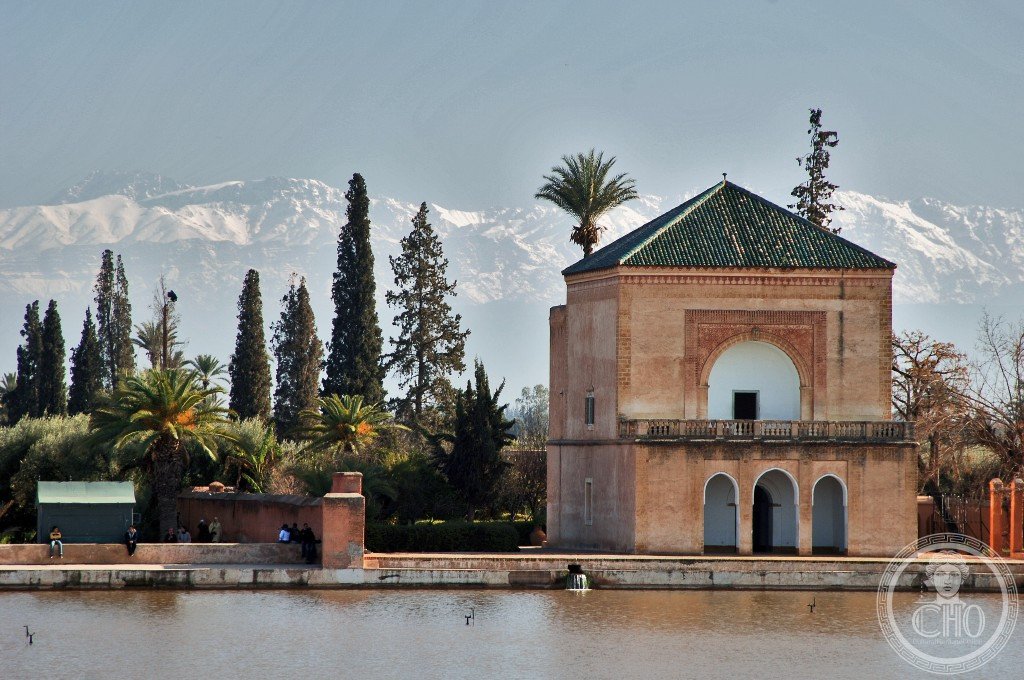
The most sensory overwhelming city in Africa and the most theatrically alive public square in the world. The Marrakech medina, one of the four imperial cities of Morocco, wraps a thousand years of Almoravid, Almohad, Saadian, and Alaouite dynastic ambition around the Jemaa el-Fna, a square where snake charmers, storytellers, Gnawa trance musicians, acrobats, and henna artists perform simultaneously from dawn to midnight under the minaret of the most beautiful mosque in the Maghreb.
At a glance
The Medina of Marrakech, UNESCO WHS 1985, is the historic walled city, and the inscribed zone covers a medieval urban core of approximately 6 km² where approximately 100,000–150,000 people live permanently. It is contained within 19 km of partially surviving ramparts of reddish-pink pisé, rammed earth: the material that gives Marrakech its terracotta colour and, among Arabs, the nickname “the Red City”, al-Hamra. The Almoravid sultan Yusuf ibn Tashfin founded it in 1070. The city was the administrative capital of the Almoravid dynasty (which controlled an empire from the Sahara to the Iberian Peninsula at its peak; the cultural influence of the Almoravids on the architecture of al-Andalus is visible most clearly in the Koutoubia minaret, which directly inspired the Giralda in Seville). One of the four imperial cities of Morocco (Fès, Marrakech, Meknès, and Rabat; each was the administrative capital of Morocco at different periods; Marrakech was capital under the Almoravids (1070–1147), the Almohads (1147–1269), and the Saadians (1524–1659)). The medina is characterised by its derbs, the narrow private lanes of the residential quarter, many of them dead-ends: the layout was designed to give privacy to individual households and to make navigation by outsiders as difficult as possible. Its defining visual elements are the Souks of the Medina — the largest souk and the most complex covered market in North Africa, approximately 18 distinct souks each specialising in a single trade, from the Souk des Babouches for slippers to the Souk des Bijoutiers for jewellers to the Souk des Épiciers for spices — the pink ramparts, the palmerie, the ancient palm grove north of the medina, and the snow-capped peaks of the High Atlas visible from the rooftop terraces.
Key facts
- The Jemaa el-Fna. The world’s most extraordinary public square: a UNESCO Living Heritage performance space active for 1,000 years. The Jemaa el-Fna (approximately 90,000 m²; the hub of the medina; an economic, social, and cultural centre that operates continuously from dawn to midnight; the square is neither architecturally significant (the buildings around it are undistinguished) nor formally planned (the square occupies what was historically an execution ground outside the mosque; the square’s name probably means “the assembly of the dead” — a reference to the public executions)). The square changes through the day. Morning belongs to the famous 4 dirham freshly squeezed orange juice, the most competitive bargain in Morocco, to dried fruit and nuts, to henna tattoo artists and the occasional monkey on a leash. In the afternoon come the Gnawa musicians, the most sonically arresting thing on the Jemaa el-Fna: descendants of sub-Saharan slaves brought to Morocco from Mali, Senegal and Guinea, playing trance music on the guembri, a 3-stringed bass lute, with the qraqeb, metal castanets, and call-and-response voices. The same music serves in religious healing ceremonies, the all-night lila rituals, and it is one of the most unusual living traditions in the Islamic world. Beside them work the storytellers, the halqa of the Arabic narrative tradition, where a rawi tells his story in a ring of listeners: the practice survives but is declining as television takes over the job, and the most skilled can hold a crowd for hours on a single episode of history or fantasy. Then the fire-eaters, the acrobats, the snake charmers. In the evening the 100+ food stalls appear in under 30 minutes, each with its tout calling in passers-by: harira soup, merguez sausage, snail broth — escargot cooked in cumin and anise, the most distinctive street food on the square — lamb or beef brochettes, couscous, tagine, khobz bread. The best view of all this is from the first-floor terraces of the cafés on the north side, particularly the Café de France and the Restaurant Argana: 7pm is the golden hour, when the square is fully alive and the Koutoubia stands lit by the setting sun behind it.
- The Koutoubia Mosque: the finest Almohad minaret in the world and the architectural mother of the Giralda. The Koutoubia (Arabic: كتبية; “Booksellers” — the mosque was originally adjacent to a market of booksellers and manuscript copyists; this was considered an appropriate neighbourhood for a mosque in the Islamic scholarly tradition). The Almohad caliph Abd al-Mumin built the present mosque in 1158. A first mosque of 1147 stood on the same site but was slightly misaligned with Mecca and was pulled down, so this is the second building, correctly oriented. Its minaret became the model for two others. The Giralda in Seville, completed 1198, was raised by the Almoravid and Almohad dynasties to the same geometric proportions, and though a Renaissance belfry added in 1568 increased its height, the original tower is identical in proportion to the Koutoubia. The Hassan Tower in Rabat, begun 1196, was left unfinished when the caliph Yusuf al-Mansur died in 1199, and its stump still stands beside the Mohammed V Mausoleum. The Koutoubia minaret is 69 m high and was the tallest building in Marrakech for 800 years. Non-Muslims cannot go inside, which is standard Moroccan policy for every mosque except the Hassan II in Casablanca, but the exterior and the minaret are visible from the whole surrounding area.
- The Saadian Tombs: the most lavishly decorated royal tombs in Morocco. The mausoleum of the Saadian sultans was built in the 16th century under Ahmad al-Mansur, the Golden One (r. 1578–1603), the most powerful Moroccan ruler since the Almohads. His victory at the Battle of the Three Kings (1578) — a famous battle in which three rulers died simultaneously: the Portuguese King Sebastião I, the deposed Moroccan sultan Abu Abdallah Mohammed II, and the reigning Moroccan sultan Abd al-Malik I, who died on the eve of the battle — made Morocco temporarily the dominant power in north-western Africa. The tombs were sealed by the Alaouite dynasty sultan Moulay Ismail after 1672; the Saadians had been the Alaouites’ predecessors, and sealing the tombs rather than destroying them was a compromise between religious obligation to the dead and dynastic desire to erase the previous dynasty from public view. They were forgotten by Europeans for 250 years. Rediscovered (in 1917; the French colonial administration found them from aerial photographs; excavated and restored). The interior (the most lavish use of zellij (mosaic tile), carved plaster (stucco), and carved cedar wood in Morocco; the Chamber of the Twelve Columns (the principal burial chamber; the 16 marble columns from Carrara imported from Italy; the honeycomb muqarnas ceiling; considered the finest example of Hispano-Moorish decorative art in existence)).
- Heritage: UNESCO World Heritage Site, Medina of Marrakech, inscribed 1985.
- GPS: 31.6295° N, 7.9811° W.
History
Foundation by Yusuf ibn Tashfin (1070; the Almoravid dynasty; the first great Berber empire of North Africa and Andalusia; the construction of the first walled medina and the first mosque at the site). The Almohad period (1147–1269; the second Berber dynasty; the construction of the Koutoubia Mosque (1158) and the expansion of the medina; the Almohads controlled Morocco, Andalusia, and Tunisia simultaneously; the zenith of Moroccan cultural power in the medieval Islamic world). The Merinid, Wattasid, and Saadian periods (14th–16th century; the Saadian dynasty (1524–1659) made Marrakech their capital; the construction of the Saadian Tombs and the El Badi Palace). The Alaouite dynasty (from 1631 to the present; the current Moroccan royal family; Moulay Ismail (r. 1672–1727) sealed the Saadian Tombs and moved the capital to Meknès; Marrakech was capital again from the 19th century). The French Protectorate (1912–1956). Moroccan independence 1956. UNESCO WHS 1985. Marrakech is now one of the most visited cities in Africa (approximately 4 million tourists per year) and a major location for luxury riad tourism.
What you see
The Jemaa el-Fna (the starting point; the terrace cafes for orientation; the food stalls after 7pm). The souks (accessible from the north side of the Jemaa el-Fna; the souk du cuir (leather goods); Souk Smarine (the main covered textile souk; the highest concentration of textile merchants; the light coming through the slatted wooden roof)). The Ben Youssef Medersa (14th-century Quranic school; the most important Hispano-Moorish interior in Marrakech; the central courtyard (the ablution pool; the carved stucco walls; the zellige mosaic tile wainscoting; the carved cedar wood screens)). The Bahia Palace (19th century; the most complete riad garden palace in Marrakech; the name means “brilliance”; built by the Grand Vizier Ahmed ibn Moussa for his harem of 4 wives and 24 concubines; the riad garden (the largest private garden in the medina; the 8 hectares; the fountain courtyards; the painted cedar ceilings)). The Saadian Tombs (the Chamber of the Twelve Columns; allow 45 min). The Mellah (the Jewish quarter; adjacent to the Saadian Tombs; the Jewish community that lived here from the 16th to the 20th century; the synagogues).
Practical information
- Getting there: Marrakech Menara Airport (RAK; Marrakech Menara Airport; 6 km from the medina; taxi approximately MAD 70–100 (EUR 6–9) to the Jemaa el-Fna). Ryanair, easyJet, Transavia, TUI, and most European LCCs fly to Marrakech from major European cities (direct flights from London, Paris, Amsterdam, Madrid, Berlin, Milan, Rome, and dozens of other cities; Marrakech is the most accessible of Morocco’s imperial cities from Europe; a 3h flight from London, 2h from Madrid). Train from Casablanca (3h; the ONCF Marrakech Express; approximately MAD 100 (EUR 8.50); 6 trains daily; the most comfortable intercity transport in Morocco).
- The riad experience: the most atmospheric accommodation in North Africa. A riad (Arabic: رياض) is a traditional Moroccan house built around an interior courtyard garden with a fountain. Its external walls are blank: every window and every ornament faces inward, which is the Islamic principle of private domesticity made into architecture, with the paradise garden hidden from the street. The medina of Marrakech has approximately 1,200–1,500 riads working as guesthouses, from the basic — EUR 30–50 a night for a courtyard, a fountain and a rooftop terrace with a view over the city — to the extraordinarily luxurious, the Riad Farnatchi and La Mamounia among them. La Mamounia, of 1922, is the most famous hotel in North Africa: Winston Churchill painted watercolours here, its garden covers 12 hectares, the largest hotel garden in the city, with olive trees centuries old, and its pool was the scene of the Marrakech hippie years of the 1960s, when The Rolling Stones stayed here in 1967. In practice the thing to book is a traditional riad in the medina within walking distance of the Jemaa el-Fna, EUR 60–120 a night, with a roof terrace.
- The hammam experience: the social bath of the Maghreb. Every neighbourhood in the medina has at least one hammam, the Moroccan steam bath. The public ones are strictly segregated, with separate sections and separate hours for men and women, and the traditional visit costs approximately MAD 60–120, EUR 5–10, including soap and exfoliating glove. You undress in the changing room, pass through the cold room, the tepid room and the hot room, then lie on the marble slab while the kessal, the scrubber, works over you with the kessa glove, a rough mitt that takes off the dead skin — the quantity removed is always surprising and faintly horrifying. Then you rinse and rest. The tourist hammams cost more, EUR 20–40, are mixed-sex in some establishments, and trade authenticity for comfort; the most famous in Marrakech is the Hammam de la Rose, beside the Ben Youssef Medersa, the most beautifully renovated traditional bath in the medina.
Getting there
Marrakech Menara Airport (6 km; taxi EUR 6–9). Ryanair, easyJet and other LCCs direct from most of Europe. GPS: 31.6295, -7.9811.
Nearby
- The High Atlas and Toubkal National Park. 60 km south of Marrakech (1h 30 min by road to Imlil, the base camp village). The highest mountains in North Africa and the finest trekking in Morocco. Jbel Toubkal rises to 4,167 m, the highest peak in Morocco and in all of North Africa, and is normally climbed as a 2-day ascent from Imlil, the valley at 1,740 m, reached by shared grand taxi from Marrakech in 90 min for approximately MAD 50, EUR 4.50. The summit trail takes 6–7h from the Neltner Refuge at 3,207 m — the French Alpine Club hut, basic accommodation, approximately EUR 15 — and crosses snowfields from January to May. From the top, on a clear day, you see Morocco’s coastal cities, the Sahara to the south and the anti-Atlas range in the distance. The Berber villages of the Imlil valley are among the most authentic communities reachable from any major Moroccan city: traditional earth-mud construction, terrace agriculture up the valley walls, and argan trees, the source of argan oil, the most important food and cosmetic oil of the country.
- Essaouira. 175 km west of Marrakech (2h 30 min by bus; Supratours or CTM buses from the Bab Doukkala bus station; approximately MAD 80 (EUR 7)). The most beautiful walled port city in Morocco and a World Heritage Site. Essaouira, UNESCO WHS 2001, takes its name from the Berber for “the well-designed”: an 18th-century fortified port whose Sqala de la Ville carries rampart batteries over the sea, on the old Genoese-built sea bastions — the Portuguese and the Genoese before them had fortified this harbour in the 15th–16th centuries. Its medina is the most relaxed and least hassle-heavy in Morocco, small enough to navigate easily, with blue doors against white walls. The beach runs 18 km along the Atlantic, exposed to the Alizée trade winds, the steady northerly of this coast that blows 300 days a year at 20–35 km/h and gives Sidi Kaouki, 25 km south, the best kitesurfing conditions in Europe or Africa. Jimi Hendrix visited in 1969 and briefly considered buying a castle in the area.
- The Ouzoud Waterfalls. 150 km north-east of Marrakech, 2h 30 min by road: the most visited natural site in Morocco and the finest waterfall in North Africa. The Cascades d’Ouzoud take their name from the Amazigh oud-zoud, “the act of grinding olives”, after the olive trees above the falls. The El-Abid River drops over a basalt cliff in the foothills of the Middle Atlas in a three-step cascade, 108 m in total, with the largest single fall of approximately 50 m, into a turquoise plunge pool. Barbary macaques live around it — Macaca sylvanus, the only non-human primate native to Africa north of the Sahara — approximately 30–50 of them in three groups in the Ouzoud gorge, habituated to visitors, watchable at close range and well known for stealing food from careless picnickers.
Sources
- Wikipedia, Marrakech. Jemaa el-Fna. Koutoubia Mosque. Saadian Tombs, accessed June 2026.
- UNESCO, Medina of Marrakech, WHS reference 331, inscribed 1985. UNESCO Intangible Heritage, Jemaa el-Fna, inscribed 2001.
- Barnaby Rogerson, A Traveller’s History of North Africa, Interlink, 1998.
Find it on the map
See this place and what’s around it →📷 Become a Cultural Heritage Online photographer
Share your photos of places: they stay published under your name as the author. The more they're seen, the more you get noticed — and soon a contest will reward the most appreciated photos.
Log in or sign up free to add a photo