
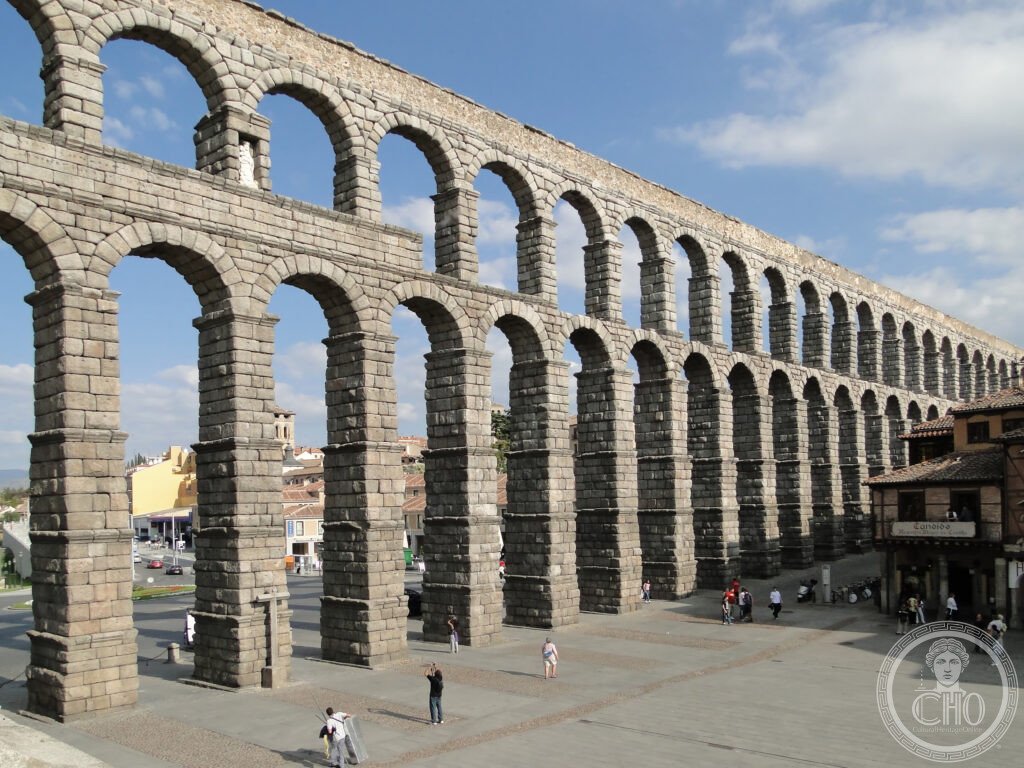
The most spectacular Roman engineering monument in Spain and one of the finest fairytale fortresses in Europe. Segovia, set on a rock spur above the confluence of two rivers at the foot of the Sierra de Guadarrama, combines the grandest surviving Roman aqueduct in the western world (24,000 granite blocks, no mortar, still standing after 2,000 years) with an Alcázar so romantically turreted that Walt Disney reportedly used it as the model for Cinderella’s Castle.
At a glance
The Historic City of Segovia and its Aqueduct (UNESCO WHS 1985; the inscribed zone covers the entire historic urban core of Segovia together with the aqueduct and the area around it; population of the Segovia municipality approximately 52,000) occupies a dramatic rock spur (approximately 1 km long; up to 250 m wide; flanked on the south by the River Eresma and on the north by the River Clamores; the spur rises approximately 80 m above the surrounding terrain) in the centre of the Castilian plateau, approximately 90 km north-west of Madrid. The three great monuments of Segovia. The Aqueduct (at the south-east entrance to the old city), the Cathedral (at the highest point of the city, facing the Plaza Mayor), and the Alcázar (at the west tip of the spur). Form a triangle across the historic core that can be walked end-to-end in approximately 30 minutes. The historic city is compact (approximately 900 m × 350 m; entirely walkable) and free of the mass overcrowding that affects Toledo and Córdoba (Segovia receives approximately 1–1.5 million visitors per year, compared to 3–4 million for Toledo; the crowds are manageable and the atmosphere relatively authentic). The surrounding Castilian landscape (the Guadarrama mountains with snow on the peaks from October to May; the dehesa (the traditional scattered-oak pasture landscape of central Spain) visible in every direction from the Alcázar terrace) adds to the drama.
Key facts
- The Roman Aqueduct. The greatest surviving Roman engineering feat in Spain: a structure that has defied gravity for 2,000 years without a single drop of mortar. The Acueducto de Segovia was built in the 1st century AD, most likely under Trajan or Domitian, approximately 98–117 AD; the date is uncertain because no dedicatory inscription survives, and the dating rests on construction technique and brick type analysis. The surviving elevated section carries 167 arches over approximately 728 m visible in the city, while a further 15 km runs underground and at ground level, bringing water down from the Sierra de Guadarrama. The two-storey arcade rises to 28.5 m at its highest point above the modern Plaza de Azoguejo — the original height was approximately 33 m, since today’s ground level is approximately 5 m above the Roman one. Its arches are built of approximately 24,000 granite blocks, quarried in the Guadarrama mountains, each weighing approximately 1,500–3,000 kg, and fitted without any mortar at all: friction between the faces and the compressive forces of the arch geometry hold them in place. The system has worked for approximately 1,900 years because Roman engineers understood perfectly well that an arch in compression carries its loads to the supports without tension. The aqueduct delivered water from the Rio Frío source until 1973, when modern piping made it redundant, and the structure still stands and could in principle still carry water.
- The Alcázar of Segovia and its Walt Disney connection: the most romantic castle silhouette in Spain. The Alcázar of Segovia stands on Roman foundations around a Romanesque core of the 11th century, greatly expanded in the Gothic period, 12th–15th century, by the Kings of Castile, who used it as royal residence and treasury. What the eye sees now — the needle turrets, the pointed slated roofs, the grey stone silhouette against the Sierra de Guadarrama — came largely after the catastrophic fire of 1862, which destroyed much of the castle. The rebuilding of 1882–1896 brought in the Neo-Romantic elements that make it so distinctive: the needle turrets are a post-fire addition, and before the fire the towers were more conventionally battlemented. Hence the Disney story. The Alcázar is widely reported as the model for Cinderella’s Castle in the original Disneyland of 1955, a claim repeated by Disney spokespersons and commonly accepted, and the visual similarity is striking; but Disney has officially said that the castle drew on several European models, Neuschwanstein in Germany and Fontainebleau in France among them, so the Segovia connection is plausible rather than confirmed. Inside is a military history museum. The Throne Room keeps its 16th-century painted wooden ceiling, gold and polychrome heraldic figures, the finest Mudéjar ceiling in Castile, and the keep, the Torre de Juan II, repays its 156 steps with the most panoramic view in Segovia: the Guadarrama mountains to the south, the three rivers to the north, the Cathedral tower to the east.
- Segovia’s cochinillo asado: the most famous culinary tradition in Castile. Cochinillo asado, roast suckling pig, is the definitive dish of Segovia: a 2–3 week old piglet roasted in a wood-fired clay oven for 2–3 hours, its skin crackling-crisp and the meat beneath so tender it can be cut with the edge of a plate. That is exactly what happens: the Segovian tradition has the waiter carve the pig at the table with a ceramic plate, to show how tender it is, and then smash the plate on the floor for luck. It is served with nothing but its own cooking juices. The most celebrated place for it is the Mesón de Cándido, Azoguejo 5, founded 1884 and standing immediately beside the aqueduct — the most famous restaurant in Castile and one of the most celebrated in Spain, where reservations are essential.
- Heritage: UNESCO World Heritage Site, Historic City of Segovia and its Aqueduct, inscribed 1985.
- GPS: 40.9503° N, 4.1253° W.
History
Celtic settlement (the Vaccaei and Arevaci; pre-Roman). Roman Segovia (Segovia; an important Roman city; the construction of the aqueduct in the 1st–2nd century AD; the Roman road Via de la Plata passes nearby). Visigothic period. Moorish occupation (8th–11th century). Christian reconquest (1079; Alfonso VI of Castile retook Segovia; the Alcázar begins). The Comuneros revolt (1520; Segovia was a centre of the Comuneros uprising against Charles V — the revolt of the Castilian cities against Habsburg rule that was crushed at the Battle of Villalar in 1521). The wool trade (Segovia was the most important centre of the Castilian wool industry in the 15th–16th century; the Mesta (the powerful shepherds’ guild that controlled the transhumance (the seasonal migration of 2–3 million sheep across Castile)) had its principal offices in Segovia; the Cathedral was built with wool-trade wealth). UNESCO WHS 1985. Present-day Segovia is the capital of the Province of Segovia and part of the autonomous community of Castilla y León.
What you see
The Plaza de Azoguejo is the main viewing point for the aqueduct: the modern ground level sits lower than the Roman road, which maximises the visual impact, and the best view of the full height of the two-storey section comes from the stairs climbing to the old city. In a niche in one pier stands a statue of the Virgin of Fuencisla, in the place of the original Roman dedicatory figure. The Cathedral was the last Gothic cathedral built in Spain, 1525–1577, and the most austere and most elegant of them: the nave is high and wide, and the clerestory lets in a remarkable quantity of light for a Gothic building. Its cloister is the only part of the original cathedral to survive the Comuneros revolt, a 16th-century Gothic cloister with azulejo tiled panels and a small museum holding the treasury, among it the 15th-century carved Pizarro altarpiece and a large 16th-century triptych attributed to Ambrosio Benson. For the Alcázar allow 1h 30 min — the Throne Room ceiling, the Torre de Juan II for the panorama, approximately EUR 8 — and end at the Mesón de Cándido for the cochinillo and the plate.
Practical information
- Getting there from Madrid: the most accessible UNESCO WHS day trip from Madrid. Avant high-speed train from Madrid Chamartín (27 min; approximately EUR 13–16; runs approximately hourly; the fastest option). Regional train from Madrid Chamartín (1h 45 min; approximately EUR 8; the slower option but with more direct access to Segovia centre, as the high-speed station is 5 km from the city (bus connection required)). ALSA bus from Madrid Moncloa bus terminus (1h 30 min; approximately EUR 8; the most convenient for those staying in central Madrid; the bus deposits passengers at the Segovia bus station, 10 min walk from the aqueduct). The classic day-trip strategy: morning train to Segovia (arrive before the Spanish coach tour groups) → walk old city → cochinillo at Mesón de Cándido → afternoon train to Toledo (change at Madrid; allows Toledo + Segovia in one day for visitors with limited time).
- The Segovia roast piglet experience: the most authentic way to eat cochinillo. The Mesón de Cándido (the most famous venue; next to the aqueduct; the show of plate-carving; the tourist setting is real — this is genuinely historic; book in advance). Alternative options (the Mesón Duque (Cervantes 12; quieter; equally authentic); the Bar Macanaz (a small bar in the old city, away from the tourist circuit; no plate-carving theatre but excellent quality at lower prices)). The suckling pigs used in Segovia are specifically raised on their mothers’ milk for approximately 21 days and weigh approximately 4–5 kg at slaughter. A quarter pig is the standard individual portion. A half pig serves two. The experience of eating at a long wooden table in a stone-walled restaurant with the roar of the wood-fired oven in the background while watching a ceramic plate shatter on the stone floor is one of the most memorable in Spain.
- La Granja de San Ildefonso: the “Spanish Versailles” 12 km from Segovia. The Royal Palace of La Granja de San Ildefonso lies 11 km south of Segovia, 20 min by bus, and was built between 1724 and 1739 by Philip V of Spain. The first Spanish Bourbon king, grandson of Louis XIV, was homesick for the French court he had grown up in and commissioned his own Versailles in the Sierra de Guadarrama: the result is the most French building in Spain, a Versailles in miniature set among mountains instead of on a plain. Its gardens are the most spectacular Baroque formal gardens in the country, 90 hectares with 26 fountains, and the Fountain of Fame, La Fama, throws water 47 m into the air — the highest jet in Europe when it was built. All the fountains play together only on particular festival days in summer, the Días de Grandes Juegos de Aguas: check the dates at patrimonionacional.es before going, because the full display is one of the great spectacles of Spanish heritage tourism.
Getting there
Avant train from Madrid Chamartín (27 min, EUR 13–16). ALSA bus from Madrid Moncloa (1h 30 min, EUR 8). GPS: 40.9503, -4.1253.
Nearby
- Toledo. 190 km south of Segovia (2h by road or 3h by public transport via Madrid). The “City of Three Cultures” and UNESCO WHS. Toledo is the most historically significant city in Castile after Segovia and makes the ideal second day on a Madrid + Segovia + Toledo itinerary. See the full place_card for Toledo at CHO (the Alcázar; the Cathedral of Toledo; the Synagogue of Santa María la Blanca; El Greco’s Burial of Count Orgaz at Santo Tomé; Toledo steel workshops; mazapán confectionery).
- Ávila. 65 km west of Segovia (1h by road; 1h 30 min by train). The most completely preserved medieval walled city in Spain. Ávila (UNESCO WHS 1985 (the old city together with its extra-muros churches)). The Murallas de Ávila (the city walls; 2.5 km complete circuit; 88 towers; 9 gates; medieval walls in perfect condition (built 1090 by Raymond of Burgundy on the orders of Alfonso VI after the reconquest; the only fully intact medieval town walls in the Iberian Peninsula); walking the full circuit of the walls takes approximately 1h 30 min; the views from the walls encompass the entire historic city and the surrounding Castilian plateau; St. Teresa of Ávila (the 16th-century Carmelite mystic and Counter-Reformation Church Doctor; born in Ávila 1515; the Convent of Santa Teresa on the site of her birthplace (1636); the most important pilgrimage site in Castile for Spanish Catholics); the Cathedral of Ávila (the first Gothic cathedral in Spain; begun c. 1170; notable for incorporating the city wall into the apse — the apse of the cathedral projects outward from the city walls and is simultaneously a chapel and a defensive tower)).
- La Pedriza and the Sierra de Guadarrama. 30 km south of Segovia (45 min by road). The nearest wilderness escape from the Castilian plateau. The Sierra de Guadarrama, a UNESCO National Park since 2013, is the granite range that separates Castile from Madrid. It is visible from Segovia, from the Alcázar terrace, where it makes the dramatic backdrop to the castle, and from Madrid, from the Puerta de Alcalá and many high points, where the mountains are the defining horizon of the skyline. At its south-eastern end lies La Pedriza, the most extraordinary granite boulder landscape in Spain: a chaos of rounded boulders, pinnacles and rock towers eroded out of the monzogranite bedrock, and the most popular climbing and bouldering destination near Madrid, with approximately 2,500 established problems and routes. The central landmark is the El Yelmo summit at 1,717 m, and the approach from the Manzanares el Real reservoir car park takes approximately 2h return on marked paths.
Sources
- Wikipedia, Aqueduct of Segovia. Alcázar of Segovia. Segovia Cathedral, accessed June 2026.
- UNESCO, Historic City of Segovia and its Aqueduct, WHS reference 311, inscribed 1985.
- Rafael Zamora, Los puentes y acueductos romanos en la Hispania antigua, CSIC, Madrid, 2002.
Find it on the map
See this place and what’s around it →
📷 Become a Cultural Heritage Online photographer
Share your photos of places: they stay published under your name as the author. The more they're seen, the more you get noticed — and soon a contest will reward the most appreciated photos.
Log in or sign up free to add a photo