
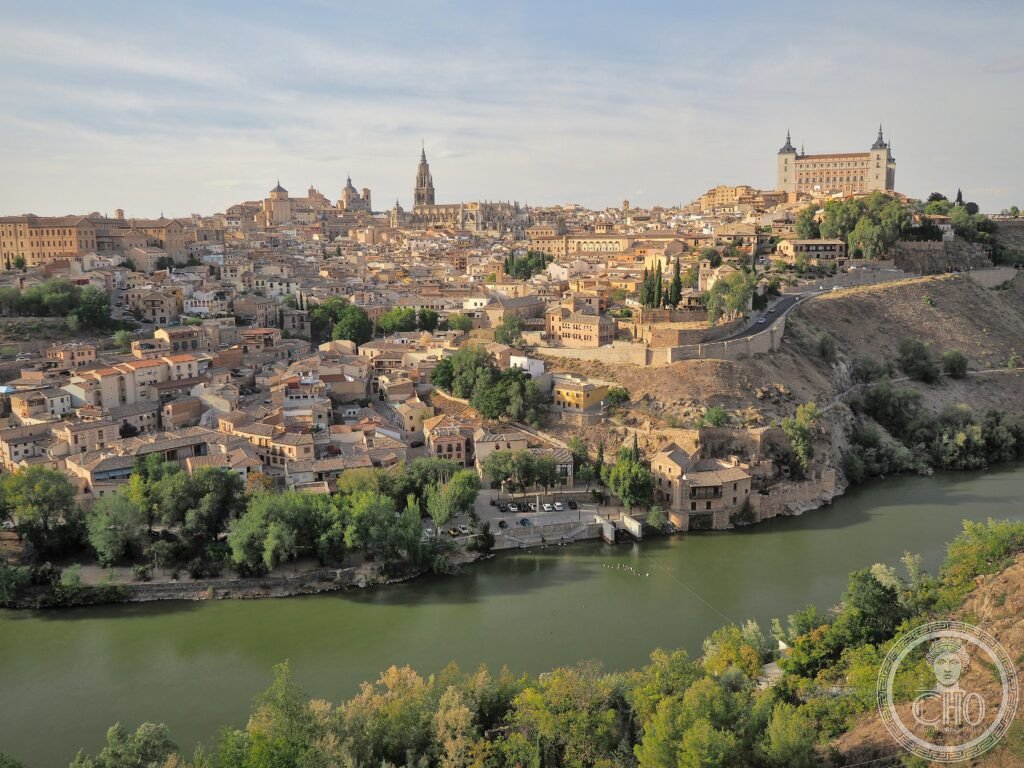
The pre-eminent “City of Three Cultures” in Spain and one of the most historically layered cities in Europe. Toledo, set on a granite hill almost entirely enclosed by a meander of the Tagus River, was the city where medieval Christian, Islamic, and Jewish scholarship met and produced the great translations that transmitted Greek philosophy and Arab science to the European Middle Ages, where El Greco found the dramatic light and mystical intensity that defined his career, and where the Spanish imperial heritage of architecture is most completely preserved.
At a glance
The Historic City of Toledo, UNESCO WHS 1986, is the urban core on the summit and flanks of a granite hill that the Tagus, the Tajo, encloses on three sides: the loop of the river makes an almost complete natural fortification, and the only open side is the north-west, where the main Bisagra Gate opens onto the plateau. Approximately 8,000 permanent residents live in the historic centre, which receives 2.5 million visitors a year. Four powers held it in turn. It was the capital of the Visigothic Kingdom from 554 AD, then a major city of the Islamic emirate and caliphate of Córdoba from 711 AD. Alfonso VI of Castile took it in 1085 AD, and unlike many Reconquista victories this one came by peaceful surrender rather than assault, so the Muslim and Jewish populations were largely allowed to remain. Last it became the imperial capital of Charles V — Holy Roman Emperor and King of Spain as Carlos I — who lived here from 1519, and the city remained the administrative centre of the Spanish Empire until Philip II moved the court permanently to Madrid in 1561. The city is defined by its extraordinary concentration of monuments from all three religious and cultural traditions: the Cathedral (for Christianity), the Mosque of Cristo de la Luz (the oldest surviving Islamic building in Toledo; 999 AD), the Synagogue of Santa María la Blanca (the oldest surviving synagogue building in Europe; c. 1180–1200), and the Synagogue of El Tránsito (1357; the finest surviving medieval Spanish Jewish building).
Key facts
- The Toledo School of Translators: the single most important intellectual project of the European Middle Ages. The Escuela de Traductores de Toledo was never a formal institution: it was a loose collaboration of Christian, Jewish and Muslim scholars who worked in the city through the 12th and 13th centuries, translating the accumulated knowledge of classical Greek antiquity and Islamic science from Arabic into Latin. Arabic had preserved and transmitted what Western Europe had lost since the fall of the Roman Empire — Aristotle, Plato, Euclid, Archimedes, Hippocrates, Galen, al-Khwarizmi, whose name gives us “algorithm”, Ibn Sina (Avicenna), Ibn Rushd (Averroës) and al-Haytham (Alhazen). The Toledo translations, made under the patronage of Archbishop Raymond of Toledo (1125–1152) and later of Archbishop Rodrigo Jiménez de Rada, brought those works into Latin for the first time in the West. The effect was the intellectual revolution of the 12th-century Renaissance and the creation of the university system in northern Europe. The indispensable intermediaries were the Jewish scholars of Toledo, trilingual in Hebrew, Arabic and Romance, who made most of the translations possible — which is why this is arguably the single most important intellectual project in the history of European civilization.
- El Greco in Toledo: the painter who defined the mystical aesthetic of the Counter-Reformation. Domenikos Theotokopoulos (born Crete, 1541; trained in Venice under Titian and Tintoretto; moved to Rome 1570; moved to Toledo 1577 (arrived at the invitation of Philip II, who wanted him to contribute to the decoration of El Escorial; El Greco’s proposal for the Martyrdom of St. Maurice was rejected by the King as “not pleasing to the beholder”; El Greco remained in Toledo instead, where he found an ecclesiastical clientele receptive to his highly personal, visionary style); lived in Toledo until his death in 1614; the characteristic features of his mature Toledo style — the elongated figures, the cold bluish-grey and yellow palette, the dramatically lit faces against dark grounds, the visionary cityscape — were developed in response to the grey Toledan light and the intensely mystical Counter-Reformation spirituality of the local clergy; his masterpiece, the Burial of Count Orgaz (1586; in the church of Santo Tomé; 4.8 × 3.6 metres; a double-register composition showing the miraculous burial of a local noble (St. Stephen and St. Augustine descend from heaven to perform the burial) above and the Count’s soul being presented to Christ in the heavenly realm above) is considered the finest painting in Spain after Las Meninas; his View of Toledo (c. 1598–1599; Metropolitan Museum of Art, New York; the first landscape painting in Spanish art history — a stormy dark green and grey view of the city from the south bank of the Tagus, with a supernatural quality that places it outside any realistic tradition) is the most famous painting of Toledo).
- The Cathedral of Toledo: the supreme achievement of French Gothic architecture in Spain. The Catedral de Santa María de Toledo was begun in 1226, largely finished by approximately 1493, and completed with additions in the 16th century. It is the sixth largest church in the world by floor area and the most historically important in Spain: the Primatial Cathedral of all Spain and the see of the Primate of the Spanish church. The interior runs 88 m long and 56 m wide, with five aisles and a forest of 88 columns. Its choir has the most elaborate stalls of any Spanish cathedral: the lower ones, by Rodrigo Alemán (1489–1495), carry 54 scenes from the fall of Granada, the most complete visual record of the Reconquista in any medium, and the upper ones are by Diego Copin de Holanda. Behind the high altar stands the Transparente, a Baroque altarpiece of 1721 by Narciso Tomé, pierced through the vaulting so that daylight falls on the sacrament: it is the most bizarre and most theatrical element in any Spanish cathedral, and the hole cut in the medieval vault to admit that light is framed by an explosion of gilded angels, clouds and sunbeams that fill the whole apse with golden light.
- Heritage: UNESCO World Heritage Site, Historic City of Toledo, inscribed 1986.
- GPS: 39.8567° N, 4.0244° W.
History
Prehistoric Celtic and then Roman city (Toletum; a provincial capital on a natural defensive site). Visigothic capital (554–711; the Visigothic Kingdom of Spain; the councils of Toledo (a series of ecclesiastical and royal councils held in Toledo 589–702; the most important political institution of Visigothic Spain)). Islamic Toledo (711–1085; first an emirate then a taifa kingdom; the Banu Dhil-Nun dynasty built the city up as a centre of Islamic culture; coexistence with the Christian and Jewish communities was largely peaceful). Christian reconquest (1085; Alfonso VI of Castile; peaceful takeover; all three religious communities permitted to remain; the Toledo School of Translators begins). Imperial capital (1519–1561; Charles V; the magnificent 16th-century palaces and churches). El Greco (1577–1614). Capital moved to Madrid (1561 by Philip II). UNESCO WHS 1986. Present-day Toledo is the capital of the autonomous community of Castilla-La Mancha.
What you see
The approach to Toledo is by the main north-west gate, the Puerta de Bisagra (the main entrance gate; originally Moorish; rebuilt 1550 by Alfonso de Covarrubias; the double arch flanked by round towers with heraldic eagles is the defining image of Toledo’s city gate architecture; immediately inside the gate, the Puerta del Sol (the Sun Gate; a 14th-century Mudéjar tower-gate built by the Knights of St. John)). The Cathedral (allow 2h; the choir stalls; the Transparente; the main altarpiece (one of the finest in Spain; Gothic polychrome sculpted tiers of the Life of Christ by Enrique Egas and others); the Tesoro (the Custodial of Toledo — the silver processional monstrance by Enrique de Arfe (1515–1524) in solid silver with 260 small figures, 18 kg; carried in the Corpus Christi procession); the church of Santo Tomé and the Burial of Count Orgaz (El Greco; allow 30 min; timed entry in summer; approximately EUR 3); the Synagogue of Santa María la Blanca (the oldest surviving synagogue building in Europe; c. 1180; the five-aisle interior with its remarkable white horseshoe arcades in the Almohad style); the Synagogue of El Tránsito (Samuel ha-Levi Abulafia, treasurer of Pedro I of Castile; 1357; the magnificent Arabic-style stucco work on the interior walls — the Hebrew inscriptions in the stucco panels make this the only example of Hebrew calligraphy in a Hispano-Moresque architectural context)).
Practical information
- Getting there from Madrid: Toledo is the most popular day trip from Madrid. High-speed AVANT train from Madrid Atocha to Toledo (34 min; approximately EUR 13–16 one way; runs approximately every 30–60 min 06:30–21:30; booking at renfe.com; the Toledo train station is a 20-min walk from the historic centre, or 5-min by bus or taxi; ALSA buses from the Estación Sur de Madrid (Méndez Álvaro) to Toledo (1h 15 min; approximately EUR 6; runs every 30 min; the Toledo bus station (Estación de Autobuses) is adjacent to the train station)). From Segovia (130 km; 2h by road; no direct train; requires a change; most visitors do Madrid–Toledo–Segovia or Toledo–Madrid–Segovia as a 2-day trip).
- Toledo mazapán: the most distinctive food souvenir in Spain. Toledo marzipan (mazapán; a confection of ground almonds and sugar, shaped and moulded into figures of animals, fruits, coats of arms, and El Grecos; produced in Toledo since at least the 16th century; sold in virtually every confectionery shop and bakery in the historic centre; the original recipe is attributed to the nuns of the Convent of San Clemente; the quality varies enormously between the tourist-oriented shops on the main streets and the traditional confectionery shops in the side streets; the Convent of San Clemente (Calle San Clemente; a working convent where the nuns sell their own marzipan through a revolving door — the traditional anonymous commerce of the enclosed orders) is the most authentic source).
- Toledo steel: the most famous metalworking tradition in medieval Europe. The craft of making sword and knife blades in Toledo — the espadas toledanas — goes back to at least the 1st century BC. Toledo steel was the preferred material for swords and armour throughout the medieval and early modern periods, thanks to the exceptional properties of the local iron and the skill of the city’s armourers, and Julius Caesar mentioned its quality. The workshops still produce high-quality blades, both for use and for decoration, by traditional techniques. The Museo del Ejército, the Army Museum in the Alcázar, holds the finest collection of Toledo swords and armour in Spain, and the workshop of Mariano Zamorano in Calle Ciudad, founded 1890 and the most respected traditional blade-maker still working, can be visited.
Getting there
AVANT high-speed train from Madrid Atocha (34 min, EUR 13–16). Bus from Madrid Méndez Álvaro (1h 15 min, EUR 6). GPS: 39.8567, -4.0244.
Nearby
- Segovia. 130 km north of Toledo (2h by road; combined Toledo–Segovia is the classic Castile day-trip circuit from Madrid). The most complete surviving Roman aqueduct and the most dramatic castle in Spain. Segovia (the Acueducto Romano (the Roman aqueduct of Segovia; 1st–2nd century AD; 15 km of channel bringing water from the Sierra de Guadarrama; the most visible section — 728 m long; 166 arches; maximum height 28.5 m; built entirely without mortar — 24,000 granite blocks held by gravity and engineering alone; the finest surviving Roman aqueduct in Western Europe; UNESCO WHS 1985 (together with the Alcázar and Cathedral))). The Alcázar of Segovia (a fairytale castle on a rock spur at the westernmost tip of the city; built on Roman foundations; medieval core 11th–13th centuries; burnt 1862; rebuilt as a Romantic fantasy with needle turrets and slated roofs in the Hohenzollern style — the influence on Walt Disney’s Cinderella Castle at Disneyland is well established; now a museum of Spanish military history). The Cathedral (the last major Gothic cathedral built in Spain; 1525–1577; known as “the Lady of all Cathedrals” for its graceful profile). The Jewish quarter (the Judería; the most complete surviving medieval Jewish quarter in Spain after Toledo).
- Consuegra and the Windmills of La Mancha. 65 km south of Toledo (1h by road; the most iconic landscape of Castilla-La Mancha). Don Quixote’s windmills. Consuegra is a small town of approximately 10,000 people in the La Mancha plain, and 12 white windmills — molinos de viento of the 16th to 20th century, 10 of them restored to working condition — line the ridge above it beside the medieval Castillo de la Muela. This is the scene of Don Quixote’s battle with the giants in Chapter 8 of Cervantes’s novel, published 1605: the Consuegra mills are the most frequently cited setting, with Campo de Criptana, 60 km east, the other main candidate. No windmill is named in the book, so none can be identified, and in that sense every mill in La Mancha is one of “the windmills of Quixote”. Consuegra is also the saffron capital of Spain, producing approximately 70% of the national crop, and celebrates it in late October with the Mondida de Azafrán festival, which elects a “Dulcinea of La Mancha” and holds a public saffron-thread-counting competition: contestants sit at long tables separating the stigmas from the flowers by hand, and the fastest wins.
- Cuenca. 150 km east of Toledo (2h by road; 50 min by high-speed AVE from Madrid Atocha). The hanging houses of Cuenca. Cuenca (UNESCO WHS 1996; the Casas Colgadas (Hanging Houses; 14th–15th century; a group of Gothic houses built on the edge of a sheer limestone gorge (the Hoz del Huécar) above the town; the wooden balconies of the houses project outward over the drop of approximately 100 m; the most iconic view in Cuenca is from the San Pablo Bridge (a 1902 iron footbridge) looking directly at the hanging houses with the gorge below; the Museo de Arte Abstracto Español (Museum of Spanish Abstract Art; in the Hanging Houses; one of the founding collections of Spanish abstract art, installed in the hanging houses by Fernando Zóbel in 1966; the most unusual museum setting in Spain))).
Sources
- Wikipedia, Toledo, Spain. Toledo School of Translators. El Greco, accessed June 2026.
- UNESCO, Historic City of Toledo, WHS reference 379, inscribed 1986.
- Jonathan Brown, El Greco of Toledo, Little, Brown, 1982.
Find it on the map
See this place and what’s around it →
📷 Become a Cultural Heritage Online photographer
Share your photos of places: they stay published under your name as the author. The more they're seen, the more you get noticed — and soon a contest will reward the most appreciated photos.
Log in or sign up free to add a photo