
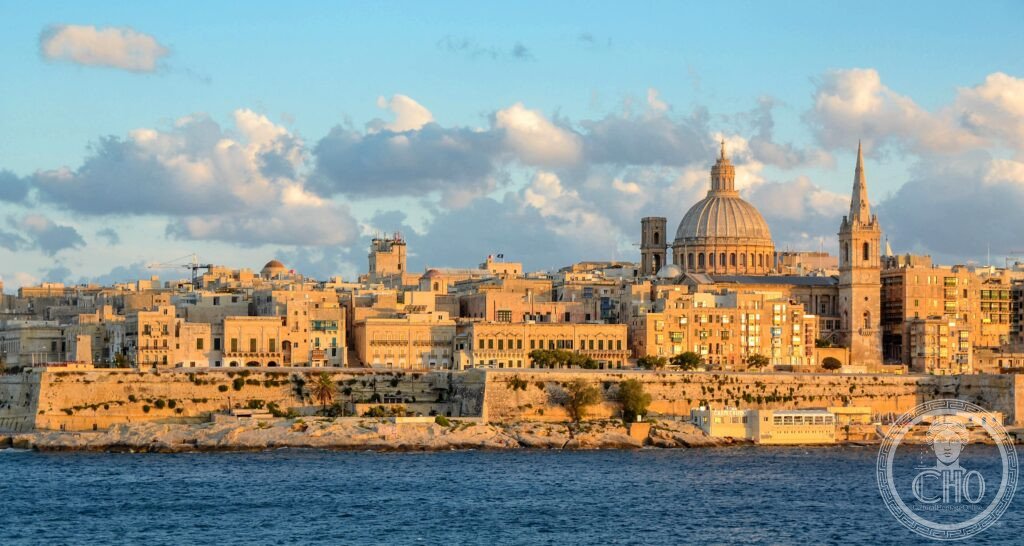
Valletta is the smallest and most concentrated historic capital city in Europe. Founded in 1566 by the Knights Hospitaller after their miraculous defeat of the Ottoman siege of Malta, it was designed and built as a planned fortress-city from scratch in less than a decade. This produced the most compact ensemble of Baroque art and architecture in the world and one of the two greatest Caravaggio paintings anywhere.
At a glance
Valletta (UNESCO WHS 1980) has been described by UNESCO as “one of the most concentrated historic areas in the world”, a remarkable designation for a city of 0.8 km². For comparison, the historic centre of Florence is approximately 5 km², and St. Peter’s Square in Rome is 0.02 km². It was built on a strategic peninsula between the Grand Harbour (to the south-east) and Marsamxett Harbour (to the north-west). The peninsula rises from sea level at both harbour entrances to a ridge approximately 60 m above the sea. The city grid was designed by the military engineer Francesco Laparelli da Cortona, a student of Michelangelo, in 1565; the planning was so fast that the first Grand Master was still alive when the main buildings were under construction. It is a simple orthogonal grid of streets running parallel and perpendicular to the ridge. The streets running up the ridge are extremely steep, approximately 10% gradient, while the streets running along the ridge are flat. The grid means that every street in Valletta has a sea view at one end or the other. The architecture is uniformly Baroque limestone: Malta has no timber and very little other building material, and the honey-coloured local limestone (Maltese: ġebla) is the only building material, giving the entire city a remarkable visual unity. The stone quarried from the basement of the buildings was used to construct the walls above, so the construction of Valletta was entirely self-financing in terms of materials.
Key facts
- St. John’s Co-Cathedral and the Caravaggio masterpieces: the most important Baroque interior in Malta and home to two of the greatest Caravaggio paintings. St. John’s Co-Cathedral (Konkattidral ta’ San Ġwann) was built 1573–1577 by the architect Gerolamo Cassar for the Knights Hospitaller as the conventual church of their Order. The exterior is austere military Baroque, intentionally unpretentious from the outside, since the Knights had a strict code of Christian humility that prohibited exterior ostentation. The interior was transformed from 1603 onwards by the Calabrian painter Mattia Preti, who covered the entire barrel-vaulted nave ceiling with 18 panels depicting scenes from the Life of St. John the Baptist. Every centimetre of the floor is covered with 375 polychrome marble tomb slabs of individual Knights. Each side chapel belongs to a national “Langue” of the Knights (France, Germany, Aragon, Castile, Italy, England, Provence, Auvergne) and is decorated with treasures funded by that langue. The oratory of the cathedral contains the two masterpieces of Caravaggio: The Beheading of St. John the Baptist (1608), the largest painting Caravaggio ever made, 3.6 × 5.2 metres, the most important painting in Malta and the greatest single painting Caravaggio ever completed. The moment depicted, immediately after the decapitation, shows the executioner bending down to complete the beheading with a knife, Salome holding the charger, a prison warden pointing, and an old woman covering her face in horror; it is the most psychologically intense scene in Baroque painting. Caravaggio uniquely signed his name in the blood pouring from John’s neck, the only painting he ever signed. St. Jerome Writing (1608) is a second Caravaggio in the same room, commissioned separately, much smaller but extraordinarily powerful.
- The Great Siege of 1565: the military campaign that made Valletta’s existence necessary. The Great Siege of Malta (18 May – 11 September 1565) began when the Ottoman Sultan Suleiman the Magnificent sent a fleet of approximately 200 ships and 40,000–50,000 soldiers to capture Malta and eliminate the Knights of St. John, who had been based on Malta since 1530, after their expulsion from Rhodes by the same Sultan in 1522. The defenders numbered approximately 700 Knights and 6,000–8,000 Maltese soldiers and civilians, and the siege lasted 4 months. The most dramatic episode was the Battle of Fort St. Elmo: the Ottoman forces captured and destroyed the small fort at the tip of the Xberras peninsula on 23 June, after the Knights in the fort had held for 31 days against overwhelming odds. When the Ottomans captured the fort, they beheaded the bodies of the dead Knights and floated them across the harbour on crosses; Jean de la Valette responded by decapitating Ottoman prisoners and firing their heads from his cannons. The Great Siege ended when a Spanish relief force arrived from Sicily on 7 September 1565, and the Ottoman force, devastated by Maltese resistance, withdrew. The victory was celebrated across Christian Europe as a miracle, and Pope Pius V declared it a great Christian victory. The construction of Valletta began the following year, 1566, to ensure that Malta could never be so vulnerable again.
- The Grand Harbour: the most strategically important natural harbour in the Mediterranean. The Grand Harbour (Port il-Kbir) is the natural deep-water harbour on the south-east side of the Valletta peninsula, 4 km long, protected by the Sciberras peninsula to the north, where Valletta stands, and the Birgu peninsula to the south, where the original Knights’ fort, Fort St. Angelo, stands. The Three Cities, Vittoriosa/Birgu, Senglea/l-Isla, and Cospicua/Bormla, on the south bank of the Grand Harbour, were the original base of the Knights before Valletta was built. The view of Valletta from the Three Cities, from Senglea in particular, is the most dramatic urban harbour view in the Mediterranean. The Grand Harbour was the primary Royal Navy base in the Mediterranean from 1800 to 1979. The harbour was one of the most heavily bombed places in World War II, 1940–1942, the Second Siege of Malta; King George VI awarded Malta, the entire island, the George Cross in April 1942, an unprecedented honour to a civilian population.
- Heritage: UNESCO World Heritage Site, City of Valletta, inscribed 1980.
- GPS: 35.8989° N, 14.5146° E.
History
The Order of Knights Hospitaller settled in Malta from 1530, granted by Charles V. The Great Siege (1565) was the greatest military event in Maltese history. Valletta was founded by Grand Master Jean de la Valette in 1566; the city was built in 15 years, an almost unprecedented speed for a complete fortified city. Caravaggio was in Malta from 1607–1608: the painter fled to Malta after a murder in Rome, was made a Knight of Honour, and painted the Beheading of St. John the Baptist; he was then imprisoned and escaped, and the circumstances remain mysterious. Napoleon captured Malta in the French occupation of 1798, and the Knights surrendered without a fight. British rule followed, 1800–1964; Malta became a key naval base, and the George Cross was awarded in 1942. Independence came in 1964, EU membership in 2004, and Valletta was European Capital of Culture in 2018. UNESCO inscribed it as a World Heritage Site in 1980.
What you see
The entry to Valletta is through the City Gate, rebuilt 2014 by Renzo Piano, the most controversial modern building in Malta: Piano replaced the previous 1960s gate with a pure-cut angular gap in the bastion walls. The Piano Parliament Building, also 2014, an open public building with a giant glass cube of the parliamentary chamber visible from the street, is immediately inside the gate. Republic Street (Triq ir-Repubblika) is the main pedestrian street, running the full length of the peninsula from the City Gate to Fort St. Elmo, approximately 1.2 km, flanked by the National Library (1796), the most important Baroque secular building in Malta, and the Grand Master’s Palace, now the Presidential Palace, the seat of the Grand Masters of the Order, open for tours, and the Merchant’s Street, the parallel commercial street. St. John’s Co-Cathedral needs 1h 30 min allowed, including the Caravaggio Oratory; queues form in summer, so book timed entry at stjohnscocathedral.com, approximately EUR 15. The Upper Barrakka Gardens are the best viewpoint in Valletta, with a panoramic view of the Grand Harbour, the Three Cities, Fort St. Angelo, and the open sea. The Saluting Battery fires an hourly salute cannon at 12pm daily, a tradition since the 19th century.
Practical information
- Getting there: Malta International Airport (MLA) is 7 km south of Valletta, served by Ryanair and other low-cost carriers from most European hubs, approximately 40 countries with direct flights. The bus from the airport, Bus X4 or Bus 72, takes 20–30 min to Valletta bus terminus, immediately outside the City Gate; taxi approximately EUR 15–20, though Bolt/Malta cab apps are cheaper. The Malta Harbour Ferry (Valletta-Birgu/Three Cities crossing) is a 5-min boat ride from the Grand Harbour Waterfront below Valletta, the most atmospheric arrival in Valletta, approximately EUR 2, running continuously 6am–11pm. Valletta is also a major Mediterranean cruise port, with multiple cruise ships docking at Valletta Grand Harbour regularly.
- Malta in depth: beyond Valletta, the Ħal Saflieni Hypogeum, in Paola, 7 km south of Valletta, is a 5,000-year-old underground prehistoric temple complex, UNESCO WHS 1980, inscribed together with the Megalithic Temples of Malta, and the most important prehistoric site in Malta. Entry is strictly limited to 80 visitors per day in groups of 10; book months in advance at heritagemalta.org, approximately EUR 35, for the most profound archaeological experience in the central Mediterranean. The Megalithic Temples of Malta comprise 7 temples; the most important are Ġgantija, on Gozo island (3600–2500 BC), the oldest freestanding structures in the world, older than Stonehenge and the Egyptian pyramids, and Tarxien, in southern Malta (c. 3150–2500 BC). Mdina is the medieval walled city in the centre of the island, the former capital, silent, car-free, limestone-perfect, with the Cathedral of Saint Paul and 4 km of walls; it is the most atmospheric city in Malta outside Valletta.
- Day trip to Gozo: the most beautiful island in the Maltese archipelago. Gozo (Maltese: Għawdex; 67 km²) is reached by ferry from Ċirkewwa, north Malta (25 min; approximately EUR 4.65 return; runs every 45 min) or high-speed ferry from Valletta Grand Harbour (45 min). The Ċitadella is the medieval walled city in the centre of Gozo, with the best panoramic view of the island. Its Cathedral (1697–1702) has a ceiling painted with a trompe-l’oeil barrel vault, since the diocese was too poor to build a real vault. The Blue Lagoon at Comino, the tiny island between Malta and Gozo, has a turquoise shallow bay, extremely crowded in summer. The Ġgantija Temples are also on Gozo.
Getting there
Malta Airport (7 km; bus 20 min or taxi). Harbour Ferry from the Three Cities. GPS: 35.8989, 14.5146.
Nearby
- The Ħal Saflieni Hypogeum — 7 km from Valletta (Paola; bus from Valletta 15 min). This is the most important prehistoric site in the Mediterranean. The Hypogeum (Greek: ὑπόγαιον; “underground”) is a 5,000-year-old (3600–2500 BC) underground complex carved from solid limestone, with three levels descending to 10.6 m below the surface. The complex contains over 30 chambers, including a main burial chamber, where approximately 7,000 human remains have been found, the largest prehistoric mass burial site in the Mediterranean; an oracle chamber, the Ħal Saflieni “oracle room”, an elongated chamber where spoken sound resonates through the entire complex, and where the low male voice frequency of approximately 111 Hz creates a profound echo effect throughout the underground network (the resonance has been the subject of acoustic research, and the chamber may have been used for ritualised sound ceremonies); and the Holy of Holies, a decorated chamber with elaborate red ochre spiral patterns on the ceiling, the finest surviving example of Neolithic decorative painting in the world. The site is open daily but strictly limited to 80 visitors, 10 per group, 8 groups per day; booking is essential months in advance.
- Mdina (the Silent City) — 12 km from Valletta, 30 min by bus, Bus 51 or 52 from Valletta. This is the former capital of Malta and the finest medieval walled city in the Maltese archipelago. Mdina (Maltese: l-Imdina; “the city”) has a population of approximately 300, one of the smallest walled capitals in Europe, and is car-free except for residents. The silence, hence “the Silent City”, is one of its primary characteristics, as the sound of the wind and distant bells replaces the traffic noise of modern cities. The Cathedral of Saint Paul (1697–1702) was built by the Order of Malta on the site where St. Paul is said to have been received by Publius, the Roman governor, after his shipwreck on Malta in 60 AD; its floor is entirely covered with marble memorial slabs of Maltese noble families. The City Wall is medieval, 4 km, entirely intact; the panoramic views from the Bastions encompass the entire island of Malta, the airport runway to the south, the dome of Mosta in the middle distance, and the Mediterranean Sea on the horizon. The Mdina Dungeons are a tourist waxworks in the dungeons below the Bishop’s Palace, not recommended but very popular.
- The Blue Grotto — 20 km south of Valletta, 40 min by car; the bus journey requires a change at Żurrieq. This is Malta’s most dramatic coastal scenery. The Blue Grotto (Maltese: l-Għar tal-Ħmieġ) is a series of sea caves in the limestone cliffs near the fishing village of Wied iż-Żurrieq. The characteristic vivid blue of the cave water is caused by the reflection of sunlight on the white sand seabed through clear water. The caves are accessible by small traditional boat, the luzzu, the traditional Maltese fishing boat with the Eye of Osiris painted on the bow. Boat trips run from Wied iż-Żurrieq from 8am, best when the water is at its most vivid, before the afternoon winds. The views of the cliff coastline from the sea looking back toward Malta are the best marine views on the main island.
Sources
- Wikipedia, Valletta; Great Siege of Malta (1565); St. John’s Co-Cathedral, accessed June 2026.
- UNESCO, City of Valletta, WHS reference 131, inscribed 1980.
- Desmond Seward, The Monks of War: The Military Religious Orders, Penguin, 1995.
Find it on the map
See this place and what’s around it →📷 Become a Cultural Heritage Online photographer
Share your photos of places: they stay published under your name as the author. The more they're seen, the more you get noticed — and soon a contest will reward the most appreciated photos.
Log in or sign up free to add a photo