
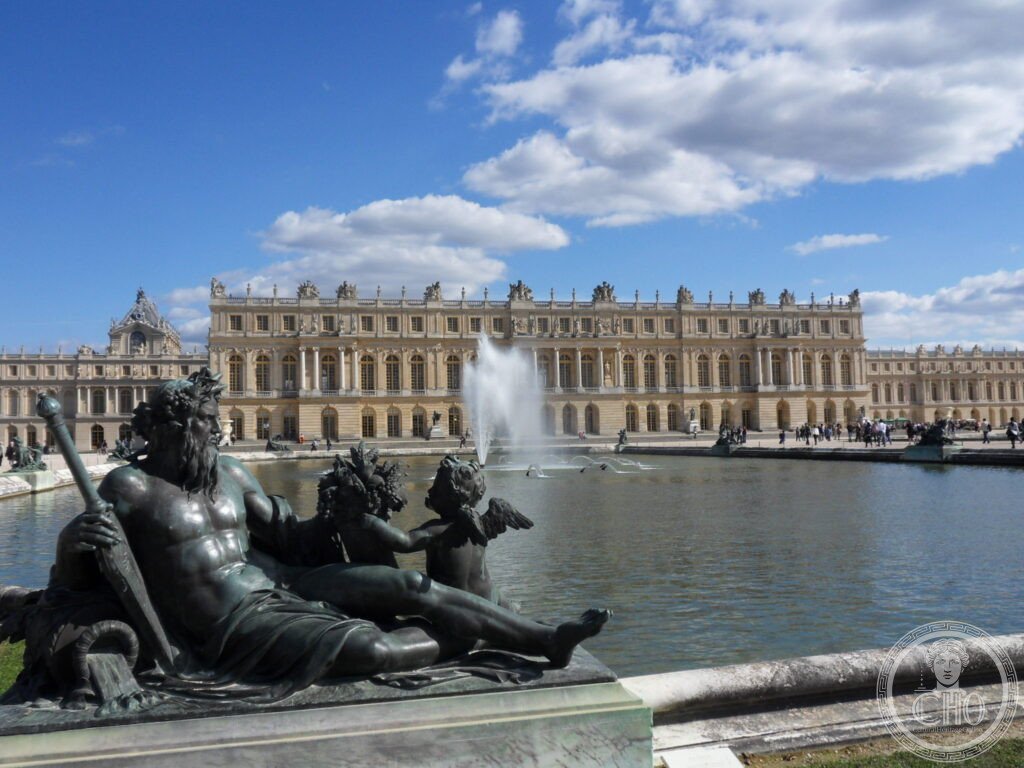
Palace of Versailles
The most complete surviving expression of absolute monarchy in European architecture — Versailles, the palace where Louis XIV moved the entire French court in 1682 and where 20,000 people lived and worked in an elaborate theatre of royal power, was simultaneously the most magnificent and the most politically claustrophobic royal residence ever built, and the model from which every other European monarch took note for the next century.
At a glance
The Palace of Versailles (Château de Versailles; UNESCO WHS 1979) began as a small brick-and-stone hunting lodge built by Louis XIII in 1623; Louis XIV inherited it, fell in love with the setting, and between 1661 and his death in 1715 invested colossal resources in expanding it into the most powerful piece of royal propaganda ever built; at its peak, the palace housed Louis XIV himself, approximately 6,000 courtiers, and 14,000 servants — a total of approximately 20,000 people; the entire court was required to be present (absence without royal permission was a mark of disfavour; the politics of being close to or far from the King was managed through the daily ritual of the lever (the ceremonial rising of the King) and the coucher (the ceremonial going-to-bed); the most coveted privilege at Versailles was the right to hold the King’s candlestick during the coucher ceremony — a position of pure symbolic power that signified nothing except closeness to the source of all power); the palace was abandoned as the royal residence after the Revolution (October 1789; the royal family was escorted to Paris by a mob of approximately 6,000 women who had marched from Paris to Versailles to demand bread; Louis XVI and Marie Antoinette were brought back to Paris, never to return to Versailles; the palace was pillaged but not destroyed during the Revolution; it was converted to a museum by Louis-Philippe in 1837 and has remained a public monument since).
Key facts
- The Hall of Mirrors (Galerie des Glaces): the most famous room in any palace in the world — the Hall of Mirrors (Jules Hardouin-Mansart, completed 1684; 73 metres long, 10.5 metres wide, 12.3 metres high; 357 mirrors in 17 arched mirror-panes facing 17 arched windows looking out over the garden; 20,000 candles in the original chandeliers and candelabra; painted ceiling by Charles Le Brun showing the military and diplomatic victories of Louis XIV; the hall was used for ceremonial receptions of foreign ambassadors, designed specifically to overwhelm them with the wealth and power of France); the Hall of Mirrors is also the room where the German Empire was proclaimed on 18 January 1871 (at the end of the Franco-Prussian War; the Prussian generals deliberately chose the Hall of Mirrors as the setting for the proclamation to humiliate France; the choice backfired 47 years later when the Treaty of Versailles, ending World War I, was also signed in the Hall of Mirrors on 28 June 1919 — a deliberate reversal)
- The gardens of André Le Nôtre: the most influential designed landscape in European history — the Versailles gardens (André Le Nôtre, first phase from 1661; covering 800 hectares; 200,000 trees; 210,000 flowers planted annually; approximately 50 fountains; the Grand Canal (1.6 km long; 62 m wide; the axis from the Hall of Mirrors runs through the Grand Parterre, down the long perspective to the Grand Canal, and theoretically continues to the horizon; the Grand Canal was used for gondola rides and naval displays; it is still used for rowing boats in summer); the fountains (the central fountains require 3,600 cubic metres of water per day; the original hydraulic machinery of the Machine de Marly was the largest machine in Europe when built in 1682; the fountains are activated for the Grandes Eaux shows on weekends in summer (an additional fee of approximately EUR 10; the best way to see Versailles)); the gardens model — strictly geometric, the natural world entirely subordinated to human reason and royal will — became the template for formal gardens across Europe for the next 100 years)
- Marie Antoinette’s domain: the most intimate corner of the Versailles estate and the most historically charged — the Petit Trianon (a small Neo-Palladian pavilion built for Louis XV’s mistress Madame de Pompadour, given to Marie Antoinette by Louis XVI on her accession; Marie Antoinette remodelled the gardens in the new English landscape style — an explicit rejection of the formality of Le Nôtre’s gardens, which Marie Antoinette found oppressive; the Hameau de la Reine (the Queen’s Hamlet; a picturesque fake rustic village of thatched cottages, a mill, a dairy, a dovecot, and a fishing lake — the ultimate antithesis of Versailles grandeur — where Marie Antoinette retreated to pretend to be a simple country girl; the Hameau was the most controversial monument in France at the time of its construction (1783–1787) because a queen spending fortunes on a fake village while the French poor starved was the perfect symbol of the monarchy’s disconnect from reality)
- Heritage: UNESCO World Heritage Site, Palace and Park of Versailles, inscribed 1979
- GPS: 48.8049° N, 2.1204° E
History
Louis XIII’s hunting lodge (1623–1624); Louis XIV’s transformation (1661–1710; principal architects: Louis Le Vau and Jules Hardouin-Mansart; interior decorator: Charles Le Brun; garden designer: André Le Nôtre); the Court moved from the Louvre to Versailles in 1682; Louis XIV died at Versailles in 1715 after a reign of 72 years; the Regency years (Louis XV a child; 1715–1723; temporary return to Paris); Louis XV and Louis XVI at Versailles (1722–1789; Opera Royal added 1770 for Marie Antoinette’s marriage); the Revolution (October 1789; the Women’s March; the royal family escorted to Paris); the palace as National Museum (Louis-Philippe, 1837; the first major opening to the public); the German Empire proclaimed in the Hall of Mirrors (18 January 1871); the Treaty of Versailles (28 June 1919); UNESCO WHS 1979; currently visited by approximately 10 million people per year, making it the most visited royal palace in the world.
What you see
The palace (the State Apartments of the King and Queen; the Hall of Mirrors; the King’s Private Apartments; the Queen’s Private Apartments; the Royal Chapel (Jules Hardouin-Mansart, 1710; two-story height; the upper level for the King; the most beautiful interior in the palace according to many visitors)); the gardens (the Grand Parterre; the Fountain of Latona; the Orangerie (10,000 orange trees stored here in winter; the Orangerie itself is a monumental piece of architecture by Jules Hardouin-Mansart, built 1686)); the Trianons (the Grand Trianon (a pink marble colonnade palace, built 1687 by Jules Hardouin-Mansart; Louis XIV’s private retreat from the formality of the main palace; currently used for official state receptions by the French President); the Petit Trianon and Marie Antoinette’s domain (the Hameau de la Reine; best visited in the morning before the crowds from the main palace arrive)).
Practical information
- Admission and getting there: Palace entry approximately EUR 20 (2026); the gardens are free except on Grandes Eaux weekends (approximately EUR 10 additional; worthwhile; Saturday–Sunday April–October; the 50+ fountains are activated from 11am to 5:30pm); the combined Palace + Gardens + Trianons ticket (approximately EUR 25; best value); the Trianons and Marie Antoinette’s domain are an additional EUR 12; the passport ticket includes everything; timed-entry to the palace is strongly recommended (book at chateauversailles.fr); the palace is extremely crowded in summer (a hot, crowded, and visually overwhelming experience in July–August); spring (April–May) and autumn (September–October) are significantly better
- Getting there from Paris: the RER C from Paris (Pont de l’Alma, Champs-de-Mars, or Saint-Michel Notre-Dame stations; direction Versailles Rive Gauche; approximately 40 min; the Versailles Rive Gauche station is the closest to the palace entrance — 10 min walk; approximately EUR 7 each way with Navigo or buy a zone 4 ticket); the TRANSILIEN L train from Paris Saint-Lazare (direction Versailles Rive Droite; the Versailles Rive Droite station is a 20-min walk from the palace via the town centre; the walk through the Versailles town centre on a Sunday morning, when the town is quiet, is pleasant)
- Practical logistics: arrive at opening (9am for the palace); do the palace interior first (the crowds build rapidly after 10:30am; by noon the Hall of Mirrors is shoulder-to-shoulder); take a picnic for the gardens (the café and restaurant options in the gardens are expensive and crowded; a picnic on the grass by the Grand Canal is the classic Versailles experience); the Grandes Eaux spectacle (the fountain show on Saturdays; the illuminated evening show on Saturday in summer) is the most spectacular way to see the fountains
Getting there
RER C from Paris to Versailles Rive Gauche (40 min, EUR 7). Walk 10 min to palace entrance. GPS: 48.8049, 2.1204.
Nearby
- Fontainebleau — 65 km south-east of Versailles (1h by road or 40 min by train from Paris Gare de Lyon); the most historically complete royal château in France — the Château de Fontainebleau (UNESCO WHS 2014; a royal palace used by every French monarch from the Capetian dynasty to Napoleon III; 1,500 rooms; the most important collection of royal furniture and decorative arts in France after Versailles; the Galerie François I (1533–1540; the first great Renaissance gallery in France, painted by Rosso Fiorentino and Francesco Primaticcio, who established the First School of Fontainebleau and brought Italian Renaissance decorative arts to France); the Salle de Bal (the Ballroom; 1552; the finest Renaissance interior in France); the Cour des Adieux (the Courtyard of Farewells; the name from Napoleon’s farewell to his Old Guard on 20 April 1814, before his first abdication and exile to Elba; the most historically poignant courtyard in France); the Forest of Fontainebleau (28,000 hectares; the most important forest recreation area near Paris; famous for bouldering (the Bleau climbing area) and for the Barbizon landscape painters who settled in the villages on its edge in the 1830s–1860s))
- Chartres Cathedral — 90 km south-west of Versailles (1h by road or 1h by train from Paris Montparnasse); the most perfectly preserved Gothic cathedral in France and the best surviving example of 12th-century stained glass in the world — Chartres Cathedral (Notre-Dame de Chartres; UNESCO WHS 1979; the two towers (the asymmetrical pair — the simple Romanesque south tower (1170) and the Flamboyant Gothic north tower (1513–1514; the addition of the new spire in a contrasting style when the original spire collapsed was deliberate; the asymmetry signals the date of each construction); the 176 stained glass windows (total area 2,600 m²; the famous “Chartres blue” — a deep saturated cobalt blue used in the 12th-century windows whose exact formula was lost; the modern restoration has partially recreated it; the windows are the most important medieval stained glass ensemble in existence); the labyrinth (the 13th-century marble floor labyrinth, 12.89 m diameter, in the nave; one of the few surviving medieval church labyrinths; pilgrims walked the labyrinth on their knees as a symbolic journey to Jerusalem))
- Paris — Sainte-Chapelle — 30 min by RER C from Versailles; the most extraordinary Gothic stained glass chapel in the world — Sainte-Chapelle (Île de la Cité; built 1242–1248 by Louis IX (Saint Louis) to house the Crown of Thorns and a fragment of the True Cross; the upper chapel has the greatest concentration of 13th-century stained glass in existence — the 15 windows (total 1,113 individual panels; 600 m² of glass) constitute 75% of the wall surface; the effect of standing inside the upper chapel when the sun is low and from the west is of standing inside a jewel box filled with coloured light; the structural logic is extreme — the window area is so large that the walls are reduced to four slender piers, with all the structural work done by flying buttresses invisible from inside; the effect of the interior is the complete opposite of Versailles in every way — intimate, mystical, otherworldly)
Sources
- Wikipedia, Palace of Versailles; Hall of Mirrors; André Le Nôtre, accessed June 2026
- UNESCO, Palace and Park of Versailles, WHS reference 83, inscribed 1979
- Tony Spawforth, Versailles: A Biography of a Palace, St. Martin’s Press, 2008
Find it on the map
See this place and what’s around it →📷 Diventa un fotografo di Cultural Heritage Online
Condividi le tue foto dei luoghi: restano pubblicate con la tua firma come autore. Più vengono viste, più ti fai conoscere — e presto un concorso premierà le foto più apprezzate.
Accedi o registrati gratis per aggiungere una foto