
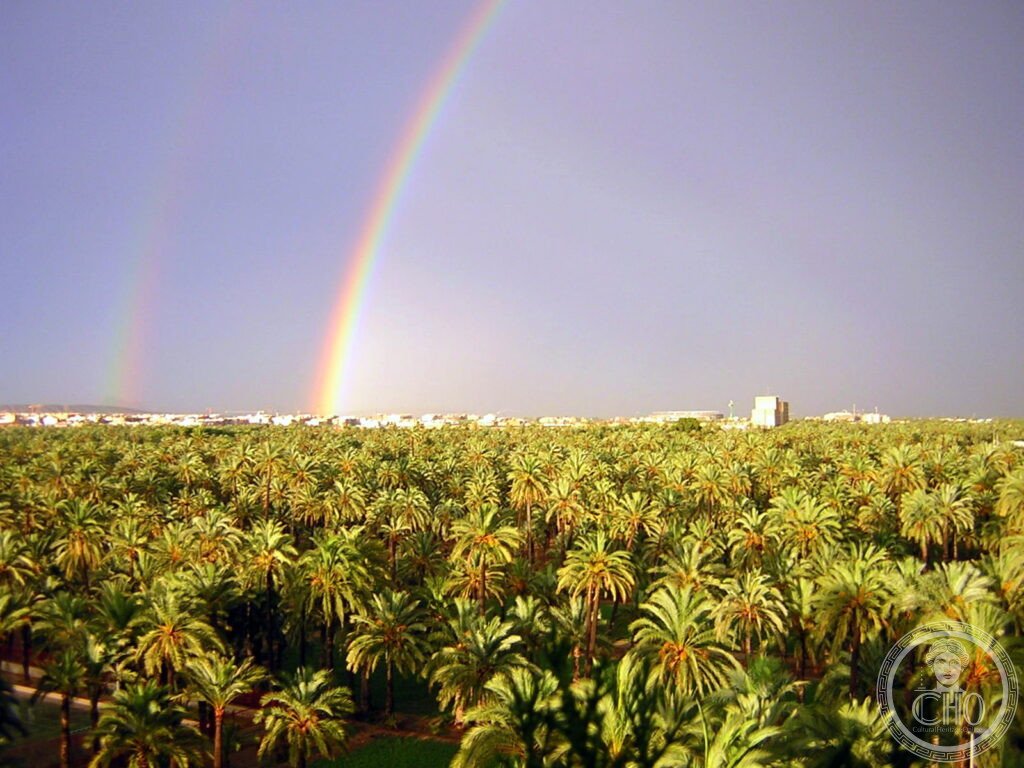
The largest date palm grove in Europe and the finest surviving example of Islamic irrigation-based agriculture on the Iberian Peninsula — the Palmeral de Elche (Palmeral d’Elx), a grid of approximately 200,000 date palms covering the western outskirts of the city of Elche (Elx) in Alicante Province, Spain, was established by the Islamic Moorish inhabitants of al-Andalus in the 10th century AD on an ancient irrigation system that diverts the Vinalopó River into an intricate network of channels; the grove has been maintained continuously for over a thousand years and is today both a UNESCO WHS and a working date palm plantation.
At a glance
The Palmeral of Elche surrounds the western part of the city of Elche (population approximately 235,000; 23 km south-west of Alicante; 55 km south of Valencia); the grove is not a single park but a complex of multiple private and public palm gardens (huertos, meaning “orchards” or “groves”) divided by the original acequia irrigation channels; the most accessible and most visited section is the Huerto del Cura (Priest’s Garden, named after a 19th-century private owner), now a public garden in the city centre with free or low-cost admission; the grove is most spectacular in late summer (September–October) when the dates ripen on the female palms; the famous white bleached fronds (the males of white-bladed varieties grown in the grove for the Palm Sunday tradition; a major commercial product of Elche — Elche supplies the majority of the white palm fronds used in Palm Sunday celebrations throughout Spain and much of Latin America) are harvested in February–March.
Key facts
- The Islamic irrigation system and the origin of the Palmeral: the engineering achievement that made the Palmeral possible — the Vinalopó River (a seasonal river with highly variable flow, typical of the semi-arid eastern Spanish coast) does not have enough year-round water to irrigate 200,000 date palms by simple diversion; the Islamic engineers of al-Andalus (10th century AD) created a system of underground and surface channels (acequias) with a complex set of distribution rules (the Water Council, or Juzgado Privativo de Aguas, which has administered the irrigation rights since the medieval period and has been in continuous operation since at least the 13th century — it is one of the oldest continuously functioning water courts in the world; its hearings are held in the square in front of the Parish Church of Santa María every Thursday morning and are open to the public) that divided the available water between the different groves and managed irrigation through the dry season; the entire channel network has a total length of approximately 50 km; the traditional water rights (measured in units called the “hilas”, a volumetric unit corresponding to a specific flow rate for a specific duration) are still the basis of all water allocation in the Palmeral today
- The date palms of Elche: species biology and commercial production — the date palms of Elche are Phoenix dactylifera (the true date palm, originating in the Arabian Peninsula and the Persian Gulf coast; cultivated in the Near East and North Africa for at least 6,000 years); the trees are dioecious (male and female flowers on separate trees); date production requires hand pollination (the male inflorescence is cut and tied into the female inflorescence when the female is receptive in late spring; a single male can pollinate 40–50 females); the Elche palms produce both dates (primarily for local markets — the dates of Elche are sweeter and less intensely flavoured than Arabian or North African dates, reflecting the cooler climate) and the white bleached fronds (the most commercially important product): in early spring, the long central fronds of selected male palms are tied and covered with raffia fibre for approximately one month, preventing light from reaching them; the resulting white (etiolated) fronds are the prized “palmas blancas” used for Palm Sunday celebrations throughout the Spanish-speaking world; Elche has the most prestigious reputation for palmas blancas in Spain
- The Misteri d’Elx (Mystery of Elche): the medieval sacred drama interwoven with the Palmeral — the Misteri d’Elx (Valencian: Misteri d’Elx; Spanish: Misterio de Elche) is a medieval liturgical drama (sung in medieval Valencian, performed annually on 14–15 August in the Basilica of Santa María) depicting the Assumption of the Virgin Mary; the play is the only surviving example of a medieval Christian mystery play performed in its original theatrical space (the Basilica was specifically designed for the play, with a trapdoor in the ceiling through which a mechanical apparatus — the “araceli” — descended to take the Virgin up to heaven during the performance) and continuously maintained in its original form; it was inscribed on the UNESCO Representative List of the Intangible Cultural Heritage in 2001 (as a companion to the Palmeral WHS inscription in 2000); the performance is in the centre of the old city, directly adjacent to the Palmeral
- Heritage: UNESCO World Heritage Site, Palmeral of Elche, inscribed 2000
- GPS: 38.2692° N, -0.7055° W
History
The site of Elche (ancient Illici) was inhabited from the Bronze Age; the famous “Dama de Elche” (the finest Iberian sculpture known; 4th century BC; now in the National Archaeological Museum in Madrid) was found near the site; the Islamic settlement of al-Andalus (8th–13th centuries) created the current irrigation network and the palmeral; the Reconquista (Christian reconquest of the city by Jaime I of Aragon; 1265); the palmeral was maintained by the Christian city; UNESCO WHS 2000; the Palmeral covers approximately 800 hectares (partially protected).
What you see
The most accessible entry point is the Huerto del Cura (in the city centre, near the bus station; the “Imperial Palm” — a large male Phoenix dactylifera with a peculiar morphology in which the trunk divides into 7 secondary trunks about 2 metres above ground; the phenomenon is attributed to natural mutation; it was already noted in the 17th century; it is the most photographed single palm in Spain); the Parque Municipal (a public park on the Avenida de la Libertad, free admission; the largest contiguous accessible section of the Palmeral); the acequia channels (visible throughout the Palmeral as narrow stone-lined waterways running between the rows of palms); the Archaeology Museum of Elche (MAHE; with the Dama de Elche cast and a complete exhibition on the Iberian, Roman, and Islamic history of the city); and the Basílica de Santa María (the church built for the Misteri d’Elx performances).
Practical information
- Admission: the Huerto del Cura is the most visited section: open daily 9am–8pm (summer), 9am–6pm (winter); admission approximately €5; the Parque Municipal is free; the acequia network is accessible throughout the Palmeral for free walking; the Misteri d’Elx (14–15 August; tickets via the Patronato del Misteri d’Elx; the performance sells out months in advance; this is one of the most extraordinary live theatre experiences in Spain — the mechanical apparatus descending from the basilica ceiling while the medieval singing fills the space is genuinely moving)
- Getting there: from Alicante (23 km north-east; 30 min by car or 25 min by Alicante-Murcia Cercanías train — train runs every 30 min and is the easiest approach without a car; the Elx-Parc station is closest to the Palmeral); from Valencia (190 km north; 1h 45 min by car or 1h 45 min by Euromed train on the Madrid-Valencia line to Elx-Carrús station); from Murcia (60 km south; 50 min by car or 1h by bus); Alicante Airport is 25 km north-east of Elche and is served by direct flights from northern Europe, the UK, and Germany
- The Alicante coast and the Levante UNESCO circuit: the Palmeral of Elche is most naturally combined with the coastal sites of the Alicante and Valencia provinces: the Monastery of Santa María de Poblet (in the interior of Catalonia, 250 km north; see Tarraco entry), the historic city of Cartagena (80 km south; the finest Roman theatre in Spain — the Teatro Romano de Cartagena, reopened in 2008 after restoration; in the medieval old city centre), and the Monastery of El Escorial (300 km north-west; 1h from Madrid; see separate CHO place card)
Getting there
From Alicante by Cercanías train (25 min, every 30 min) or car (30 min). Alicante Airport 25 km. GPS: 38.2692, -0.7055.
Nearby
- Dama de Elche and the Iberian culture — the Elche Archaeological Museum (MAHE) holds the best copy of the Dama de Elche (the original is in Madrid); the Dama is the finest sculptural work of the ancient Iberian civilization (4th century BC; the Iberians were the pre-Roman indigenous peoples of the eastern and southern Iberian Peninsula; they were culturally influenced by Greek colonists and Phoenician traders and developed a sophisticated art tradition combining Mediterranean influences with local traditions; the Dama, found at La Alcudia 2 km south of Elche in 1897, is a painted stone bust approximately 56 cm high, depicting a woman in elaborate headdress and jewelry; her function is debated — funerary urn, votive offering, or divine representation; she is the most recognizable image of ancient Spanish civilization)
- Santa Pola and the Salinas de Santa Pola — 20 km south-east of Elche (25 min by car); a major flamingo and wader site on the Alicante coast — the Parque Natural de las Salinas de Santa Pola (salt pans of Santa Pola) is one of the most important waterbird sites on the Spanish Mediterranean coast; approximately 2,000 flamingos (Greater Flamingo, Phoenicopterus roseus) breed annually; the salt pans also host Avocet, Black-winged Stilt, Lesser Kestrel, and in migration a wide variety of waders; the area is a natural park (free entry; observation towers along the path around the outer dike; the best time is sunrise or late afternoon in spring and summer when the flamingo colony is most active)
- Alicante Old Town and the Castillo de Santa Bárbara — 23 km north-east of Elche (30 min by car or train); the best-preserved castle in the Valencian Community — the Castillo de Santa Bárbara dominates the city of Alicante from a rocky promontory 170 metres above the sea; originally a 9th-century Moorish fortress, rebuilt by the Christians in the 13th–16th centuries and later enlarged with Spanish Renaissance military engineering; the castle is accessed by a lift tunnel cut through the rock from the beach side or by a road from the north (free admission); the views from the summit over the harbour, the Alicante plain, and the Palmeral of Elche visible in the distance make this the best elevated viewpoint on the central Alicante coast
Sources
- Wikipedia, Palmeral of Elche; Misteri d’Elx; Dama de Elche; Elche, accessed June 2026
- UNESCO, Palmeral of Elche, WHS reference 930, inscribed 2000
- Antoni Ivorra Pérez, El palmerar d’Elx, patrimoni de la humanitat, Institut Municipal de Cultura d’Elx, 2002
Find it on the map
See this place and what’s around it →📷 Become a Cultural Heritage Online photographer
Share your photos of places: they stay published under your name as the author. The more they're seen, the more you get noticed — and soon a contest will reward the most appreciated photos.
Log in or sign up free to add a photo