
The most complete ensemble of Roman monuments in Spain and the capital of the most important Roman province in the Iberian Peninsula. Tarraco (modern Tarragona) was the capital of Hispania Citerior, the Roman province established after the Second Punic War (218 BC) that at its peak encompassed the entire Iberian Peninsula east and north of the Tagus River. It was the winter residence of Emperor Augustus during the Cantabrian Wars (26–24 BC) and one of the most important cities in the western Roman Empire. Its Roman walls, amphitheatre, circus, forum, and monumental arch are preserved in and beneath the modern city.
At a glance
Tarraco (modern Tarragona; population approximately 140,000; 100 km south-west of Barcelona on the Catalan coast) preserves the most complete collection of Roman monuments in Spain: the Augustan city walls (1st–2nd century AD; 3.6 km of original wall circuit; the most completely preserved section in the Old City). The amphitheatre (2nd century AD; on the sea cliff; open to visitors as an archaeological park). The Roman Circus (1st century AD; 330 metres long; the second longest Roman circus surviving in the world after Carthage; the vaulted underground passages of the circus substructure are accessible beneath the medieval city centre). The Forum (the Roman provincial forum and the local city forum, on different levels of the city — the distinction between the two forum levels reflects the administrative complexity of a provincial capital). The Priory Tower (the apse of the imperial cult temple, incorporated into the medieval cathedral complex). And the Torre de los Escipiones (the funerary tower of the Scipio family, 1st century AD) and the Pons del Diable (the Roman aqueduct, approximately 217 metres long, preserved in the countryside 4 km from the city).
Key facts
- Tarraco as the capital of Hispania Citerior: the political and administrative significance of Roman Tarragona. Tarraco was founded as the main winter base of the Roman expeditionary forces during the Second Punic War (218 BC; when Gnaeus Cornelius Scipio and Publius Cornelius Scipio landed at the mouth of the Ebro River and established a base for operations against Hannibal’s Carthaginian forces in Spain). The city grew rapidly as the provincial capital of Hispania Citerior (the “nearer Spain”, the province east and north of the Tagus River; the other province, Hispania Ulterior or “further Spain” centred on Córdoba, was later divided into Baetica and Lusitania). Under the emperor Augustus, Tarraco became one of the most important cities in the western Roman Empire: Augustus spent the winter of 26–24 BC in Tarraco during the Cantabrian Wars (the final Roman pacification of the last independent peoples of the Iberian Peninsula, the Cantabrians and Asturians of the northern coast). The famous story that the city’s palm tree miraculously grew from the wreath placed on Augustus’s head after his recovery from illness in Tarraco is recorded by Quintilian and illustrates the city’s close association with the emperor.
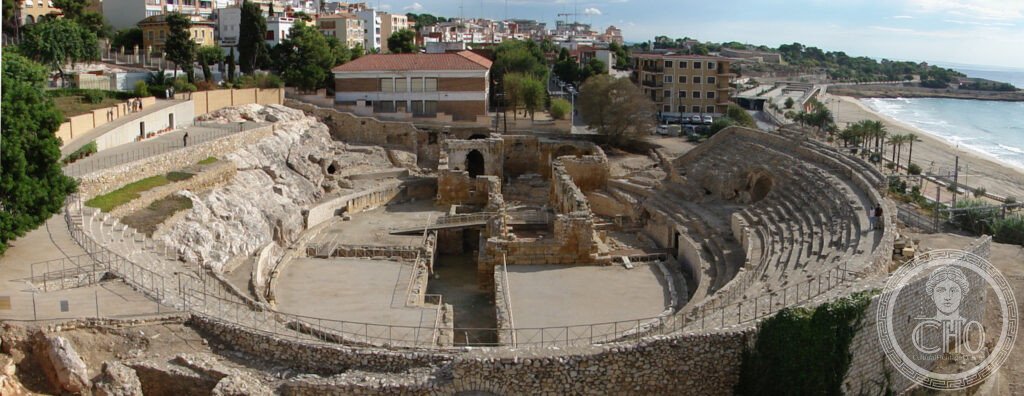
- The Roman Amphitheatre: the most accessible and the most dramatically situated of Tarraco’s Roman monuments. The Amphitheatre of Tarraco was built in the 2nd century AD (probably under Hadrian or the Antonines; the precise date of construction is not known) on the cliff edge of the Mediterranean shore, at the southern edge of the ancient city. The oval arena (109 × 86 metres; estimated capacity 12,000–14,000 spectators) is built into the natural slope of the cliff, with the seating on the uphill side partially supported by earth and on the downhill side by a complex system of vaulted masonry. The arena hosted gladiatorial combats, beast hunts (venationes), and public executions. A Visigothic church was built in the arena floor in the 6th century AD (over the site of the martyrdom of Bishop Fructuosus and two deacons, burned in the arena in 259 AD during the Valerian persecution). The ruins of a 12th-century Romanesque church (built over the Visigothic church) still stand in the centre of the arena. The combination of Roman arena, early Christian martyrdom, Visigothic church, and Romanesque church is unique in the world.
- The Roman Circus (1st century AD): the urban underworld of Tarraco. The Roman Circus of Tarraco (1st century AD; 330 × 115 metres; capacity approximately 23,000 spectators; the race track running from west to east through the centre of the upper ancient city) was one of the largest chariot racing venues in the Roman Empire. The circus is still largely underground. The medieval and modern city of Tarragona was built directly on top of the circus substructure, and the vaulted corridors and rooms beneath the circus seating banks still run under the medieval old town. The accessible sections of the underground circus (available for guided tours from the Pretori i Circ Romà archaeological complex in the old city) give the most powerful sense of the scale of Roman infrastructure at Tarraco.
- Heritage: UNESCO World Heritage Site, Archaeological Ensemble of Tarraco, inscribed 2000.
- GPS: 41.1180° N, 1.2550° E.
History
Founded 218 BC by the Scipio brothers as a military base in the Second Punic War. Became provincial capital of Hispania Citerior. Winter residence of Augustus 26–24 BC. Bishopric established by the 3rd century. Bishop Fructuosus martyred in the amphitheatre 259 AD (Valerian Persecution). Visigothic kingdom seat 5th–7th centuries. Moorish capture 714. Catalan reconquest 1089. Medieval city built on Roman foundations. The Roman remains were rediscovered and systematically studied from the 18th century. Archaeological excavations ongoing. UNESCO WHS 2000.
What you see
The Amphitheatre archaeological park (entrance from the Rambla Vella, the lower main boulevard) is the best introduction to Roman Tarraco: the arena oval is clearly visible. The Romanesque church ruins in the centre are surreal. The sea view from the top of the Roman seating banks is exceptional. The Forum (Fòrum Provincial and Fòrum Local; two separate complexes) is in the upper city near the Cathedral. The Cathedral itself is built over the Augustan-era temple of the imperial cult (the apse of the Roman temple is preserved as the Priory Tower of the Cathedral). The Roman Circus underground tour (Pretori i Circ Romà; central old city; the most dramatic experience) involves walking through the vaulted substructures of the circus beneath the city streets. The Roman Walls walk (the preserved northern section along Carrer de Sant Ermenegild) allows walking along the top of the wall.
Practical information
- Admission: a combined ticket for the main monuments (Amphitheatre, Circus/Pretori, City History Museum, Palaeochristian Necropolis) is approximately €11 adult. Each individual site has its own ticket (approximately €3–4 each). Open Tuesday–Sunday (closed Monday) approximately 9am–9pm (summer), 9am–5pm (winter). The Cathedral is separately accessed (approximately €5; open daily; the cloister and the Romanesque apse are the most important architectural elements). The Passeig Arqueològic (the walk along the outer face of the Roman walls; free access to the archaeological park surrounding the walls) is the most scenic free activity.
- Getting there: from Barcelona: 100 km south-west by car (1h) or by train (AVE high-speed train from Barcelona Sants to Tarragona: 35 minutes; regional trains also available, 1h 10 min; trains run frequently; Tarragona train station is in the lower city; the old city with the Roman monuments is 15 min walk uphill). From Valencia: 235 km north-east (2h 30 min by car or AVE). From Madrid: 580 km east (4h by AVE or 5h by car). Tarragona is also accessible by bus from Barcelona (1h 30 min by Alsa or Monbus from Barcelona Nord bus station).
- The Tarragona UNESCO Roman circuit: Tarraco can be combined with the Poblet Monastery (Monastery of Santa Maria de Poblet; UNESCO WHS 1991; 48 km north-west; the most important Cistercian monastery in Spain; the royal pantheon of the kings of Aragon; the most complete Gothic Cistercian complex in Europe) and the Priorat wine region (the most prestigious wine appellation in Catalonia; centred on the village of Gratallops and the Scala Dei monastery ruins; the Garnacha and Cariñena wines of the Priorat are among the most concentrated and complex red wines in the world) in a 2-day Tarragona–Priorat–Poblet circuit from Barcelona.
Getting there
From Barcelona by AVE (35 min) or car (1h, 100 km). From Valencia by AVE (1h) or car (2h 30 min). GPS: 41.1180, 1.2550.
Nearby
- Poblet Monastery. 48 km north-west of Tarragona (45 min by car). The most important Cistercian monastery in Spain and the royal necropolis of the Kings of Aragon. The Monastery of Santa Maria de Poblet (founded 1150 by Ramon Berenguer IV of Catalonia; UNESCO WHS 1991) is the most complete surviving Gothic Cistercian monastery complex in Europe. The royal pantheon (the tombs of the Kings of Aragon from Alfons I, d. 1196, to Joan I, d. 1396) in the church chancel are the finest examples of Catalan Gothic funerary sculpture. The 12th-century cloister, the dormitory, the Chapter House, and the wine cellar (still in use for Poblet’s own winery) are the essential spaces. Poblet was sacked and burned in 1835 during the anti-clerical violence of the Spanish First Carlist War. Cistercian monks returned in 1940 and have maintained the monastery since. It is still an active monastery and some areas are restricted to visitors.
- Priorat Wine Region. 50 km inland from Tarragona (45 min by car). One of Spain’s two premier wine appellations (the other being Rioja) and the source of some of the world’s most concentrated red wines. The Priorat (Catalan for “priory”; named for the former Carthusian priory of Scala Dei) is a deeply incised schist-and-granite landscape in the interior of the Tarragona province. The llicorella (blue-black schist and quartzite) soils and the extreme microclimate of the Montsant massif produce extraordinarily concentrated Garnacha (Grenache) and Cariñena (Carignan) wines with alcohol levels typically above 14% and intensely mineral flavours unique to this geology. The leading estates (Álvaro Palacios, Clos Mogador, Clos de l’Obac, Mas d’en Gil, Vall Llach) attract wine tourism throughout the year.
- Delta de l’Ebre (Ebro Delta). 80 km south-west of Tarragona (1h by car). The most important wetland and birdwatching site in Catalonia. The Ebro Delta (Catalan: Delta de l’Ebre) is the second largest river delta in the Iberian Peninsula (approximately 320 km²; the largest is the Guadalquivir/Doñana delta in Andalusia). The flat deltaic landscape of paddy fields (Ebro Delta rice is a Denomination of Origin product; the local bomba rice is the preferred variety for paella throughout Catalonia), lagoons, and salt marsh is the most important resting and wintering site for migratory birds on the western Mediterranean flyway. Over 300 bird species have been recorded. The flamingo colony (approximately 2,000 pairs; the most important flamingo colony in Catalonia), the elegant tern colony (up to 20,000 pairs), and the passage of raptors (osprey, marsh harrier, Montagu’s harrier) are the primary ornithological attractions.
Sources
- Wikipedia, Tarragona. Amphitheatre of Tarragona. Roman Circus of Tarragona. Hispania Citerior, accessed June 2026.
- UNESCO, Archaeological Ensemble of Tarraco, WHS reference 875, inscribed 2000.
- Xavier Dupré i Raventós, Las capitales provinciales de Hispania: Tarragona, Colonia Iulia Urbs Triumphalis Tarraco, Consejo Superior de Investigaciones Científicas, 2004.
Find it on the map
See this place and what’s around it →
📷 Become a Cultural Heritage Online photographer
Share your photos of places: they stay published under your name as the author. The more they're seen, the more you get noticed — and soon a contest will reward the most appreciated photos.
Log in or sign up free to add a photo