
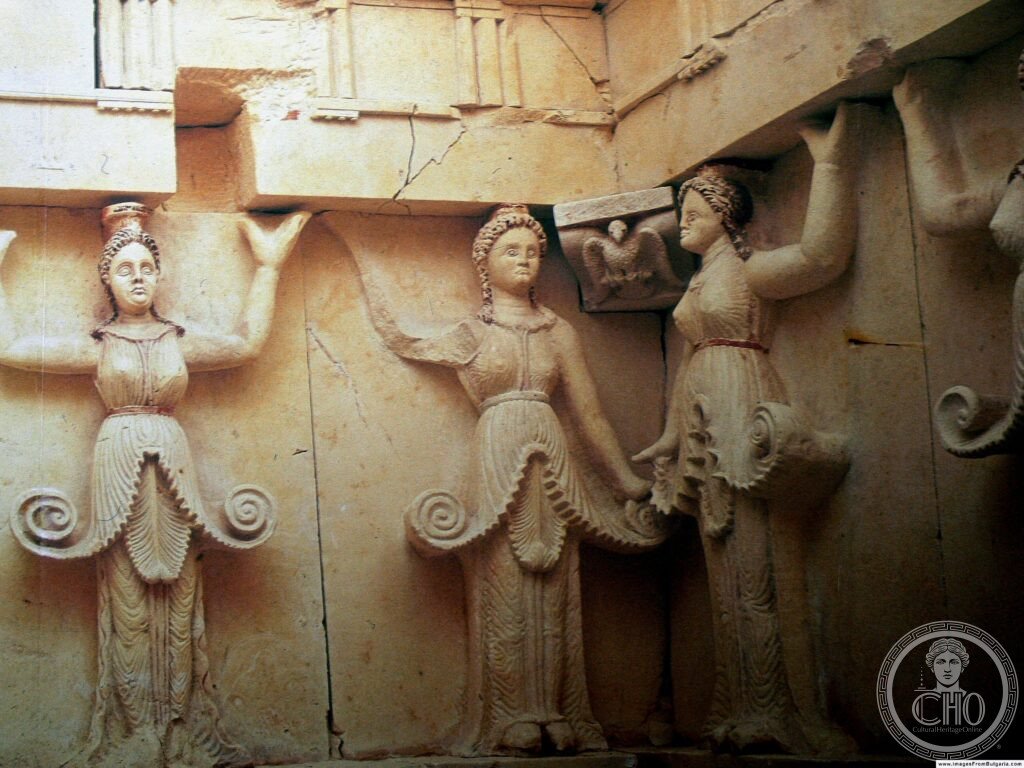
The most architecturally unique Thracian royal tomb in Bulgaria and one of the most remarkable funerary structures of the ancient world — the Sveshtari Tomb, built approximately 300–260 BC for a Getae Thracian king in what is now north-eastern Bulgaria, contains ten extraordinary high-relief female figures carved in stone on the lower walls of the burial chamber, each gesturing upward as if supporting the vault above; no other Thracian tomb has this combination of architectural structure and figural relief, and the ensemble was inscribed on the UNESCO World Heritage List just three years after discovery.
At a glance
The Sveshtari Tomb is located approximately 2 km north of the village of Sveshtari and 42 km west of Razgrad, in the flat agricultural plain of north-eastern Bulgaria (the historical region of Dobruja); the landscape offers no visual clue to the presence of the buried tomb — from outside, the site is a low earthen mound (tumulus) approximately 15 metres in diameter and 3–4 metres high, surrounded by a fence; an entrance ramp leads down to the modern protective structure covering the tomb; the tomb interior is accessed through a low modern corridor adjoining the original dromos (entrance corridor); a small visitor centre and guide facility are at the site; visiting alone (without a guide) is not possible. The nearest city is Razgrad (42 km; a provincial capital with a historical museum holding some Sveshtari Tomb finds).
Key facts
- The Getae and Thracian burial traditions: the people who built the Sveshtari Tomb — the Getae (or Getai) were a northern Thracian group occupying the territory of modern north-eastern Bulgaria and the Dobruja region of Romania; they spoke a Thracian language (closely related to Dacian; not yet fully deciphered), worshipped an extensive pantheon of gods including Sabazios and the Great Mother (an earth goddess), and maintained a tradition of elaborate royal burial in earthen tumuli; the Getae are known to ancient sources primarily through the campaigns against them by Philip II of Macedon (who crossed the Danube and raided the Getae in 339 BC) and Alexander the Great (who reached the Danube and briefly crossed into Getae territory in 335 BC); Herodotus (c. 484–425 BC) describes the Getae as the most just and courageous of the Thracians; they were eventually absorbed into the Dacian polity in the 1st century BC and then into Roman Dacia after Trajan’s conquest in 106 AD; the Sveshtari Tomb was built during the period when the Getae were adjusting to the aftermath of Alexander’s campaigns and the new Hellenistic world order, and the tomb reflects both native Thracian tradition and Hellenistic Greek influence
- The caryatid figures: the unique decorative programme of the burial chamber — the ten high-relief stone figures on the lower half of the burial chamber walls are the defining feature of the Sveshtari Tomb and the primary reason for its UNESCO inscription; the figures (each approximately 1 metre tall) are female, wearing a distinctive costume that appears to combine elements of Thracian dress with Hellenistic Greek elements; each figure has one arm raised and extended toward the entablature above (the cornice course at the top of the figural zone), as if pushing upward and supporting the vault — the caryatid function, in which a human figure serves as an architectural support, a form most familiar from the porch of the Erechtheion on the Athenian Acropolis (c. 421–405 BC) and from Hellenistic funerary monuments; however, the Sveshtari figures are carved in high relief on a flat wall (not free-standing as the Erechtheion caryatids are), and their function is more symbolic than structural; the faces are individualized (each face is slightly different from the others, suggesting a specific portrait tradition rather than stock types); the surface preserves traces of polychrome pigment (white, red, and yellow); the combination of the caryatid gesture with the individualized faces and Thracian-Hellenistic costume makes this the most complex and sophisticated example of Thracian figural stone carving known
- The architecture of the tomb: a sophisticated combination of a corbelled vault and a semi-circular apse — the tomb has three chambers: a long entrance dromos (corridor), an antechamber, and the main burial chamber; the burial chamber (the main room) has a corbelled stone vault (each course of stone projects slightly inward beyond the course below until the opening is closed by a capstone — the same principle as the Treasury of Atreus at Mycenae but at a much smaller scale); at the back of the chamber (the far end from the entrance), a semi-circular apse cut into the rear wall housed the burial bier or sarcophagus; the apse has a painted vaulted ceiling with a rosette pattern (alternating lotus flowers and palmettes in red, yellow, and blue against a white background) — the most complete surviving example of Thracian architectural polychrome painting in Bulgaria; the burial goods included gold objects (including a gold foil burial mask found in the position of the king’s face), iron weaponry, and bronze horse trappings
- Discovery (1982) and the fastest UNESCO inscription: the accidental discovery and exceptional significance — the Sveshtari Tomb was discovered in 1982 when a Bulgarian farmer working a field near Sveshtari accidentally struck the edge of the tumulus with agricultural machinery; the Bulgarian Academy of Sciences dispatched a team immediately and excavated the tomb in 1982–1985; the UNESCO inscription was granted in 1985 — only 3 years after discovery, one of the fastest UNESCO inscriptions on record; the speed of the inscription reflects the unanimous assessment of the international heritage community that the Sveshtari caryatid figures represented a completely unprecedented type of Thracian artistic achievement with no parallel in any other known tomb
- Heritage: UNESCO World Heritage Site, Thracian Tomb of Sveshtari, inscribed 1985
- GPS: 43.5700° N, 26.6000° E
History
Constructed c. 300–260 BC for an unidentified Getae Thracian king (possibly the king Dromichaetes, who captured Lysimachus of Thrace c. 292 BC and was one of the most powerful Getae rulers); buried in approximately 260 BC; the tumulus was sealed; the site was undisturbed for 2,250 years; discovered by agricultural accident 1982; excavated 1982–85 by Bulgarian Academy of Sciences; UNESCO WHS inscription 1985; the gold burial mask and the key portable finds are in the National History Museum, Sofia; the tomb is maintained in situ and is open to visitors with a guide.
What you see
The visitor enters through a modern protective corridor adjoining the original entrance dromos; the stone-lined corridor (approximately 10 metres long, less than 2 metres high) leads to the antechamber; the antechamber is plain stone; from the antechamber, the doorway into the main burial chamber is a narrow stone-linteled opening; the burial chamber (approximately 3.3 metres wide and 3.6 metres long) is dramatically lit by the guide; the ten caryatid figures appear immediately on the lower walls; the corbelled vault overhead; the semi-circular apse at the far end with its painted rosette ceiling; the original wooden burial bier has long rotted away but its stone platform base remains; the polychrome paint on the caryatid figures and the apse ceiling is partially preserved; the guide points out the traces of original pigment; the visit takes approximately 30–45 minutes inside the tomb.
Practical information
- Admission and hours: approximately 10–15 BGN (approximately €5–8); open Tuesday–Sunday 9am–5pm (closed Monday; hours may vary seasonally; confirm at the Razgrad Regional Museum of History, which manages the site); guided visit only; the guide provides lighting and commentary (in Bulgarian; English interpretation can sometimes be arranged in advance by contacting the museum); the visit inside the tomb itself is 30–45 minutes; combined with the visitor centre display and the exterior site, allow 1h 30 min total
- Getting there: from Razgrad (42 km west; 45 min by car on secondary roads; follow signs to Sveshtari village and then the archaeological site); from Shumen (90 km; 1h by car); from Ruse (90 km; 1h 15 min); there is limited public transport between Razgrad and Sveshtari; a taxi from Razgrad is the most practical option for visitors without a car
- The Thracian and medieval north-eastern Bulgaria circuit: the Sveshtari Tomb is best combined with the Madara Rider (75 km east; the only large-scale cliff rock relief in the Balkans; c. 710 AD; the horseman figure with Greek inscriptions recording Bulgar Khan victories; UNESCO WHS 1979; see separate CHO place card), the Shumen Fortress (4 km east of Shumen; the largest medieval Bulgarian fortress in north-eastern Bulgaria; the founders’ monument at the top of the plateau above Shumen is one of the most recognizable in Bulgaria), and the Thracian Tomb of Kazanlak (250 km south-west; UNESCO WHS 1979; the finest Thracian painted burial chamber in Bulgaria; see separate CHO place card) as part of a Thracian cultural heritage circuit through Bulgaria
Getting there
From Razgrad (42 km west, 45 min by car). From Shumen (90 km, 1h). Taxi from Razgrad recommended (limited public bus). GPS: 43.5700, 26.6000.
Nearby
- Madara Rider — 75 km east of Sveshtari (1h by car); the only large-scale rock relief in the Balkans and the defining monument of the first Bulgarian Empire — the Madara Rider (c. 710 AD; carved into the Madara cliff at approximately 100 metres above the valley floor; approximately 2.6 metres high; a horseman thrusting a spear into a lion, with Greek inscriptions recording the military victories of the Bulgarian Khans Tervel, Krum, and Omurtag) is the most important early medieval monument in Bulgaria; the adjacent cliff caves and the remains of the Madara pagan sanctuary form a wider complex; UNESCO WHS 1979; see separate CHO place card
- Ancient City of Nessebǎr — 220 km south-east of Sveshtari (2h 30 min by car); the most complete Byzantine city in Bulgaria and a major Black Sea resort — Nessebǎr (ancient Mesembria; Thracian, Greek, Byzantine, Bulgarian, Ottoman) occupies a small peninsula on the Black Sea coast connected to the mainland by a narrow causeway; the old city contains the most important collection of Byzantine-period church ruins in Bulgaria (over 40 Byzantine churches; 14 of them partially standing), a characteristic Black Sea townscape of wooden-balconied houses, and an active fishing port; UNESCO WHS 1983; see separate CHO place card
- Ruse City and Danube heritage — 90 km north-west of Sveshtari (1h 15 min by car); the most European city in Bulgaria and the gateway to Bucharest — Ruse (population 140,000; the Danube port and railway junction) was the first Bulgarian city connected to Europe by rail (the Ruse–Varna railway, 1866, was Bulgaria’s first railway line and the third in the Balkans) and has a fine collection of late 19th-century Central European-style architecture (Secession, Neo-Renaissance, Neo-Baroque) along its main boulevard; the Ruse Regional Museum of History has the best collections of prehistoric, Thracian, Roman, and medieval objects from north-eastern Bulgaria; Ruse is the most convenient base for visiting both Ivanovo and Sveshtari
Sources
- Wikipedia, Thracian Tomb of Sveshtari; Getae; Thracian art, accessed June 2026
- UNESCO, Thracian Tomb of Sveshtari, WHS reference 359, inscribed 1985
- Diana Gergova, The Thracian Tomb at Sveshtari, Bulgarian Academy of Sciences, 1987
- Zofia H. Archibald, The Odrysian Kingdom of Thrace, Clarendon Press, Oxford, 1998
Find it on the map
See this place and what’s around it →📷 Become a Cultural Heritage Online photographer
Share your photos of places: they stay published under your name as the author. The more they're seen, the more you get noticed — and soon a contest will reward the most appreciated photos.
Log in or sign up free to add a photoDo you manage this place?
This page is read by travellers and heritage enthusiasts who find it on Google. Keep it accurate — and make it work for you. Free for non-profit heritage institutions.