
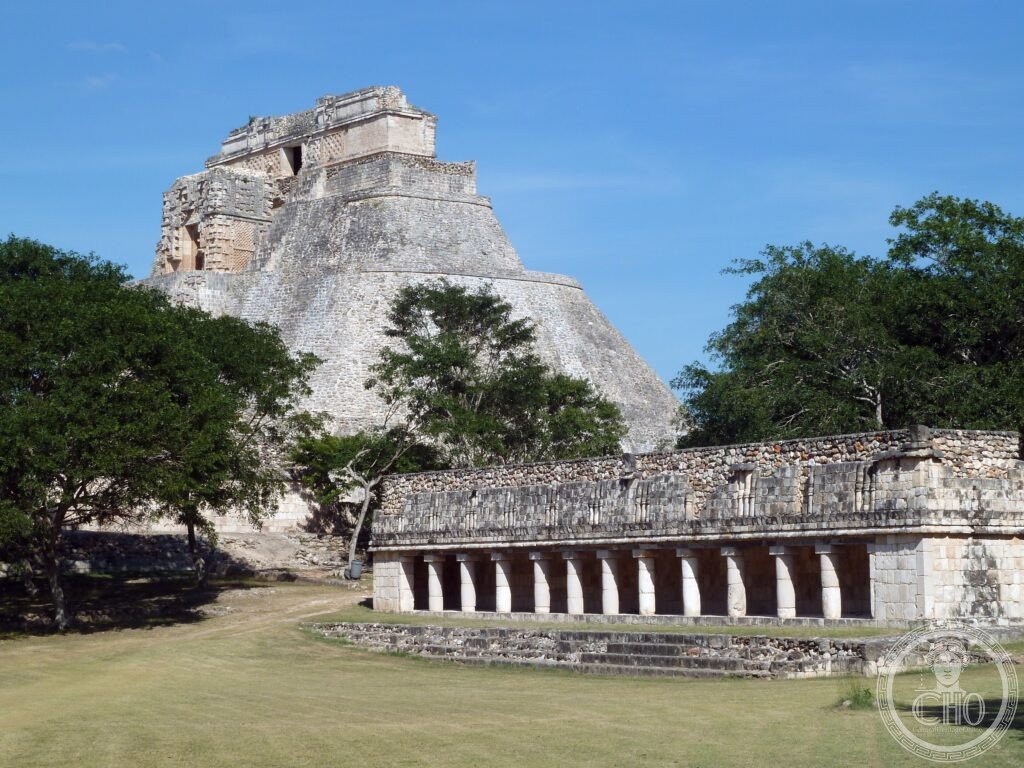
The architectural masterpiece of the Classic Maya and the finest example of the Puuc style. Uxmal (Yucatec Maya: “three times built”, pronounced “oosh-MAL”) was one of the great cities of the northern Yucatán during the Classic period (600–900 AD), its Governor’s Palace (a 100-metre-long mosaic of 20,000 individually cut stone pieces) considered by the mid-19th-century explorer John Lloyd Stephens “the most perfect building in the Americas”, while the Pyramid of the Magician’s oval plan remains unique in all of pre-Columbian architecture.
At a glance
Uxmal is 78 km south of Mérida (the capital of Yucatán state), in the low hills of the Puuc region of northern Yucatán. The site is significantly less visited than Chichen Itza (130 km north-east) and correspondingly more pleasant: the crowds are smaller, the site is not surrounded by souvenir stalls, and the quality of the architecture is arguably higher. The UNESCO site (inscribed 1996) covers the main ceremonial complex of Uxmal and the surrounding Puuc sites (Kabah, Sayil, Labná, and the Xlapak arch are within 20–60 km and are usually visited on the same day as the Ruta Puuc circuit). The daily light-and-sound show (Noche de Uxmal, at the site from approximately 8pm) is atmospheric and free with the admission ticket for evening visitors.
Key facts
- Pyramid of the Magician (Pirámide del Adivino, c. 700–1000 AD): the most instantly recognisable monument at Uxmal and the most architecturally unusual pyramid in all of Mesoamerica. Unlike every other Mesoamerican pyramid (which are built on a rectangular or square base), the Pyramid of the Magician is built on an oval/elliptical base (approximately 60 x 47 metres at the base, rounded at the long ends, straight on the two long sides). The oval plan is structurally and aesthetically unusual. It creates a steeply-raked profile from the front and a more gradual one from the sides, emphasising the verticality of the pyramid when approached from the Nunnery Quadrangle to the south. The pyramid has five successive temples built inside one another over approximately 300 years (the earliest, Temple I at the base, was built approximately 700 AD; the newest, Temple V at the top, was built approximately 1000 AD; each new temple was built as a shell encasing the previous one, so the pyramid grew in size with each construction phase while preserving all previous temples intact within its core). The west staircase faces 65.5° west of north and aligns to the sunset on the summer solstice. The east staircase leads directly to the entrance of a Chenes-style temple chamber (Temple IV, at the second from top level) whose doorway is surrounded by a giant mosaic mask of the rain god Chac with the mouth as the doorway opening. The most elaborately ornamented Maya temple door in Yucatán.
- Governor’s Palace (Palacio del Gobernador, c. 900–1000 AD): the most complex and perfectly composed building of Classic Maya architecture. The Governor’s Palace is 97 metres long, 12 metres wide, and 8 metres high, built on a massive triple-tiered platform. The lower walls are smooth limestone. Above the cornice runs a continuous frieze of approximately 20,000 individually cut stone mosaic pieces, arranged in geometric patterns (lattice, Greek key), with Chac mask stacks on the corners and at intervals along the frieze (Chac, the rain god with the long hook nose, appears 150 times on the facade). In the centre of the south face, above the main doorway, is a large double-headed jaguar throne and a panel with the seated image of the Uxmal lord who built or renovated the palace, identified by an inscription as “Lord Chak” (Chan K’ak’, approximately 900 AD). The central doorway of the Governor’s Palace aligns precisely with the rising of the planet Venus at its southernmost point on the horizon (Venus was the war star of the Maya, and the Venus alignment is significant for Maya political astronomy). John Lloyd Stephens’ description of the building in Incidents of Travel in Yucatan (1843) was the first extensive account of Uxmal read in Europe and sparked the modern archaeological study of the Maya.
- Nunnery Quadrangle (Cuadrángulo de las Monjas, c. 900 AD): the largest and most elaborate residential or administrative complex at Uxmal. A four-building courtyard complex (named by the Spanish for its resemblance to a convent, though the original function is unknown; possible interpretations include a school, an administrative centre, or a celestial cosmological model). Each of the four buildings has a different frieze programme: the north building has a feathered serpent mosaic along the entire upper frieze. The south building has repetitive Chac masks. The east building has serpent heads and lattice. The west building has the most elaborate programme (including a model of a Maya thatched house in stone mosaic — the “Nunnery Annex” houses the goddess Ix Chel and various astronomical alignments are noted in the positions of the buildings relative to each other and to the Venus cycle).
- The Puuc style: the architectural tradition unique to the Uxmal/Kabah/Sayil/Labná region. Puuc (from the Maya word for “hills”) architecture is characterised by: (1) a smooth lower wall of precisely fitted stone blocks below the cornice. (2) an upper frieze (the medial cornice between the lower wall and the upper frieze is a distinctive Puuc hallmark) of complex stone mosaic composed of hundreds or thousands of pre-cut pieces assembled like a puzzle onto a core of small stones and mortar. (3) Chac rain-god masks stacked corner-to-corner at building corners (the nose of each Chac curls downward and outward, creating the characteristic profile of every Puuc building corner). (4) circular columns and round columns flanking doorways. (5) false arches (corbel arches) in the Maya tradition (true arches using the keystone principle were not used in Mesoamerica).
- Heritage: UNESCO World Heritage Site, Pre-Hispanic Town of Uxmal, inscribed 1996.
- GPS: 20.3595° N, 89.7712° W.
History
Uxmal was occupied from approximately 600 AD and reached its height of population and construction activity between 800 and 1000 AD (the Terminal Classic period). The Puuc region had no accessible fresh water (the limestone karst has no surface rivers or lakes and the water table is very deep), so the Maya of Uxmal depended entirely on stone-plastered cisterns called chultuns (cut into the bedrock beneath houses and public spaces) to collect rainwater. The Terminal Classic period drought (a series of prolonged dry spells from approximately 800 to 950 AD, documented by palaeoclimatic lake-sediment records from Yucatán and Belize) is hypothesized as a major cause of the abandonment of the southern Maya cities (Palenque, Copán, Tikal, etc.) and the subsequent decline of the Puuc cities. Uxmal was probably largely abandoned by approximately 1000–1100 AD, though the site was reoccupied during the Postclassic period (1100–1450 AD) by the Xiu family (one of the main Yucatán noble lineages) who used it as a ceremonial centre. The Spanish arrived in the 1540s and found Uxmal already abandoned. The site was first described to European audiences by John Lloyd Stephens and Frederick Catherwood in Incidents of Travel in Yucatan (1843), the most important early account of Maya ruins.
What you see
The main circuit at Uxmal takes 3–4 hours on foot. Entry is from the north (the parking area and ticket office). The Pyramid of the Magician (immediately south of the entrance; climb the east staircase for the view of the complete site from the top; the west staircase is steeper but gives the best view of the Nunnery Quadrangle below). Nunnery Quadrangle (immediately west of the Pyramid; walk through the arch entrance into the courtyard and examine all four frieze programmes in turn). Ball Court (between the Nunnery and the Governor’s Palace). Governor’s Palace (on its massive triple platform to the south; the view from the Governor’s Palace across the Nunnery and Pyramid of the Magician to the north is the panoramic view of Uxmal). House of the Turtles and Great Pyramid (south-west of the Governor’s Palace; the House of the Turtles is an elegant small building with a frieze of carved turtles; the Great Pyramid / Pyramid of the Old Woman is larger but less restored than the Pyramid of the Magician).
Uxmal is best visited in the early morning (7–10am) before the heat becomes extreme (temperatures reach 35–40°C by midday from April to October) and before the day-trips from Mérida arrive. The evening light-and-sound show (8pm daily) is atmospheric and the golden light on the Governor’s Palace frieze in late afternoon is exceptional.
Practical information
- Admission: approximately 571 MXN (approximately €28 at current exchange rates, including the evening sound-and-light show). The sound-and-light show alone approximately 100 MXN. INAH passes valid. The site opens at 8am and closes at 5pm for entry (the sound-and-light show runs separately from 8pm).
- Getting there: Mérida International Airport (MID) is 80 km north of Uxmal (1h 15 min by car). Direct international flights from Mexico City (1.5h), Houston (2h), Miami (2h), Toronto (4h), and other US/Canadian cities. From Mérida city by car 78 km south on the SCI-261 road (1h). By bus from Mérida CAME terminal (Sur or ATS lines, 1h 30 min, infrequent — check schedule in advance). By organised tour from Mérida (the most common option for tourists without a car: half-day or full-day tours depart from Mérida hotels at 7–8am and include Uxmal + the Ruta Puuc circuit of Kabah/Sayil/Labná; approximately €40–60 per person). No accommodation in Uxmal except the Hacienda Uxmal (on-site luxury hotel in a converted henequen hacienda; breakfast included; the swimming pool faces the pyramid silhouette, one of the great hotel location views in Mexico).
- Best combined itinerary: Uxmal (morning, 3h) + Kabah (25 km north on the SCI-261; the Codz Poop “building of masks” at Kabah has the most extreme Chac-mask facade in the Puuc region — approximately 250 Chac masks covering the entire facade in a single continuous mosaic; 30 min) + Sayil (35 km north of Kabah; the three-storey “Palace” with its distinctive open round columns is the most graceful multi-storey building of the Puuc; 30 min) + Labná (15 km from Sayil; the Labná Arch is the most famous and most photographed corbelled arch in the Maya world, with its elaborate mosaic frieze and two adjoining corbelled wings; 30 min) + dinner in Mérida.
Getting there
Mérida Airport (MID): 80 km north (1h 15min by car). By car from Mérida (78 km, 1h). Organised tours from Mérida from €40. GPS: 20.3595, -89.7712.
Nearby
- Chichen Itza. 130 km north-east of Uxmal (1h 45 min by car). The most famous Maya site in Mexico and the most visited (approximately 2.5 million visitors/year; UNESCO WHS 1988). The Pyramid of Kukulcán, El Castillo, c. 950–1150 AD, is the defining image of Maya architecture: on the equinox the angle of sunlight on its balustrade creates a moving shadow that looks like a serpent descending from the summit, and the spring equinox sunrise draws approximately 100,000 visitors, though the effect is visible during the two weeks around each equinox. Around it stand the Temple of Warriors with its forest of carved columns, the Great Ball Court, the largest in Mesoamerica at 168 x 70 metres and carved with relief panels of the ballgame, the Observatory, El Caracol, a circular building with windows aligned for astronomical observation, and the Sacred Cenote, the natural sinkhole into which the Maya threw offerings and sacrificial victims. Together they make Chichen Itza more spectacular in total than Uxmal, though architecturally more varied and less pure in style: the post-900 AD city mixes Puuc style with Toltec influence from Central Mexico.
- Mérida. 78 km north of Uxmal (1h by car). The most pleasant large city in Mexico for cultural tourism. Mérida (founded 1542 by Francisco de Montejo on the ruins of the Maya city of T’Ho) is a compact, walkable colonial city of 800,000 inhabitants with a vibrant cultural life. The Zócalo, the central plaza, carries the Cathedral of Mérida of 1598, the oldest cathedral in the continental Americas still in use, whose massive façade reused stone from the Maya city demolished to build it. The Gran Museo del Mundo Maya, opened in 2012, is the finest museum of Maya civilisation in the world, covering the entire Maya region from Guatemala to Yucatán in chronological and thematic galleries, with the best collection of Maya sculpture, ceramics and manuscripts in Mexico. The Paseo de Montejo is the grand 19th-century boulevard lined with Porfiriato-era mansions in the French and Italian Beaux-Arts style. On Saturday evenings the Vaquería, a traditional Yucatecan folk dance, is performed on the Zócalo, free and open to all. Together they make Mérida one of the most rewarding of all Mexican cities.
- Cenotes of the Yucatán. Within 20–100 km of Uxmal. The most distinctive natural feature of the Yucatán Peninsula. Cenotes (from Maya “dzonot”, sinkholes) are natural freshwater pools formed where the limestone karst roof of underground rivers has collapsed. The Yucatán has approximately 6,000 known cenotes, ranging from open-sky lakes (like the Sacred Cenote at Chichen Itza) to partly-collapsed caverns (the Cenote Zaci at Valladolid) to completely underground cave systems (the Cenote Dos Ojos near Tulum, part of the Ox Bel Ha system which is the longest underwater cave system in the world at 270 km). Swimming in cenotes is one of the most popular activities in Yucatán. The closest significant cenote to Uxmal is the Cenote Yokdzonot (30 km north-east of Uxmal, off the road to Chichen Itza), a partially open cenote with a wooden platform for jumping into the turquoise water below.
Sources
- Wikipedia, Uxmal. Pyramid of the Magician. Governor’s Palace, Uxmal. Puuc, accessed June 2026.
- UNESCO, Pre-Hispanic Town of Uxmal, WHS reference 791, inscribed 1996.
- Jeff Karl Kowalski, The House of the Governor: A Maya Palace at Uxmal, Yucatán, Mexico, University of Oklahoma Press, 1987.
- John Lloyd Stephens, Incidents of Travel in Yucatan (2 vols.), Harper & Brothers, 1843.
Find it on the map
See this place and what’s around it →📷 Become a Cultural Heritage Online photographer
Share your photos of places: they stay published under your name as the author. The more they're seen, the more you get noticed — and soon a contest will reward the most appreciated photos.
Log in or sign up free to add a photo