
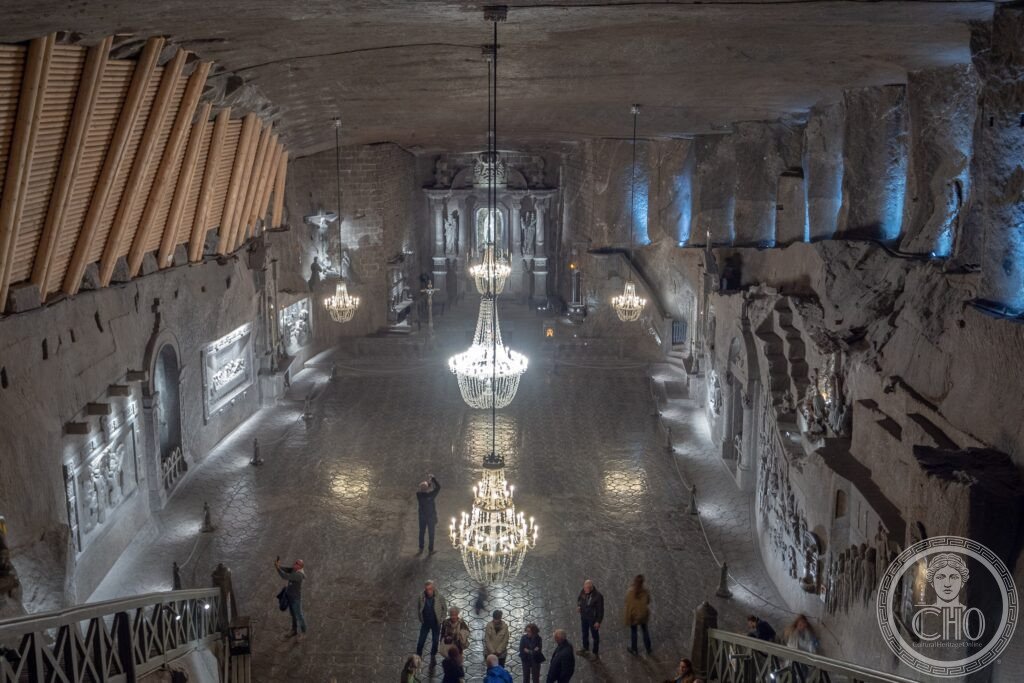
The most extraordinary underground world in Europe. The Wieliczka Salt Mine (Kopalnia Soli Wieliczka), 14 km south-east of Kraków, was in continuous operation for 700 years (from the 13th century to 2007), honeycombing the Miocene salt deposits of the Kraków-Wieliczka trough with 300 km of passages across 9 levels descending to 327 metres. Within its galleries, generations of miners carved a complete underground world of chapels (the greatest, the Chapel of St Kinga, rivals many Gothic cathedrals in scale and ambition), lakes, sculptures, and chandeliers, all of salt. One of the original UNESCO World Heritage Sites of 1978.
At a glance
Wieliczka (population approximately 22,000) is a small town 14 km south-east of Kraków, accessible in 30 minutes by bus or suburban railway. The salt mine is within 5 minutes of the town centre. The Tourist Route (the main visitor experience) descends 380 stairs to 64 metres depth and winds through 3.5 km of passages over 3 levels, taking approximately 2–3 hours with a guide (mandatory; tours in English, German, French, Italian, Russian, and Polish). The lowest point on the Tourist Route is 135 metres underground. UNESCO inscribed the Wieliczka Salt Mine in 1978 as part of the original cohort of Polish UNESCO sites (alongside the Historic Centre of Kraków and the Auschwitz-Birkenau Memorial). It was the first complete industrial complex to receive UNESCO protection anywhere in the world.
Key facts
- Chapel of Saint Kinga (Kaplica Świętej Kingi, 1895–1963): the single most remarkable space in the mine and one of the most extraordinary interiors in Poland. Named for St Kinga (Kunigunde of Hungary, 1224–1292, a Hungarian princess who married Bolesław V of Poland and later became a Franciscan nun; according to legend, she threw her engagement ring into the Wieliczka salt spring in Hungary and the ring reappeared in the first block of rock salt mined at Wieliczka when she arrived in Poland — a story that makes her the patroness of salt miners). The chapel was begun by miner Józef Markowski in 1895 and completed by sculptor Mieczysław Kluzek in 1963. It measures 54 metres long, 18 metres wide, and 12 metres high (a three-nave space rivalling a medium-sized Gothic cathedral in volume). The floor is inlaid with salt crystal mosaics. The three chandeliers (the largest 8 metres in diameter) are made entirely of salt crystals that glitter like glass. The walls carry relief carvings of the Last Supper (after Leonardo da Vinci), the Annunciation, the Nativity, and the life of St Kinga. The altar has a carved salt sculpture of Pope John Paul II (who was born in Wadowice, 30 km south of Wieliczka, and visited the mine in 1978 as a cardinal before his election) and a carved panel of the Last Supper. Catholic Mass is celebrated here every Sunday. The acoustics of the salt cave are extraordinary (extremely dry, highly reverberant).
- The mine’s production history (13th century–2007): the Wieliczka deposits were formed approximately 13.6 million years ago when the Miocene Tethys Sea evaporated and left salt beds up to 400 metres thick in the Kraków-Wieliczka basin. The first documented salt extraction at Wieliczka is from the early 13th century (the town’s name, from “wielki”, meaning “great”, refers to the richness of the deposits). The mine was a royal monopoly (the “saline in Wieliczka” is mentioned in a royal charter of 1290 by King Przemysław II) and was one of the most important sources of income for the Polish crown from the 13th to the 18th century (salt was an essential medieval commodity, required for food preservation, leather tanning, and textile dyeing). At its peak in the 17th century, the mine employed approximately 2,000 miners and its revenue represented approximately one-third of the royal treasury income. The mine continued to produce salt until 2007, when extraction was permanently ceased in favour of the tourist and cultural use that had been the primary function since the 1970s.
- Underground lakes, chambers, and sculptures: the mine’s 300 km of passages contain more than 2,000 chambers, dozens of underground lakes (the largest, Lake Wessel, is approximately 1,000 m² and at a depth of 61 metres; the water is a brine solution of approximately 30% salinity, three times that of seawater), and hundreds of carved salt sculptures accumulated over 700 years of miner-artists. The most famous sculptures include the salt statue of Copernicus (in the Chamber of Copernicus, one of the oldest and most architecturally impressive chambers on the Tourist Route, commemorating the astronomer’s alleged visit to Wieliczka; Copernicus was born in Toruń, 400 km away, and his connection to the mine is more legendary than documented), the carved gnomes (in the Chamber of Dwarfs, a playful tradition of small carved figures that became the mine’s popular symbol), the crystal grottos (natural salt crystal formations in the lower levels, created by brine seepage and slow crystallisation over centuries).
- Health tourism: the underground climate of the Wieliczka mine (constant temperature 14–16°C, very high humidity at 75–80%, extremely low allergen levels, and the presence of salt aerosol) is used as a therapy for respiratory conditions including asthma, bronchitis, and allergies. The mine has an underground sanatorium (the Wieliczka Salt Cave Sanatorium) at a depth of 135 metres, which offers multi-day treatment programmes. Patients sleep in underground rooms and breathe the salt-saturated air (speleotherapy). This is the longest-established underground salt therapy resort in the world (the medical use dates from 1839).
- Heritage: UNESCO World Heritage Site, Wieliczka and Bochnia Royal Salt Mines, inscribed 1978 (extended to include Bochnia mine in 2013).
- GPS: 49.9843° N, 20.0536° E.
History
The Wieliczka salt deposits were first extracted on an industrial scale in the early 13th century. The royal monopoly on salt (the “jus regale minae salis”, established by Bolesław the Wry-Mouthed in the 12th century) made the mine a direct source of crown revenue. The great 14th-century Polish kings (Casimir III the Great, 1333–1370, who built a castle at Wieliczka to oversee the mine, and later the Jagiellonian dynasty) depended on the mine’s income to fund their courts and armies. The Vistula Salt Route (from Wieliczka north to Gdańsk, then by sea) was one of the most important trade routes of medieval Central Europe. The mine survived the Swedish occupation of Poland (the “Deluge”, 1655–1660) with its operations relatively intact. In 1772, the First Partition of Poland transferred Wieliczka to Austrian rule (as part of Austrian Galicia), and the Habsburg Empire continued to operate it as a state salt monopoly. The Austrian period (1772–1918) introduced modern engineering (the steam-powered pumping system to remove underground water, first installed in the 1850s), produced the Chapel of St Kinga, and began the formal tourist use of the mine. After Polish independence in 1918, the mine returned to Polish state ownership. It was used as an ammunition and equipment storage facility by the Germans during WWII (the underground chambers proved ideal for the storage of aircraft engines and other heavy equipment requiring stable temperature and humidity).
What you see
The Tourist Route is the standard visitor experience: descend 380 steps (approximately 64 metres) then walk 3.5 km over 3 levels (the mine has 9 levels total; the Tourist Route covers the top 3) through a sequence of chambers including the Chamber of Copernicus (the largest chamber on the upper Tourist Route, with a salt crystal chandelier and the Copernicus statue), the Chamber of the Blessed Kinga (a massive chamber with an underground lake), the Chamber of Dwarfs (the popular gnome sculptures), and the Chapel of St Kinga (the climax of the tour, 135 steps below the previous level). Return is by lift (elevator), which rises the 135 metres in approximately 30 seconds with a notable deceleration at the top. Allow 2.5–3 hours for the Tourist Route. Photography is permitted throughout (no flash in the chapel during services). The temperature underground is 14–16°C year-round. Bring a jacket even in summer.
Practical information
- Admission: Tourist Route approximately 119 PLN (approximately €27; book online 2–3 weeks in advance in summer as the mine sells out; timed entry slots every 30 minutes from 7:30am to 5pm). Combined ticket with the Mining Museum (the above-ground museum in the former mine administration building) approximately 139 PLN. The Health Resort (underground sanatorium) is separately bookable (minimum 4-day programme, from approximately €400 per person including accommodation and meals).
- Getting there: from Kraków Old Town by minibus 304 (Wieliczka Kopalnia stop, 30 min, frequent, approximately 5 PLN — the most convenient option) or suburban railway (Kraków Główny to Wieliczka Rynek or Wieliczka Park station, 25–35 min). By car from Kraków 14 km south-east on the DK4 road (20 min without traffic). The mine entrance is 500m from the railway station and 800m from the bus stop. Kraków John Paul II International Airport (KRK) is 20 km from Wieliczka (25 min by car), making Wieliczka a practical stop on the way to or from the airport.
- The Kraków-Wieliczka circuit: Wieliczka is almost always visited as a half-day extension from Kraków (UNESCO WHS 1978; the Wawel Royal Cathedral and Castle, Rynek Główny, St Mary’s Basilica, the Kazimierz Jewish Quarter, and the Schindler Factory Museum are the Kraków priorities). Wieliczka + Auschwitz-Birkenau Memorial (50 km west of Wieliczka, 45 km west of Kraków) form the two most visited sites outside Kraków itself. Both require advance booking at peak season.
Getting there
Minibus 304 from Kraków Old Town (30 min, very frequent). Suburban rail from Kraków Główny (25–35 min). Kraków Airport (KRK): 20 km (25 min by car). GPS: 49.9843, 20.0536.
Nearby
- Historic Centre of Kraków. 14 km north-west of Wieliczka (30 min by minibus). One of Poland’s three original 1978 UNESCO inscriptions (alongside Wieliczka and Auschwitz). The Wawel Royal Castle was the residence of Polish kings from 1000 to 1600, and its Renaissance courtyard was designed by Italian architects of the Sigismundean period. In the Wawel Cathedral Poland’s kings were crowned and buried: the Golden Chapel of King Sigismund I, 1519–1533, is the masterwork of the Polish Renaissance, and the crypt holds the sarcophagi of virtually every Polish king and national hero, among them Tadeusz Kościuszko, Joseph Piłsudski and Lech Kaczyński. The Rynek Główny is the largest medieval market square in Europe, 200 x 200 metres, with the Gothic St Mary’s Basilica on the east side and the Renaissance Cloth Hall, the Sukiennice, at the centre. Kazimierz, the historic Jewish quarter, was established by Casimir III the Great in 1335 as a separate Jewish city beside Kraków, and is now the city’s most vibrant creative district, with its best restaurants, bars and galleries.
- Auschwitz-Birkenau Memorial and Museum. 50 km west of Wieliczka (45 min by car from Wieliczka, 55 km from Kraków). The largest German Nazi concentration camp and extermination centre of the Holocaust. The Auschwitz I camp (the original 1940 camp, with 28 brick buildings including the Block 11 “Death Block” and the gas chamber and crematorium reconstructed after the war) and the Birkenau (Auschwitz II) camp (the much larger extermination facility, 3 km from Auschwitz I, where the majority of the approximately 1.1 million victims — of whom approximately 90% were Jewish — were killed). UNESCO WHS 1979. Approximately 2.5 million visitors per year. Advance booking required (free guided tours in English every 30 min from Auschwitz I; combined visits require approximately 5–6 hours).
- Nowa Huta. 10 km east of Kraków Old Town (30 min by tram). The most complete example of Socialist Realist urban planning outside of Russia. Nowa Huta (New Steelworks) was planned in 1949 by the Polish communist government as a model socialist city for the workers of the Lenin Steelworks (now the Sendzimir Steelworks). The city plan is a symmetrical semi-circle of broad avenues radiating from the Central Square (now renamed Ronald Reagan Square), lined with neoclassical residential blocks inspired by Stalin’s Moscow and Warsaw rebuilding. The city has a resident population of approximately 200,000. It is simultaneously a monument to communist planning ideology and a vibrant working-class neighbourhood with its own identity and culture. The Solidarity movement was particularly active here (the 1979 papal visit that galvanised the Polish opposition began with John Paul II’s outdoor Mass in Nowa Huta’s “Meadow”).
Sources
- Wikipedia, Wieliczka Salt Mine. Chapel of Saint Kinga, Wieliczka. Wieliczka, accessed June 2026.
- UNESCO, Wieliczka and Bochnia Royal Salt Mines, WHS reference 32, inscribed 1978.
- Marek Strojny, Wieliczka Salt Mine: A Tourist Guide, Wieliczka Salt Mine Publishing, 2018.
- Zbigniew Pałosz, Kopalnia Soli w Wieliczce, Wydawnictwo PTTK “Kraj”, 1980.
Find it on the map
See this place and what’s around it →
📷 Become a Cultural Heritage Online photographer
Share your photos of places: they stay published under your name as the author. The more they're seen, the more you get noticed — and soon a contest will reward the most appreciated photos.
Log in or sign up free to add a photo