
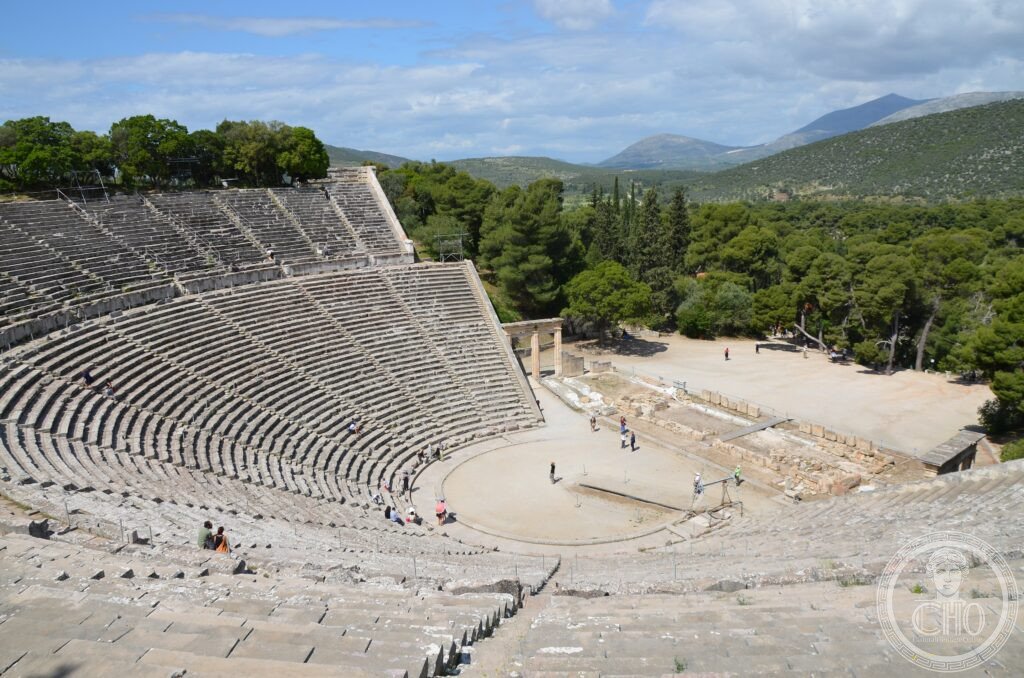
The most acoustically perfect theatre of the ancient world and the most important healing sanctuary of the Greek world — the Sanctuary of Asklepios at Epidaurus (Ἀσκληπιεῖον τῆς Ἐπιδαύρου) drew patients from across the Mediterranean to sleep in its sacred dormitory in hope of divine healing, while Polykleitos the Younger’s theatre (c. 340 BC, seats 14,000) achieves an acoustic precision so extreme that a pin dropped at the centre of the circular orchestra can be heard in the highest row 55 metres away, a phenomenon still not fully explained by modern acoustic science.
At a glance
The Sanctuary of Asklepios at Epidaurus (not to be confused with the separate ancient city of Epidaurus on the Saronic Gulf coast, 10 km north-east) is in the mountains of the Argolida peninsula of the Peloponnese, 30 km south-west of Nafplio (the nearest major town) and 150 km south-west of Athens. The UNESCO site (inscribed 1988) covers the complete sanctuary complex including the theatre, the abaton/enkoimeterion (sacred dormitory for healing incubation), the temple of Asklepios, the tholos (circular building), the stadium, the gymnasion, and the katagogion (guest house). The theatre alone justifies the journey for any visitor interested in ancient architecture, drama, or acoustics; the annual Epidaurus Festival (Greek National Theatre, late June–August) uses the theatre for performances of Greek tragedy and comedy in the original language that are among the most atmospheric cultural events in Europe.
Key facts
- The Theatre (Polykleitos the Younger, c. 340 BC): the greatest surviving theatre of antiquity and the model for every study of ancient theatrical performance — designed by the Argive sculptor-architect Polykleitos the Younger (son of the famous sculptor Polykleitos, author of the Doryphoros and the Diadoumenos), the theatre was built into the natural slope of a hillside in the Sanctuary precinct; the original theatre (c. 340 BC) had 34 rows of seats and seated approximately 6,200; it was enlarged in the 2nd century BC by the addition of 21 further rows (the upper cavea), raising the capacity to approximately 14,000; the orchestra (the circular playing area, 20.28 metres in diameter, the original dancing-floor from which “theatre” derives its name) is defined by a ring-channel of Poros limestone; the acoustics of the theatre are measurably superior to any other ancient Greek theatre and are the subject of ongoing acoustic research: a 2007 study by Georgia Tech researchers proposed that the rows of limestone seats function as acoustic filters, selectively reflecting high-frequency sound (speech, music) while absorbing low-frequency background noise (wind, crowd rustles); subsequent research disputes and refines this, but no complete acoustic model yet accounts for all the observed phenomena; the theatre is remarkably intact (the limestone seating is approximately 85% original Greek stonework; the stage building and skene have been partially reconstructed for modern use)
- Healing incubation and the Abaton: the defining practice of the Asklepion sanctuary — patients (called “suppliants”) who came to Epidaurus for healing underwent a ritual of purification (bathing, fasting, prayer) before sleeping in the abaton (the sacred dormitory, a long portico-building of two stories on the north side of the sanctuary) in hope of receiving a divine healing dream in which Asklepios appeared and prescribed or performed the cure; hundreds of stelae (stone slabs inscribed with accounts of cures, the iamata, “cures”) were set up at the sanctuary to record successful healings — they are the most detailed body of evidence for ancient medical practice and religious healing in the classical world; the cures described range from the miraculous (blind men restored to sight; paralysed men who walked) to the prosaic (a woman cured of headache) to the comic (a man cured of worms after dreaming a boy was sitting on his chest)
- Tholos of Polykleitos (c. 360–320 BC): the most complex and architecturally refined circular building in the ancient Greek world — the tholos (also called the thymele, the altar, though its exact function is disputed) was a concentric rotunda approximately 22 metres in diameter with 26 Corinthian columns on the exterior and 14 Corinthian columns on the interior (the earliest monumental use of the Corinthian column order in mainland Greece); beneath the tholos, three concentric circular corridors wind underground in a labyrinth-like pattern (the purpose is debated: a snake-pit for the sacred snakes of Asklepios? the actual burial place of Asklepios? a symbolic representation of the descent to the underworld? no consensus has been reached); the carved decorative elements of the tholos (the ceiling coffers, the Corinthian capitals, the door frames) were the most expensive and precisely carved elements of the entire sanctuary, suggesting the building was of exceptional ritual importance; the tholos is largely ruined, with scattered elements around the central area of the sanctuary
- The Epidaurus Festival (Φεστιβάλ Επιδαύρου): the annual festival of ancient Greek drama performed in the original theatre — established in 1954 by the Greek National Theatre under Dimitris Rondiris, the Epidaurus Festival runs from late June to late August, with performances on Friday and Saturday evenings; the National Theatre of Greece performs ancient tragedy (Sophocles, Euripides, Aeschylus) and comedy (Aristophanes) in modern Greek translation, with occasional original-language performances; international theatre companies (from Germany, UK, France, Italy) are invited in alternating years; attendance typically 13,000–14,000 per performance (the theatre fills completely), with audience members arriving at sunset and the performance concluding after midnight under the Peloponnese stars; this is one of the great open-air performance experiences in Europe
- Heritage: UNESCO World Heritage Site, Sanctuary of Asklepios at Epidaurus, inscribed 1988
- GPS: 37.5963° N, 23.0764° E
History
The sanctuary of Asklepios at Epidaurus grew from a much older cult of Apollo Maleatas on the hill above the sanctuary (known and active from the 8th century BC); Asklepios (the son of Apollo and the mortal Coronis, raised by the centaur Chiron and trained as a healer) gradually assumed primary importance over his father at this site during the 6th century BC; by the 5th century BC, Epidaurus was the most important Asklepion in the Greek world (a network of healing sanctuaries spread from here to Athens, Kos, Pergamon, and Rome); the 4th century BC was the great building period of the sanctuary (the theatre of Polykleitos the Younger, the tholos, the new temple of Asklepios, and the abaton all date from this period); the Sanctuary continued to function under Roman rule (several emperors, including Antoninus Pius, funded new buildings) until it was sacked by Sulla in 87 BC and again by Alaric’s Visigoths in 396 AD; the Christian community at Epidaurus gradually converted or suppressed the pagan sanctuary in the 4th–5th centuries AD; the theatre was buried by landslip and forgotten until 1881, when it was rediscovered and excavated by the Greek Archaeological Society under Panagiotis Kavvadias.
What you see
The standard visit sequence: park and museum (the small archaeological museum at the site entrance has the carved elements from the tholos and the temple of Asklepios, including the finest surviving Corinthian capitals in Greece from the tholos — allow 30 min) → the sanctuary precinct (the temple of Asklepios foundations, the abaton, the tholos ruins, the katagogion foundations, all in the central valley — 20 min walk) → the theatre (a 5-min walk up the slope from the sanctuary precinct; arrive from the top for the panoramic view of the cavea before descending to the orchestra to test the acoustics; drop a coin in the dead centre of the orchestra — the guide will mark it for you — and listen from the 55th row; the acoustics are genuinely supernatural, and seeing other tourists’ reactions when they first hear a whisper from 70 metres below is one of the rare unreplicable experiences in archaeology tourism).
The theatre is best experienced at a performance of the Epidaurus Festival (July–August): buy tickets in advance from the Greek National Theatre website (hellenicfestival.gr); the cheapest seats (upper cavea) are often the best acoustically; arrive at least 1 hour early for the parking and the pre-performance atmosphere; bring a sweater (temperatures drop after midnight in the hills even in August); the drive back to Athens (150 km) takes 2h on the Athens-Corinth motorway, or stay overnight in Nafplio.
Practical information
- Admission: approximately €12 (summer); combined ticket with the ancient city of Epidaurus (on the coast, 10 km away) approximately €20; the Epidaurus Festival tickets range from approximately €15 (upper cavea, standing) to €50 (reserved numbered seats in the lower cavea); museum card valid for the archaeological museum
- Getting there: Athens International Airport (ATH) is 150 km east (2h by car on the Athens-Corinth motorway A8 then the Nafplio road via Epidaurus); by public bus: KTEL buses from Athens (Kifissos Terminal A) to Nafplio (2h 30 min, approximately €15; 6 per day), then taxi or local bus from Nafplio to Epidaurus (30 km, 45 min by taxi approximately €30, or KTEL local bus 3x/day in summer); the festival bus (run by the Hellenic Festival on performance nights) departs from Athens Syntagma Square to the theatre and returns after the performance — the single most convenient option for festival-goers; by car from Athens 150 km south-west on the Corinth motorway (A8) to Epidaurus junction, then 30 km on the local Epidaurus road; from Nafplio 30 km west (35 min); from Corinth 50 km south (50 min)
- The Argolida circuit: the Epidaurus sanctuary is best combined with Nafplio (the most beautiful small city in Greece, capital of the Argolida peninsula, with a Venetian fortress and Bavarian neoclassical architecture of the brief Greek kingdom period, 1828–1834, when it was the capital of modern Greece) and Mycenae/Tiryns (the UNESCO WHS Mycenaean sites, 30 km north of Nafplio on the road to Corinth)
Getting there
Athens Airport (ATH): 150 km (2h by car). By car from Nafplio (30 km, 35 min). Festival bus from Athens Syntagma on performance nights. GPS: 37.5963, 23.0764.
Nearby
- Nafplio (Nauplia) — 30 km east of Epidaurus (35 min by car); the most beautiful small city in Greece — the Venetian-Bavarian capital of the first modern Greek state (1828–1834, with the Palamidi fortress visible from everywhere, built by the Venetians in 1711; the old town preserves the neoclassical architecture of the brief Bavarian kingdom with Bougainvillea-covered balconies, marble-paved pedestrian alleys, and the harbour-front cafés looking over the Bourtzi islet fortress in the middle of the bay; the Archaeological Museum (housed in an 18th-century Venetian warehouse) contains the bronze armour from the Mycenae shaft graves)
- Mycenae (Mykines) — 50 km north of Epidaurus (55 min by car, via Nafplio); the citadel of Agamemnon, the most dramatic Bronze Age site in Greece (UNESCO WHS 1999) — the Lion Gate (the monumental entrance of the citadel, 1250 BC, the oldest monumental sculpture in Europe and the only one surviving in situ from the Bronze Age Aegean), the shaft graves of Circle A (where Schliemann in 1876 discovered the gold funeral masks including the famous “Mask of Agamemnon”, now in the National Archaeological Museum Athens), and the Treasury of Atreus (also called Tomb of Agamemnon: a tholos tomb of 1250 BC with the largest corbelled dome in the ancient world before the Pantheon — 13.5 metres in diameter and 13.2 metres high, built without mortar or keystone by stacking progressively-corbelled rings of stone); the on-site museum (2003, architecturally excellent) displays the Mycenaean finds in their site context
- Corinth (ancient Korinthos) — 50 km north of Epidaurus (1h by car); the ancient city of Corinth was one of the wealthiest and most cosmopolitan cities of the ancient Greek world — the seven columns of the Doric Temple of Apollo (550 BC, the best-preserved archaic Doric temple in mainland Greece, older than the Parthenon by 100 years) stand above the archaeological site; the Bema (the platform from which St Paul addressed the Corinthians on his second missionary journey, c. 51 AD; mentioned in Acts 18:12) is a flat stone platform in the middle of the Roman forum; the museum (1932, one of the oldest site museums in Greece) contains impressive mosaics and a reconstructed Roman kitchen; above the town, the Acrocorinth (the citadel hill, 575m, with medieval walls built on ancient foundations, the most impressive citadel in the Peloponnese) has panoramic views from the Saronic Gulf to the Corinthian Gulf
Sources
- Wikipedia, Theatre of Epidaurus; Epidaurus; Asklepeion; Epidaurus Festival, accessed June 2026
- UNESCO, Sanctuary of Asklepios at Epidaurus, WHS reference 491, inscribed 1988
- N. Nico Declercq and Cindy Dekeyser, “Acoustic Diffraction Effects at the Hellenistic Theater of Epidaurus”, Journal of the Acoustical Society of America 121(4), 2007
- Rudolf Herzog, Wunderheilungen und Traumorakel aus Epidauros (the iamata stelae), Teubner, 1931
Find it on the map
See this place and what’s around it →📷 Become a Cultural Heritage Online photographer
Share your photos of places: they stay published under your name as the author. The more they're seen, the more you get noticed — and soon a contest will reward the most appreciated photos.
Log in or sign up free to add a photo