
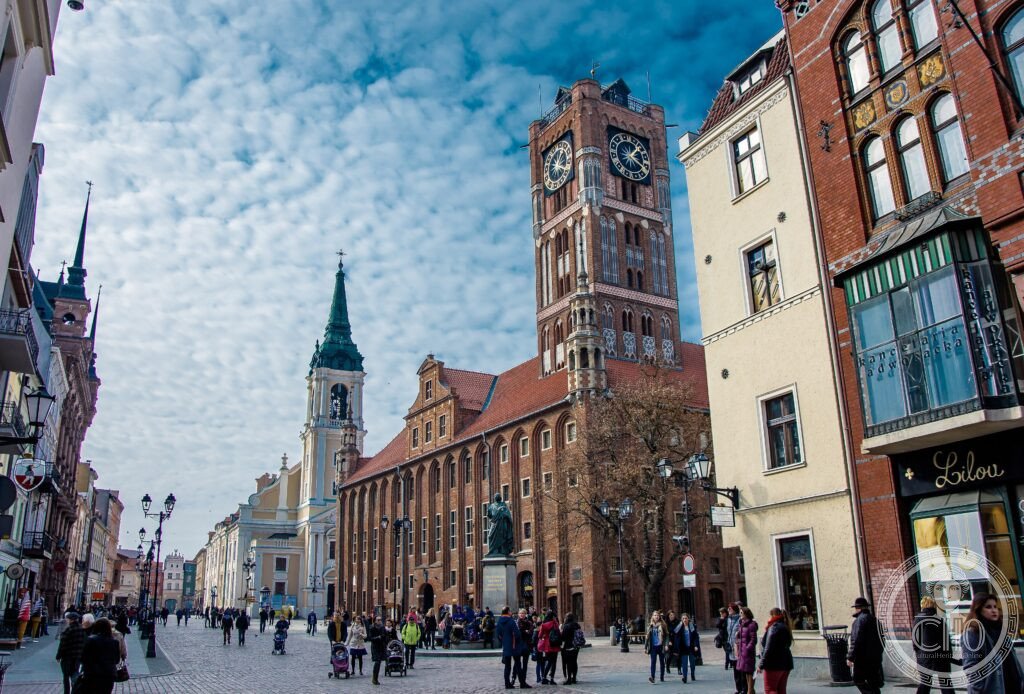
The city of Copernicus and gingerbread, and the finest surviving medieval Hanseatic city in Poland. Toruń (German: Thorn, the name by which it was long known in western Europe) was founded on the south bank of the Vistula River in 1231 by the Teutonic Knights as their first stronghold in Prussia, grew as one of the most important Hanseatic trading cities of the Baltic hinterland, was the site of the two Peace of Thorn treaties (1411 and 1466, the documents that shaped the political geography of Central Europe), and was the birthplace on 19 February 1473 of the astronomer Nicolaus Copernicus (Mikołaj Kopernik), who placed the sun at the centre of the solar system and changed the human understanding of the universe.
At a glance
Toruń (population approximately 198,000) is the capital of the Kuyavian-Pomeranian Voivodeship of north-central Poland, on the Vistula River approximately 200 km north-west of Warsaw and 170 km south of Gdańsk. The historic centre consists of two adjacent medieval towns (the Old Town and the New Town, both founded in the 13th century by the Teutonic Order) that have retained their original street grids, their brick Gothic church towers, and many of their patrician brick townhouses. UNESCO inscribed the Medieval Town of Toruń in 1997 as a rare example of the complete planned medieval town type used by the Teutonic Knights in their conquest of the Baltic, citing the intact street fabric, the quality of the Gothic civic architecture, and the city’s unique role as the site of the treaties that ended the Teutonic Knights’ power in the Baltic.
Key facts
- Ratusz Staromiejski (Old Town Hall, 1391–1399): the most important Gothic civic building in Poland and one of the finest Gothic secular buildings in Central Europe. Built by the merchants of the Old Town of Toruń between 1391 and 1399 on the site of a previous market hall, the Old Town Hall is a massive brick Gothic structure of three wings around an internal courtyard, with a 40-metre square corner tower (the “watchtower”, added in the 15th century) that gives the building its distinctive silhouette. The building measures 52 x 60 metres, making it one of the largest medieval town halls in the Polish-Lithuanian Commonwealth. The six great cross-vaulted rooms of the ground floor (formerly used as market stalls, now as exhibition spaces of the Muzeum Okręgowe Toruniu, the Regional Museum of Toruń) and the council chamber on the first floor are the finest Gothic civic interiors in Poland. The façade is a masterwork of North German Brick Gothic ornament, with blind tracery, decorative friezes, and the distinctive stepped gable silhouette of the Hanseatic tradition.
- Birthplace of Copernicus (Nicolaus Copernicus, 1473–1543): the most significant scientific birthplace in Poland and one of the most significant in Europe. Nicolaus Copernicus was born on 19 February 1473 in a merchant’s house at Kopernika 15/17 (the house with the red shutters, two buildings from the church of St John, in the Old Town) to a wealthy merchant family. The house is now the Copernicus Museum (Muzeum Mikołaja Kopernika), with a reconstruction of his study, a collection of early editions of De revolutionibus orbium coelestium (his epoch-making 1543 work proposing the heliocentric model of the solar system), and astronomical instruments of his period. Copernicus was baptised in the Cathedral of St John the Baptist and St John the Evangelist (Katedra ŚŚ. Janów) immediately adjacent to his birthplace house. The equestrian statue of Copernicus in the Old Market Square (Rynek Staromiejski, 1853, by Friedrich Tieck) is the primary landmark of the square and the most reproduced image of Toruń. Copernicus spent his formative years in Toruń before moving to Kraków University (1491) and then to Italy (1496–1503). He spent his adult life in Frombork (on the Baltic coast, 180 km north of Toruń) where De revolutionibus was completed and where he died in 1543.
- Pierniki (Toruń Gingerbread): the most famous food product of Toruń and one of the oldest culinary traditions in Poland. Toruń gingerbread (Piernik Toruński, protected geographical indication “Katarzynka Toruńska” and “Piernik Toruński”) has been made in the city continuously since at least the 14th century (the earliest documentary evidence of gingerbread production in Toruń is 1380). The traditional recipe uses honey, gingerbread spice (a blend of pepper, cinnamon, cloves, cardamom, and anise), flour, and eggs, baked in carved wooden moulds to produce the characteristic flat gingerbread figures (figures of the Copernicus statue, of a knight, of a fish — the Toruń fish shape, known as Katarzynka, is the most traditional form). The Muzeum Toruńskiego Piernika (Gingerbread Museum, Rabiańska 9) is a living museum where visitors bake their own gingerbread in historical moulds using period methods. A 90-minute hands-on experience that is the most popular family attraction in Toruń. Copernicus and gingerbread are the twin emblems of the city.
- Teutonic Castle ruins and the Treaties of Thorn: the ruined castle of the Teutonic Knights on the Vistula bank (the castle was demolished by the citizens of Toruń in 1454 immediately after the Peace of Thorn ended the Thirteen Years’ War and expelled the Order from the city) and the two Peace of Thorn treaties that defined the political order of the Baltic: (1) First Peace of Thorn (1411, signed in the Old Town Hall following the Polish-Lithuanian victory at the Battle of Grunwald in 1410, which broke the military power of the Teutonic Knights but did not end their territorial control). (2) Second Peace of Thorn (1466, which definitively ended the Teutonic Knights’ rule of West Prussia, ceding Gdańsk Pomerania and Toruń to the Polish Crown, one of the most significant territorial adjustments in medieval Central European history). The ruins of the Teutonic Castle (on the Vistula waterfront, east of the old town, demolished to the foundations by the citizens in 1454 as an act of political statement — only the western wing survives to 1st storey height) are now an archaeological museum and the site of evening medieval shows in summer.
- Heritage: UNESCO World Heritage Site, Medieval Town of Toruń, inscribed 1997.
- GPS: 53.0139° N, 18.5986° E.
History
The Teutonic Knights (the Deutsche Orden, a crusading military order of German knights formed during the Crusades) built their first castle on the south bank of the Vistula at Toruń in 1231 as the base for their conquest and Christianisation of the pagan Baltic Prussians. The Old Town of Toruń was founded adjacent to the castle in 1233 and the New Town in 1264 (the two towns were formally separate legal and administrative entities, with separate market squares and separate governing councils, until their administrative merger in 1454). Both towns joined the Hanseatic League (the Old Town in 1280) and grew as important trading cities, exporting grain, amber, and wax from the Baltic hinterland to Flanders and England and importing cloth, salt, and manufactured goods in return. The decisive moment in Toruń’s history was the Thirteen Years’ War (1454–1466) in which the Prussian Confederation (an alliance of Prussian cities and nobles, including Toruń) invited the Polish Crown to take them under its rule and expelled the Teutonic Knights. The Second Peace of Thorn (1466) settled the conflict in Poland’s favour, making Toruń a Polish royal city for the following three centuries (1466–1772). The First Partition of Poland (1772) made it Prussian and it remained German-administered (as “Thorn”) until 1918 when it returned to the newly independent Polish state under the Treaty of Versailles.
What you see
The old town circuit is walkable in 2–3 hours. Entry point: the Old Market Square (Rynek Staromiejski) with the Copernicus statue and the Old Town Hall (the single most important architectural space in Toruń; enter the Regional Museum for the Gothic interior). Copernicus Museum (Kopernika 15/17, immediately north-east of the market square). Cathedral of St John the Baptist and St John the Evangelist (Gothic, 13th–15th century, where Copernicus was baptised; the church tower is the second-tallest medieval brick tower in Poland after Gdańsk’s St Mary’s). New Town Square (Rynek Nowomiejski, immediately east of the Old Town, with a different scale and character: more intimate, with the Church of the Holy Spirit and the Dominican monastery). Teutonic Castle ruins (Vistula waterfront, south side, with the museum and summer medieval events). Vistula promenade (the north waterfront, with views across the river to Bydgoszcz County and the town of Bielany on the opposite bank). Gingerbread Museum (Rabiańska 9, worth a 90-minute visit for the baking workshop).
Practical information
- Admission: Old Town Hall Regional Museum approximately 16 PLN (€3.50). Copernicus Museum approximately 14 PLN. Teutonic Castle ruins (outdoor site) approximately 8 PLN. Cathedral of St John free (small donation box). Gingerbread Museum workshop approximately 40 PLN (advance booking recommended at weekends). New Town Market Square free. Vistula promenade free. The best single-ticket deal is the combined ticket covering the Regional Museum, Copernicus Museum, and Teutonic Castle (approximately 35 PLN).
- Getting there: Toruń Główny (main railway station) is on the south bank of the Vistula, connected to the old town (north bank) by the Adam Mickiewicz Bridge (15 min walk across the bridge, scenic route) and by city bus (bus 22, 10 min). Direct PKP Intercity trains from Warsaw Centralna (2h 30 min, approximately 40–60 PLN advance booking). Direct trains from Gdańsk (1h 45 min, approximately 40–50 PLN). Direct trains from Poznań (1h 45 min, approximately 35–50 PLN). From Warsaw by car 200 km north-west on the A1 motorway (2h 15 min). The Copernicus Airport Bydgoszcz (BZG) is 45 km south-west of Toruń (40 min by car; connections from London Stansted, Dublin, Brussels with Ryanair). Toruń has good quality mid-range hotels within and adjacent to the old town.
- The Copernicus connection: Toruń forms the western anchor of a Copernicus heritage circuit that begins at his birthplace of 1473. Next is Lidzbark Warmiński (Heilsberg), 120 km north-east, where Copernicus served the Bishop of Warmia as his personal physician; the Bishop’s Castle, one of the finest Gothic castles in the Baltic, is the setting for the beginning of De revolutionibus. Last is Frombork (Frauenburg), where Copernicus spent most of his adult life as a canon of the Warmia Chapter and where he died in 1543. The Cathedral of Frombork, on a hill above the Vistula Lagoon, was both his workplace and his burial place; his tomb beneath the main altar was identified by DNA testing in 2005 and a new tombstone placed by the Polish Church in 2010.
Getting there
Train from Warsaw (2h 30min), Gdańsk (1h 45min), Poznań (1h 45min). Bydgoszcz Airport (BZG): 45 km, 40 min (Ryanair from London/Dublin). By car from Warsaw (2h 15min, A1). GPS: 53.0139, 18.5986.
Nearby
- Malbork Castle. 130 km north of Toruń (1h 30 min by car, or 2h by train via Bydgoszcz/Gdańsk). The largest Gothic castle in the world by land area (21 hectares of floor space) and the best-preserved medieval castle complex in Central Europe (UNESCO WHS 1997). The Marienburg Castle (German: Burg Marienburg) was the headquarters of the Teutonic Order from 1308 (after the Order moved from Venice) until 1457 (when they were expelled after the Second Peace of Thorn). The three concentric castles (the High Castle, the Middle Castle, and the Outer Castle) form a complete self-contained fortified monastery-palace complex. The amber collection in the museum is the largest collection of Baltic amber in the world. The castle was severely damaged in 1945 (approximately 50% destroyed) and has been meticulously rebuilt over 70 years of Polish restoration work.
- Gdańsk (Danzig). 170 km north of Toruń (2h by direct train). One of the great European port cities. Although Gdańsk (German: Danzig) is not itself a UNESCO World Heritage Site (a surprising omission given its heritage quality), the Long Market (Długi Targ) and the Royal Way (Droga Królewska) constitute one of the most impressive postwar reconstruction achievements in Europe (the entire old city centre was approximately 90% destroyed in 1945 and rebuilt in meticulous replica of the 17th-century Hanseatic mercantile architecture from 1948–1980). The Solidarity Movement and the beginning of the fall of Communism in Europe originated here (the Lenin Shipyard Strike of 1980, the Solidarność trade union, Lech Wałęsa). The European Solidarity Centre museum (2014, in a striking rust-Corten-steel building adjacent to the shipyard gate) is the most important museum of the Cold War’s end in Central Europe.
- Chełmno (Kulm). 40 km north-east of Toruń (35 min by car, 45 min by bus). The most intact small medieval Teutonic town in Poland. Chełmno (German Kulm) was the first city founded by the Teutonic Knights in Prussia (1233, the same year as Toruń Old Town) and the site of the Kulm Law (the basic legal charter granted to Teutonic-period towns that governed all the cities of the Order’s Prussian territory). The intact 13th-century city walls with 23 towers and gates are the most complete medieval fortification circuit in Poland. The 12th-century Romanesque collegiate church of the Assumption is the oldest stone church in the Teutonic domain. The old market square retains its 13th-century chessboard plan. The town has a population of 20,000 and the intimacy of a minor medieval city that never outgrew its medieval walls.
Sources
- Wikipedia, Toruń. Old Town Hall, Toruń. Nicolaus Copernicus. Toruń gingerbread, accessed June 2026.
- UNESCO, Medieval Town of Toruń, WHS reference 835, inscribed 1997.
- Zenon Hubert Nowak, Dzieje Torunia: Od początków po kres władzy krzyżackiej, Toruńskie Towarzystwo Naukowe, 1987.
- Owen Gingerich, The Book Nobody Read: Chasing the Revolutions of Nicolaus Copernicus, Walker & Co., 2004.
Find it on the map
See this place and what’s around it →
📷 Become a Cultural Heritage Online photographer
Share your photos of places: they stay published under your name as the author. The more they're seen, the more you get noticed — and soon a contest will reward the most appreciated photos.
Log in or sign up free to add a photo