
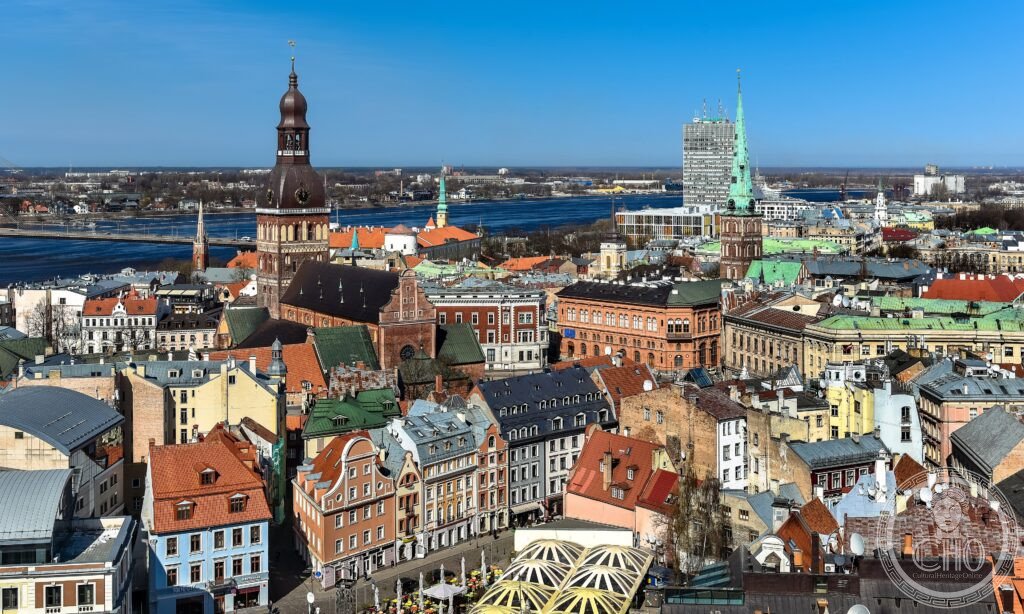
The largest and most intact Hanseatic merchant city in the Baltic region and the capital of what is sometimes called the “Art Nouveau City of the World”. Riga was founded in 1201 as the base for the German crusade to convert the Baltic pagans, grew into the most prosperous commercial city in the eastern Baltic as a member of the Hanseatic League, and at the turn of the 20th century was transformed by a wave of Art Nouveau and Jugendstil architecture so extensive (approximately 800 buildings, the largest concentration of Art Nouveau architecture of any city in the world) that it earned Riga its global reputation.
At a glance
Riga (population approximately 615,000; metropolitan area approximately 1.1 million) is the capital of Latvia, on both banks of the Daugava River approximately 15 km from the Baltic Sea, and the largest city in the Baltic States. Founded in 1201 by Albert of Buxhoeveden (Bishop of Livonia), the city became the headquarters of the Livonian Brothers of the Sword (the crusading military order that conquered the Baltic peoples) and subsequently a major Hanseatic trading port. UNESCO inscribed the Historic Centre of Riga in 1997. The inscription covers both the medieval old town (Vecrīga) and the 19th–20th-century Art Nouveau district (the “Quiet Centre”, Klusais centrs) of the adjacent Centrs district.
Key facts
- Art Nouveau district (Alberta iela and surroundings): the most concentrated collection of Art Nouveau architecture in the world. Approximately 800 Art Nouveau and Jugendstil buildings survive in Riga, mostly in the Centrs district (immediately east of the medieval old town), built between 1896 and 1913 during Riga’s industrial boom as the largest port in the Russian Empire. The most spectacular buildings are on Alberta iela (Alberta Street), Elizabetes iela, and Strēlnieku iela, designed primarily by the Latvian architect Mikhail Eisenstein (1867–1921 — father of the film director Sergei Eisenstein) whose extraordinarily ornate façades in the Eclectic Art Nouveau style (combining Jugendstil flower and female-face decoration with Classical pediments, Egyptian sphinxes, and Baroque putti) are the most exuberant examples of the style anywhere in Europe. The Riga Art Nouveau Museum (Alberta iela 12) occupies a Mikhail Eisenstein building exactly as it appeared in 1903.
- Riga Cathedral (Rīgas Doms, founded 1211): the largest medieval religious building in the Baltic States and the seat of the Archbishop of Riga. Founded in 1211 by Bishop Albert on the site of the first German settlement in Riga, the cathedral was built over 500 years in an accumulation of Romanesque, Gothic, and Baroque styles that reflects every major period of Baltic history. The cloister (approximately 1300, the oldest part of the cathedral complex) contains a lapidarium of medieval stone sculpture. The organ (1882–1884, by E.F. Walcker & Co. of Ludwigsburg) was the largest organ in the world when installed (today the 10th largest in Europe, with 6,768 pipes). The cathedral’s interior is remarkable for the scale of the Gothic nave (the widest in the Baltics) and the Baroque pulpit (1641, carved wood).
- Riga Castle (Rīgas pils, 1330, rebuilt 15th century): the seat of the Livonian Order of Knights and now the official residence of the President of Latvia. The current castle is largely a 15th–16th century reconstruction of the original 1330 fortification (the original was burned multiple times in the conflicts between the Order of Knights and the city burghers). The castle houses the National History Museum of Latvia, the National Art Museum, and the Presidential Office. The outdoor terrace on the Daugava River side gives one of the best views of the river and the old town.
- Three Brothers (Trīs brāļi): the oldest surviving residential buildings in Riga and a unique sequence of architectural periods in a single streetscape. Three medieval burgher houses at Mazā Pils iela 17, 19, and 21 form a continuous façade that spans four centuries of domestic architecture: No. 17 (“The White Brother”, the oldest stone dwelling house in Riga, built approximately 1490 in the late Gothic style — the only surviving example of a Gothic burgher house in Riga, now the Riga Architecture Museum), No. 19 (“The Yellow Brother”, 17th century Dutch Renaissance style), and No. 21 (“The Green Brother”, 18th century Baroque with Art Nouveau details added in 1900). The ensemble is the most complete illustration of Riga’s domestic architectural history in a single location.
- Central Market (Rīgas Centrāltirgus, 1924–1930): the largest market in the European Union and one of the greatest examples of interwar industrial repurposing. Built in five former Zeppelin hangars (used to house German military airships during World War I, transported from the airship station at Vaiņode to Riga after the war) and repurposed as a food market covering approximately 72,300 m². The five pavilions (meat, dairy, fish, vegetables, and general goods) are connected by a covered arcade and together form a market complex that serves approximately 80,000 customers per day. The hangars’ curved steel roofs are impressive structural achievements. The market is a UNESCO listed property within the Riga inscription.
- Heritage: UNESCO World Heritage Site, Historic Centre of Riga, inscribed 1997.
- GPS: 56.9460° N, 24.1059° E.
History
The site at the confluence of the Rīdzene stream and the Daugava River had been occupied by the Livonian (Baltic Finnic) people before German arrival. Bishop Albert of Buxhoeveden chose the site in 1201 for the German crusading stronghold in Livonia and received a papal charter from Pope Innocent III. The Sword Brothers (later absorbed into the Teutonic Knights as the Livonian Order) used Riga as their northern headquarters and the city grew rapidly as a Hanseatic trading member (joining the Hanseatic League in 1282) trading amber, furs, flax, and grain from the Russian hinterland via the Daugava river route for Flemish cloth, salt, and manufactured goods from western Europe.
Riga passed successively under Polish-Lithuanian (1581), Swedish (1621), and Russian (1710, in the Great Northern War) rule. The Russian period was the most transformative economically. Riga became the largest port of the Russian Empire (surpassing St Petersburg) by 1900, with a population that grew from 80,000 in 1867 to 500,000 in 1913 (making it the fourth largest city in the Russian Empire after Moscow, St Petersburg, and Warsaw). This explosive growth produced the extraordinary wave of Art Nouveau architecture (1896–1913) that is Riga’s most distinctive heritage. Latvian independence (1918–1940 First Republic; 1991 Second Republic after Soviet occupation) built on this architectural foundation.
What you see
The historic centre divides naturally into two complementary circuits: the medieval old town (Vecrīga) and the Art Nouveau Quiet Centre (Klusais centrs). Medieval circuit: Riga Castle terrace (river view). Three Brothers burgher houses (Mazā Pils iela). St James’s Cathedral (the smallest of the three old-town cathedrals, originally Catholic, seized by Lutherans in 1522 in one of the first acts of the Baltic Reformation). Riga Cathedral and cloister. Dome Square (Doma laukums, the main square in front of the cathedral). The Gothic Warehouse district (Mārstaļu iela, 13th–16th century stone warehouses). St Peter’s Church (lift to the tower observation deck, best panoramic view of the city). Town Hall Square (Rātslaukums, with the reconstructed medieval Town Hall and the House of Blackheads — rebuilt 1995 after destruction in World War II — originally built in 1334 as the guildhouse of the Brotherhood of Blackheads, a merchants’ fraternity).
Art Nouveau circuit (15 min walk from the old town): the essential walk is along Alberta iela, Elizabetes iela, and Strēlnieku iela in the Centrs district. The concentration of decorated façades is extraordinary. The Riga Art Nouveau Museum (Alberta iela 12, Mikhail Eisenstein, 1903) is the most accessible Art Nouveau interior in the city. The Latvian National Museum of Art (Valdemāra iela 10a, K.I. Pflug, 1905, Neo-Baroque) has the finest collection of Latvian painting and hosts the largest Baltic art collection in the world.
Practical information
- Admission: Vecrīga streets free. Riga Cathedral approximately €4. St Peter’s Church tower lift approximately €9. Riga Art Nouveau Museum approximately €8. Three Brothers (Riga Architecture Museum) free on Tuesdays. Central Market free entry. House of Blackheads approximately €8. Riga Card (24h/48h/72h, approximately €27/35/40) covers public transport and many museums. The Art Nouveau walking tour (many versions available, self-guided or guided — download the official Riga Art Nouveau walking route from the Riga Tourism Development Bureau website for free).
- Getting there: Riga International Airport (RIX). Direct flights from London Gatwick (3h, Ryanair), Amsterdam (3h, Ryanair/airBaltic), Paris CDG (3.5h, airBaltic), Frankfurt (3h, airBaltic/Lufthansa), Helsinki (1h, Finnair/airBaltic). AirBaltic is the national carrier and hub airline at Riga. The airport is 10 km south-west of the city centre. Bus 22 from the airport to the old town (30 min, €1.15) or taxi approximately €12 (15 min). By train from Vilnius (4.5h), Tallinn (4.5h by daily direct train), Warsaw (8h).
- Baltic Triangle: Riga is the central point of the Baltic states triangle. Tallinn (Estonia, 4.5h by direct train or 5h by bus; UNESCO WHS 1997 old town, the best-preserved medieval Hanseatic city in the Baltics) is to the north, Vilnius (Lithuania, 4.5h by bus; UNESCO WHS 1994 old town, the finest Baroque city in the Baltics, with its extraordinary concentration of Jesuit Baroque churches) is to the south. The Baltic states bus network (FlixBus, Lux Express, Ecolines) makes the Riga-Tallinn-Vilnius circuit feasible in 2-3 days with a morning departure from each city. The three cities’ UNESCO inscriptions together represent the full arc of Baltic architectural history from medieval to Baroque.
Getting there
Riga Airport (RIX): 10 km from centre. Bus 22 (30 min, €1.15). Flights from London (3h), Amsterdam (3h), Frankfurt (3h). GPS: 56.9460, 24.1059.
Nearby
- Jūrmala. 25 km west of Riga (25 min by suburban train, frequent services from Rīgas Centrālā stacija). The principal Baltic Sea resort of Latvia and the former summer retreat of the Russian and Latvian elites. A linear resort town of 32 km of pine forest, white sand beach, and wooden Art Nouveau and eclectic summer villas (dāčas) along the Baltic shore. The wooden resort architecture of Jūrmala (late 19th–early 20th century, in a distinctive Latvian folk-national style with carved wooden decorations and coloured paintwork) has been compared to the wooden dacha culture of Finnish and Estonian Baltic resorts. The open-air concert venue at Jūrmala (the Dzintari Concert Hall, 1936, rebuilt 1960) hosts the annual Jūrmala Song Festival.
- Sigulda and the Gauja National Park. 50 km north-east of Riga (45 min by train). The most spectacular natural landscape in Latvia. The ancient valley of the Gauja River (up to 90 m deep, carved through Devonian sandstone, with the steepest cliffs in the Baltics) contains three medieval castle ruins (Turaida, Cēsis, and the Livonian Order castle of Sigulda, partially inhabited as a manor house until 1917) and extensive limestone cave systems. The Turaida Castle museum (12th century, Latvian folk hero Maija of Turaida is buried in the grounds) is the most visited non-Riga heritage site in Latvia.
- Rūndale Palace. 75 km south of Riga (1h 15 min by bus from Riga bus terminal). The finest Baroque palace in the Baltic States. Built 1736–1740 by Bartolomeo Rastrelli (the same architect who designed the Winter Palace in St Petersburg and the Catherine Palace at Tsarskoe Selo) for Ernst Johann von Biron (Duke of Courland, the favourite of the Russian Empress Anna Ioannovna). The palace (76 rooms, with painted ceilings by Francesco Martini, gilded woodwork, and formal French gardens) is the largest Baroque ensemble in Latvia and has been restored over the past four decades to approximately 80% of its original condition.
Sources
- Wikipedia, Riga. Art Nouveau in Riga. Mikhail Eisenstein. Riga Cathedral, accessed June 2026.
- UNESCO, Historic Centre of Riga, WHS reference 852, inscribed 1997.
- Jānis Krastiņš, Rīgas jūgendstils, Zinātne, 1980 (the standard reference on Riga Art Nouveau).
- Ineta Lipša, History of Riga, University of Latvia Press, 2014.
Find it on the map
See this place and what’s around it →
📷 Become a Cultural Heritage Online photographer
Share your photos of places: they stay published under your name as the author. The more they're seen, the more you get noticed — and soon a contest will reward the most appreciated photos.
Log in or sign up free to add a photo