

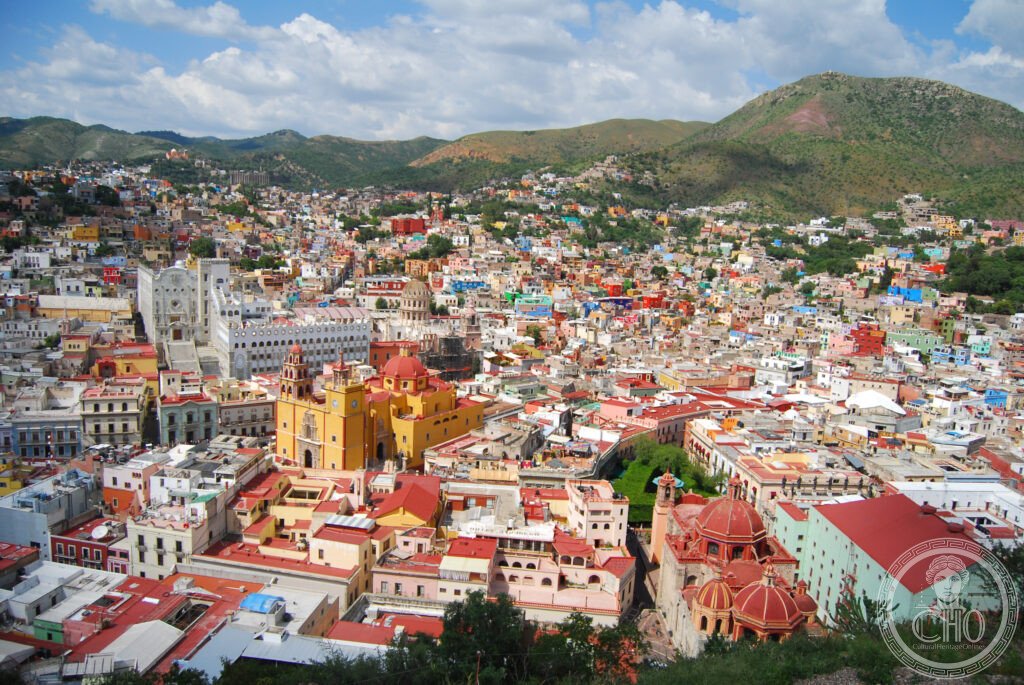
The most visually dramatic colonial city in Mexico. Built entirely in a mountain valley and ravine so narrow that its streets have no grid and instead follow the course of a seasonal river, with the houses stacked on the valley walls five and six floors above street level. Once the source of approximately one-third of all the silver in the world (the Valenciana and Rayas mines, active 1558–present), it is also the cradle of Mexican independence and the home of the world’s oldest and most celebrated theatre festival.
At a glance
Guanajuato (Nahuatl: Quanaxhuato, “Place of Many Frogs”; a reference to the shape of the nearby hills as seen from the plain) is the capital of Guanajuato State, central Mexico, at 2,040 m altitude in the Sierra Gorda mountains of the Bajío region, 380 km north-west of Mexico City. The city was founded as a silver-mining settlement in 1548, one year after the discovery of silver at Zacatecas. By the 18th century it was producing approximately one-third of the world’s silver supply and was the wealthiest city in New Spain. The historic centre (the UNESCO Heritage zone) is characterised by its compressed valley topography. The streets follow the curves of the dry Guanajuato River valley (now a subterranean road system underground), the houses are stacked on the valley walls, and the panoramic mirador views from the surrounding hills look down on a dense carpet of colonial buildings in yellow, ochre, pink, and burgundy. UNESCO inscribed the Historic Town of Guanajuato and its adjacent mines in 1988.
Key facts
- The Valenciana Mine: the most productive silver mine in human history. Active from 1558 to the present (the mine’s principal shaft is still in operation for gold and silver). At its production peak in the 18th century, the Valenciana produced approximately two-thirds of the world’s silver. The shaft descends approximately 600 metres. The adjacent church of San Cayetano de la Valenciana (built 1765–88, Churrigueresque Baroque, paid for by the mine’s owner Antonio de Obregón y Alcocer, first Count of Valenciana) is the finest single Baroque monument in Guanajuato and one of the greatest Churrigueresque buildings in Mexico. The facade is covered to the top of its twin towers with carved stone ornament of extreme density and complexity, financed by the count’s silver fortune.
- The callejones (alleyways): the defining spatial experience of Guanajuato. The old city has no proper street grid because it was built in a valley too narrow for one. The result is a system of callejones (alleys) that wind between houses at different levels, connected by stairs. The most famous is the Callejón del Beso (“Alley of the Kiss”), a 68-cm-wide passage between two colonial houses whose second-floor balconies are close enough to touch. The romantic legend attached to the alley (a pair of star-crossed lovers could only meet on their respective balconies, but the alley was too narrow for them to do more than kiss over the 68-cm gap) has made it the most photographed alley in Mexico. It is traditional to kiss in the alley for good luck (according to which step you kiss on).
- The Battle of Alhóndiga de Granaditas (1810): the first significant military victory of the Mexican War of Independence. The colonial grain warehouse (Alhóndiga de Granaditas) was used by the Spanish colonial militia of Guanajuato as a fortress against the insurgent force of Father Miguel Hidalgo’s army (which had been growing since the Grito de Independencia on 16 September 1810 in nearby Dolores Hidalgo). A young miner known as “el Pípila” (José de los Reyes Martínez Amaro) strapped a flat stone to his back as protection against Spanish fire and crawled to the wooden door of the Alhóndiga to set it alight, allowing Hidalgo’s army to enter. The battle was followed by a massacre of the Spanish and Creole defenders. The Alhóndiga is now the Museo Regional de Guanajuato Alhóndiga de Granaditas. The severed heads of Hidalgo and other independence leaders (executed 1811) were displayed on its four corners for ten years after their deaths, as a warning.
- The Cervantino Festival: the world’s largest theatre and performing arts festival focused on the works of Cervantes. The Festival Internacional Cervantino has been held annually in Guanajuato every October since 1972. It grew from a tradition of staging the Entremeses (one-act comedies) of Miguel de Cervantes in the city’s plazas by the University of Guanajuato theatre company. The festival now brings approximately 900 performances by companies from 50+ countries to the city’s theatres, streets, plazas, and mirador stages over 17 days. Approximately 100,000 international visitors attend annually. Guanajuato’s combination of outdoor theatre venues (the Plaza San Roque, the Plazuela de los Ángeles) with its university intellectual tradition made it the natural home for the festival.
- Diego Rivera birthplace: the painter Diego Rivera (1886–1957 — the defining figure of the Mexican Muralist movement and one of the most significant artists of the 20th century) was born in Guanajuato. The Museo Casa Diego Rivera (the house where he was born and spent his childhood, on Calle Pocitos) preserves the original 19th-century interior with family furniture and a collection of his early and late paintings.
- Heritage: UNESCO World Heritage Site, Historic Town of Guanajuato and Adjacent Mines, inscribed 1988.
- GPS: 21.0190° N, 101.2574° W.
History
Silver was discovered at Guanajuato in approximately 1548, one year after the major discoveries at Zacatecas. The settlement grew rapidly as independent mine operators (unlike Potosí, which was state-controlled under the Potosí mita, Guanajuato’s mines were operated by private entrepreneurs who competed vigorously for labour and investment) opened new shafts and processing mills along the valley. By the 1720s the Valenciana Mine under the Count of Valenciana was the single most productive mine in the world. The Valenciana Mine alone financed the construction of approximately half the churches and public buildings in the city during the 18th century. Guanajuato was, briefly, the wealthiest city in the Americas.
The city’s role in the Mexican War of Independence (1810–21) was foundational: the Grito de Independencia (the declaration of independence) was made by Father Hidalgo in nearby Dolores Hidalgo on 16 September 1810. The Battle of the Alhóndiga (28 September 1810) was the first major military confrontation. The independence movement swept the Bajío region before being suppressed at the Battle of Calderón Bridge (January 1811). The independence leaders’ heads were displayed on the Alhóndiga for a decade. Mexican independence was finally achieved in 1821. Guanajuato became the state capital. The silver mines declined through the 19th century (due to flooding, the disruption of the independence wars, and the exhaustion of the richest veins) but never completely stopped. Today the region produces gold, silver, and zinc from both historic and modern mines.
What you see
The historic centre is compact (the entire walking circuit of the principal monuments fits within 2 km) and best approached from the Jardín de la Unión. The main plaza, a triangular garden with wrought-iron benches and a bandstand, flanked by the Teatro Juárez (an 1896 Neoclassical opera house that contrasts dramatically with the colonial surroundings) and the Templo de San Diego (18th-century Churrigueresque). The circuit typically covers: the Jardín de la Unión. Callejón del Beso. Alhóndiga. Basílica de Nuestra Señora de Guanajuato (the second-oldest church in Mexico, with a 7th-century image of the Virgin that was sent to Guanajuato by King Philip II in 1557 as a gift). Universidad de Guanajuato (the white Neo-Churrigueresque facade of 1955 that dominates the central city view). Mercado Hidalgo (1910 market hall, now a handicraft market).
The panoramic views of Guanajuato from above are essential. The Pípila Monument (with a mirador) is accessible by funicular from near the Jardín de la Unión (approximately MXN 40 return). The view from the monument terrace gives the full compressed valley panorama that is the definitive image of Guanajuato. An evening walk through the callejones by lamplight is one of the most atmospheric experiences in Mexico.
Practical information
- Admission: historic streets and plazas free. Museo Regional Alhóndiga de Granaditas approximately MXN 80 (about €4). Teatro Juárez MXN 25 for interior visit. Museo Casa Diego Rivera MXN 30. Most churches free. The underground road system (subterráneo, the former riverbed) is open for pedestrians at no charge. The funicular to the Pípila MXN 40–50 return.
- Getting there: the nearest airport is Del Bajío International Airport (BJX), in the industrial city of Silao, 30 km from Guanajuato (45 min by taxi, approximately MXN 600). Direct international flights from Houston (United Airlines), Dallas (American Airlines), Chicago (United), Los Angeles (VivaAerobus, Volaris), and domestic connections from Mexico City (1h), Cancún (2h), and Monterrey (1h). From Guanajuato bus station, taxis to the historic centre (cars cannot enter the narrow callejones of the historic core — the subterráneo tunnel road is the access for vehicles). .
- Circuit with Dolores Hidalgo and San Miguel de Allende: the standard central Mexico heritage circuit (3–4 days from Guanajuato) covers Dolores Hidalgo (50 km north, the “Cradle of Independence,” where Hidalgo rang his bell on 16 September 1810) and San Miguel de Allende (90 km east, a colonial city with an unusually large North American expat community, a famous art school, and the neo-Gothic Parroquia de San Miguel Arcángel whose pink stone silhouette is one of the iconic images of Mexico; UNESCO WHS 2008 jointly with Atotonilco).
Getting there
Del Bajío Airport (BJX, 30 km, 45 min taxi). Buses from Mexico City (4h), Guadalajara (3h). Vehicles enter via the underground subterráneo road. GPS: 21.0190, -101.2574.
Nearby
- San Miguel de Allende. 90 km east of Guanajuato. A perfectly preserved colonial city with a famous art school (Instituto Allende, founded 1938), a large North American expatriate community, and the iconic neo-Gothic Parroquia de San Miguel Arcángel (a 17th-century parish church given its current pink stone Gothic façade by the self-taught stonemason Ceferino Gutiérrez in the late 19th century, who designed it based on postcards of French Gothic cathedrals). UNESCO WHS 2008 (jointly with the Sanctuary of Jesús Nazareno de Atotonilco). The city’s concentration of galleries, design shops, restaurants, and cooking schools has made it Mexico’s most expensive real estate market.
- Dolores Hidalgo. 50 km north of Guanajuato. The “Cradle of National Independence”. The town where Father Miguel Hidalgo rang the bell of the parish church at 11 pm on 15 September 1810 (the Grito de Independencia, “Cry of Independence”) and gathered the first insurgent force of the independence movement. The church (Parroquia de Nuestra Señora de los Dolores, with its 18th-century Churrigueresque façade) and the Hidalgo Museum (in the priest’s former house) are the main monuments. The tradition of re-enacting the Grito on the night of 15 September is replicated in every Mexican city annually, with the President ringing the national bell in Mexico City from the balcony of the National Palace.
- Querétaro. 100 km south-east of Guanajuato. The colonial city (UNESCO WHS 1996) where the conspiracy that led to the Mexican War of Independence was organised (in the house of the Corregidora Josefa Ortiz de Domínguez, 1810). The aqueduct (1738–1738, 74 arches, 1.28 km long) and the well-preserved historic centre are the main attractions. Combined Guanajuato + San Miguel + Querétaro is the standard 4-day Bajío circuit.
Sources
- Wikipedia, Guanajuato. Valenciana Mine. Battle of Alhóndiga de Granaditas, accessed June 2026.
- UNESCO, Historic Town of Guanajuato and Adjacent Mines, WHS reference 482, inscribed 1988.
- Brígida von Mentz, Guanajuato colonial, El Colegio de Michoacán, 1996.
- INAH (Instituto Nacional de Antropología e Historia), Heritage Inventory of Guanajuato State, 2023.
Find it on the map
See this place and what’s around it →📷 Become a Cultural Heritage Online photographer
Share your photos of places: they stay published under your name as the author. The more they're seen, the more you get noticed — and soon a contest will reward the most appreciated photos.
Log in or sign up free to add a photo