
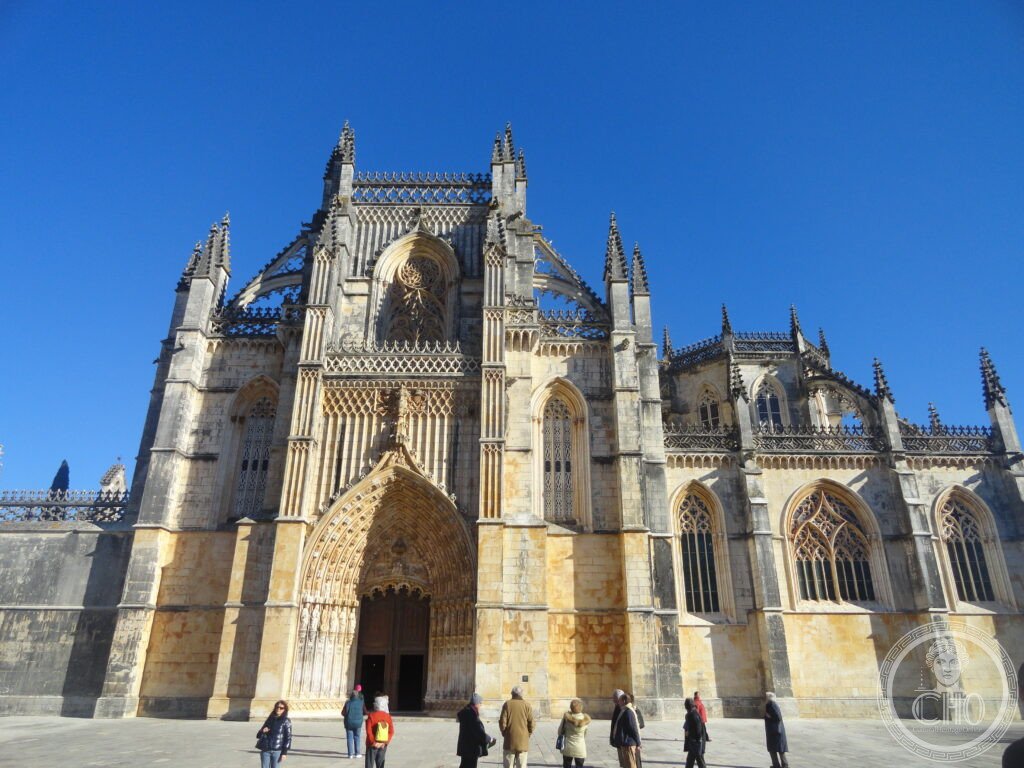
The most important Gothic building in Portugal — a Dominican monastery built as a vow by King João I to commemorate his decisive victory at the Battle of Aljubarrota (1385), which ended Castilian claims to the Portuguese throne and founded the Avis dynasty that would launch Portugal’s Age of Discovery; its construction over 130 years by five Portuguese architects traces the transition from International Gothic to the Manueline style (the distinctly Portuguese version of Late Gothic, saturated with maritime and colonial imagery) in a single building.
At a glance
The Mosteiro de Santa Maria da Vitória (Monastery of Saint Mary of Victory), known universally as Batalha (“Battle”), is a Dominican monastery in the town of Batalha, Leiria District, central Portugal, 120 km north of Lisbon. Construction began in 1386 under Master Afonso Domingues and continued with successive royal patronage through five monarchs (João I, Duarte, Afonso V, João II, and Manuel I) until approximately 1517; the monastery was never fully completed — the Royal Cloister (the Unfinished Chapels, begun 1434 for King Duarte, still open to the sky) remains incomplete to this day because the Manueline doorway is so elaborately carved that completing the chapels themselves seemed less important than preserving the doorway. UNESCO inscribed the Monastery of Batalha in 1983.
Key facts
- The Battle of Aljubarrota (1385): the battle that founded modern Portugal — a decisive Portuguese victory under João I (then Master of the military order of Aviz, not yet king) over Castilian forces more than twice the size of the Portuguese army (approximately 7,000 Portuguese vs. 20,000 Castilians plus their English, French, and Aragonese allies); the Portuguese longbowmen (many of them English allies) played a decisive role, similar to the English victories at Crécy and Agincourt; the victory confirmed João I as king and established the Avis dynasty that would rule Portugal through the Age of Discovery (1385–1580)
- The Founder’s Chapel (Capelas do Fundador): the octagonal chapel attached to the south of the main church, built as the burial place of João I and his family; the tombs of João I and his English queen Philippa of Lancaster (daughter of John of Gaunt, whose marriage alliance with England was the foundation of the Anglo-Portuguese Alliance of 1386, the oldest active treaty alliance in the world) lie at the centre of the chapel beneath a fan vault; their son Prince Henry the Navigator (Infante Dom Henrique, 1394–1460, the driving force behind Portugal’s initial Atlantic exploration) is also buried here
- The Manueline style: the later sections of Batalha (from approximately 1490, under the architect Mateus Fernandes and the patronage of King Manuel I) show the transition from International Gothic to the Manueline style — a distinctly Portuguese form of Late Gothic in which maritime imagery (ropes, coral branches, armillary spheres, anchors, and the Cross of the Order of Christ) is carved into the stone of portals, windows, and vaulting ribs; the doorway of the Unfinished Chapels (by Mateus Fernandes, c. 1509) is the purest example of Manueline architectural carving in existence
- The Tomb of the Unknown Soldier: two Portuguese soldiers killed in World War I (one on the Western Front, one in Africa) are buried in the Royal Cloister of Batalha; an honour guard of the Portuguese armed forces maintains a continuous watch at the tomb (the changing of the guard takes place every hour); the tomb is the Portuguese national memorial to the dead of all wars and is the site of official commemorations
- The Unfinished Chapels (Capelas Imperfeitas): the seven radiating chapels begun by King Duarte I in 1434 as a royal pantheon, which were never roofed; the Manueline portal (1509) that was meant to be the entrance to the completed chapels is the most elaborate stone doorway in Portugal — every centimetre of the arch mouldings, jambs, and tympanum is covered with Manueline ornament (armillary spheres, coral branches, and the Cross of the Order of Christ); the chapels remain open to the sky, a spectacular skylight of blue above the carved stone
- Heritage: UNESCO World Heritage Site, Monastery of Batalha, inscribed 1983
- GPS: 39.6589° N, 8.8249° W
History
João I made his vow at the Battle of Aljubarrota: if the Virgin Mary gave him victory, he would build her a monastery. Construction began the following year (1386) under the architect Afonso Domingues on a site chosen for its proximity to the battlefield; the monastery was assigned to the Dominicans (the order then most closely associated with royal patronage in Portugal). The construction moved slowly, as each monarch added their ambitions to the building programme: the main church (Gothic hall-church with a raised nave and side aisles), the Royal Cloister, and the Founder’s Chapel were largely complete by approximately 1434 (the death of João I); King Duarte then began the Unfinished Chapels; Afonso V added to the Royal Cloister; Manuel I, at the height of Portugal’s Atlantic empire (the Vasco da Gama route to India was established in 1498), added the definitive Manueline decoration that transformed the building from a Gothic monastery into an expression of Portuguese imperial identity.
The monastery was suppressed in 1834 when the Liberal government of Portugal dissolved all religious orders; the buildings passed to the state and were converted to a museum. Significant conservation work was undertaken in the late 19th and early 20th centuries, including some controversial restorations; the current management is by the IGESPAR national heritage authority. The Monastery of Batalha forms part of a trio of outstanding Portuguese Gothic-Manueline monasteries that define the artistic identity of the Age of Discovery (the others being the Jerónimos Monastery in Lisbon and the Convent of Christ in Tomar).
What you see
The monastery is entered from the west façade (the most visually complex front elevation in Portuguese Gothic architecture — a wall of carved buttresses, pinnacles, niches with statues, and elaborate tracery windows that reads as a cliff of carved stone from the main approach). The interior circuit typically moves through the main church (the most spacious Gothic nave in Portugal), the Royal Cloister (the finest Gothic cloister in Portugal, with Manueline tracery added to the Gothic arcade by Manuel I’s architects in the early 16th century), the Chapter House (with its fan vault — considered the most daring vault in Portugal, because the master mason executed it in a single unsupported span without a temporary supporting structure, considered dangerous enough that he allegedly forced his enslaved workers to stand under it while it set), the Founder’s Chapel (the tombs of João I and Philippa at the centre), and then to the Unfinished Chapels (at the east end, outside the main cloister circuit).
The Unfinished Chapels are best seen from the open centre looking up at the sky through the seven open radiating chapels, and then turning to examine the Manueline portal at close range — stand directly in front of the door and work outward from the door surround through the successive rings of arch mouldings, each one a different programme of Manueline ornament.
Practical information
- Admission: €6 adult (€3 youth 12–25); EU citizens under 25 free; open daily 9 am–6 pm (April–October) or 9 am–5 pm (November–March); closed 1 January, Easter Sunday, 1 May, Christmas Day; the monastery is a 2-hour visit at a thorough pace; the Changing of the Guard at the Unknown Soldier’s tomb takes place on the hour
- Getting there: Batalha is 120 km north of Lisbon and 12 km north-east of Leiria; by car from Lisbon (A1 to Leiria, then N1 north, approximately 1.5 hours); by bus from Lisbon Sete Rios terminal to Batalha (Rede Expressos, approximately 1.5 hours); the Batalha bus stop is adjacent to the monastery; by bus from Leiria (15 km, 30 minutes); Batalha is on the Fátima–Alcobaça–Batalha–Óbidos tourist route (“Route of the Monasteries”), one of the standard central Portugal day circuits from Lisbon
- The Route of the Monasteries: Batalha is most efficiently combined with the Monastery of Alcobaça (22 km north, the first great Cistercian monastery in Portugal, 12th century, burial place of all the 13th–14th-century Portuguese kings; UNESCO WHS 1989) and the Shrine of Fátima (13 km south, the most visited Catholic pilgrimage site in Portugal after Lisbon, 5–6 million visitors annually) in a single day circuit from Lisbon (hire car recommended)
Getting there
120 km north of Lisbon (1.5h by car or bus). Bus from Lisbon Sete Rios (~1.5h). On the Route of the Monasteries circuit (Alcobaça + Batalha + Fátima). GPS: 39.6589, -8.8249.
Nearby
- Monastery of Alcobaça — 22 km north of Batalha; the first Cistercian monastery in Portugal (founded by King Afonso Henriques, 1153); the purest example of Cistercian Gothic in the Iberian Peninsula; the tombs of Pedro I and Inês de Castro (the most famous pair of medieval Portuguese royal tombs, carved in the 14th century with scenes from the Last Judgment and surrounded by mourners) and the Gothic cloister of Silence are the highlights; UNESCO WHS 1989
- Convent of Christ, Tomar — 75 km east of Batalha; the headquarters of the Knights Templar in Portugal, built 1160, later the headquarters of the Order of Christ (the Portuguese successor to the Templars); the Charola (the Templar rotunda, modelled on the Holy Sepulchre in Jerusalem) and the Chapter Window (the most extravagant Manueline ornamental window in Portugal, c. 1510, whose entire stone surface is covered with ropes, coral, seaweed, armillary spheres, and the Cross of the Order of Christ) are the defining monuments; UNESCO WHS 1983
- Óbidos — 45 km south of Batalha; a small walled medieval town (the entire historic centre is enclosed within 13th-century walls, walkable on the circuit) given by the King of Portugal as a wedding gift to his queen in the 13th century, a tradition maintained by every subsequent Portuguese king for 500 years; the painted blue-white houses, the castle (now a pousada, state-owned hotel), and the small Romanesque and Gothic churches give a complete picture of a small medieval Portuguese town; not UNESCO but a significant complement to the Batalha visit
Sources
- Wikipedia, Batalha Monastery; Battle of Aljubarrota; Manueline, accessed June 2026
- UNESCO, Monastery of Batalha, WHS reference 264, inscribed 1983
- Paulo Pereira, Mosteiro de Santa Maria da Vitória, Batalha, IPPAR, 1997
- Rui Lobo and Ana Tostões (eds), Architecture and Urbanism in the Portuguese-Speaking World, Caleidoscópio, 2015
Find it on the map
See this place and what’s around it →📷 Become a Cultural Heritage Online photographer
Share your photos of places: they stay published under your name as the author. The more they're seen, the more you get noticed — and soon a contest will reward the most appreciated photos.
Log in or sign up free to add a photoDo you manage this place?
This page is read by travellers and heritage enthusiasts who find it on Google. Keep it accurate — and make it work for you. Free for non-profit heritage institutions.